
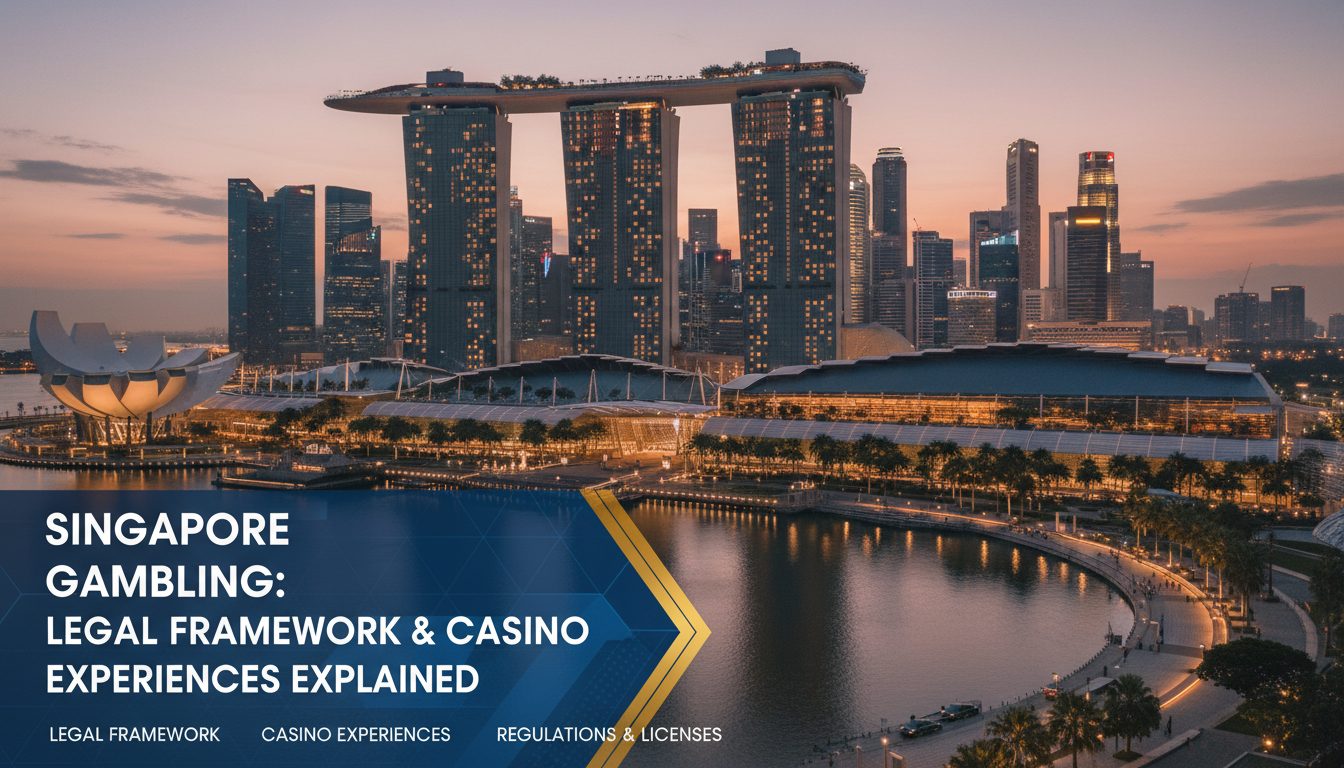
Singapore Gambling represents a highly regulated and tightly monitored industry. The nation balances economic growth with strict social safeguards. Legal betting is limited to state-backed lotteries and two massive integrated resorts. Remote betting faces strict bans, though a new sandbox opens doors for supervised sports betting. Authorities focus heavily on preventing financial crimes. Player protection remains a top priority for the local government.
Key Information
The gambling landscape in Singapore spans several decades of legal evolution. Early laws aimed to curb rampant underground betting rings. Over time, regulations adapted to modern digital threats and international tourism.
| Year | Legislative Event | Impact |
|---|---|---|
| 1960 | Betting Act Enacted | Provided the first legal framework for regulating betting activities. |
| 1961 | Common Gaming Houses Act | Introduced rules to prohibit and regulate gaming houses and public gaming. |
| 1968 | Singapore Pools Established | Created a state-owned lottery operator to provide legal alternatives. |
| 2014 | Remote Gambling Act | Prohibited unlicensed online gambling with strict remote gaming measures. |
Regulation by Activity Type
Different rules apply depending on the type of game. Casinos are restricted to two physical locations. Sports betting and lotteries are monopolised by state entities. Unregulated offshore sites are strictly blocked.
Singapore Pool provides a legal avenue to bet on lotteries. This successfully countered illegal betting syndicates. The most popular legal games are 4D and Toto. Recent surveys show 30 percent of bettors play 4D. Another 29 percent bet on Toto.
Casino License: Application Process and Requirements
Casinos are only allowed via integrated resorts. An integrated resort combines a casino with luxury hotels, theme parks, and convention spaces. Marina Bay Sands and Resorts World Sentosa hold the sole licenses.
Regulators demand rigorous background checks for these licenses. Market operators must submit detailed financial audits. They must also prove strong anti-money laundering frameworks. The Gambling Regulatory Authority enforces these strict rules.
Key Requirements for Obtaining and Maintaining Licenses
Existing exemptions for the two major resorts remain intact. Macau-style VIP rooms also fall under strict oversight. However, new rules aim to expand player safeguards.
- Platforms must integrate national responsible-gaming tools.
- Operators are required to submit recurring external audit reports.
- Casinos must display real-time gambling-addiction statistics.
- Free access to professional counselling services is mandatory.
Casino License: Costs and Financial Requirements
Operating a legal gaming venue requires massive capital. The industry originally invested 7.1 billion US dollars in the two integrated resorts. Ongoing costs remain incredibly high.
The government recently increased the gambling revenue contribution. Taxes on the integrated resorts rose from 10 percent to 12 percent. These extra funds are directed toward problem gambling prevention programs.
Public Debate and Criticisms
Building the integrated resorts sparked heavy debate. Singaporeans argued about the social impact for years. A petition gathered tens of thousands of signatures against the casinos. This intense debate lasted until 2014.
Leaders acknowledged these public concerns. They implemented strict social safeguards to limit local access. Citizens and permanent residents must pay a 150 dollar daily levy to enter. Families can also apply for exclusion orders to bar loved ones from casinos.
What Penalties Apply for Illegal Online Gambling in 2026?
The government maintains a zero-tolerance policy for unauthorised betting. Individuals caught accessing unlicensed websites face severe penalties. Repeat offenders face up to two years behind bars.
Fines can reach up to 5,000 dollars for illegal online activity. Despite this, over 2.3 million login attempts occurred on offshore sites in 2026. This resulted in over 4,800 recorded prosecutions in a single year.
Illegal Gambling and Remote Gambling Offences Highlighted
Police crackdowns on underground networks are frequent. In 2023, authorities arrested more than 450 people for illicit gambling. One-third of these arrests involved illegal online platforms.
Counselors note that internet anonymity fuels this behavior. Convenience makes illegal online gambling highly addictive. As a result, problem gambling numbers continue to rise. Unlicensed foreign apps and unauthorized slot machines remain illegal.
How Will the Changes Affect Foreign Operators Targeting Singapore Players?
A new regulatory sandbox opens in March 2026. This allows a handful of vetted foreign platforms to operate legally. They can offer online sports betting and limited-skill games.
Foreign operators must register directly with the regulator. They must demonstrate full technical and financial compliance. A firm 30 percent cap on betting stakes will apply. Mandatory geolocation verification is also required.
Strategic Framework: Assessing Singapore’s Money Laundering Vulnerabilities
Singapore thrives as a global financial hub. This status attracts massive international wealth. Unfortunately, it also attracts transnational criminal syndicates.
Global watchdogs note that foreign criminals target the country. The open economy presents vulnerabilities for money laundering. Authorities constantly review their strategic framework to protect the financial sector.
Gambling Sector Supervision Receives Strong Assessment
The Financial Action Task Force heavily reviewed local regulations. They concluded that casino operators possess robust monitoring controls. Identity verification procedures align well with global sector risks.
The regulator uses both on-site and off-site tools perfectly. They review internal audits and conduct focused examinations. From 2020 to 2026, authorities conducted 16 specific examinations. Both major operators received highly favourable compliance findings.
Virtual Assets and Proliferation Financing Risks
Digital currencies create new compliance challenges. Reports highlight deep vulnerabilities with digital payment token services. Cross-border transfers of virtual assets require intense supervision.
Foreign entities operating locally show low awareness of proliferation financing risks. The authorities demand tighter control over multi-layered corporate structures. Unregulated trusts often obscure the real source of funds.
Systematic Failures: Identifying the Nexus of Scams and Betting
Illegal betting platforms often wash stolen money. Cyber fraud syndicates rely on these exact underground mechanisms. They use peer-to-peer transfers to hide their digital audit trails.
This dynamic forms a powerful nexus between scams and unauthorized betting. Criminals use complex, cross-border operations to evade local laws. Digital wallet transactions complicate law enforcement efforts tracking illicit funds.
Where the Funds Actually Go
Money from illegal betting often leaves the local economy. It moves across borders into offshore accounts. When access tightens, demand simply flows elsewhere.
Conversely, legal casino revenue gets redirected into public systems. Legal capital supports vital public services. Taxes fund prevention programs and long-term economic stability.
From Gambling to Digital Entertainment
Player preferences are shifting heavily toward digital ecosystems. Mobile gaming and esports platforms show massive regional growth. Fantasy sports easily capture the younger demographic.
When physical casinos tighten access, users move online. They transition into adjacent digital entertainment spaces. The overall demand for interactive entertainment never actually disappears.
Asia Pacific
The local regulatory model influences the wider Asia Pacific region. Neighbors watch closely as digital regulations evolve. Singapore often sets the regional benchmark for strict compliance standards.
SOFTSWISS Heads to SiGMA Asia 2026 to Help Operators Scale Across Asian Markets
Major B2B providers continue looking at regional expansion. Companies recognize the massive potential within regulated Asian markets. Trade shows like SiGMA Asia 2026 serve as vital networking hubs.
These events help foreign platforms understand strict technical compliance. Software providers adapt their systems to meet local geolocation requirements. Adapting technology is crucial for regional scaling.
Compliance as a Growth Industry
Stricter regulations naturally create new business opportunities. Navigating international betting laws requires expert professional guidance. External consultants frequently review and improve anti-money laundering frameworks.
During recent audits, regulators issued multiple financial penalties. Breaches resulted in 2.7 million dollars in fines. Consequently, investing in bulletproof compliance is now a major growth sector.
Data Silos, Not Technology, Key Bottleneck for Gaming’s Future: Panel
Industry experts pinpoint data sharing as a major problem. Advanced technology exists to catch fraud. However, data silos prevent different systems from communicating effectively.
Regulators want a more risk-based approach to data. Breaking down these silos will improve threat detection. Better data alignment allows authorities to track cross-border criminal syndicates efficiently.
Malta Eyes Public Feedback on AI Charter for Gaming Sector
Global regulatory bodies are watching international innovations. Jurisdictions like Malta are exploring Artificial Intelligence charters. These AI frameworks help monitor player behavior.
Asian regulators study these European advancements closely. Integrating AI can identify problem gambling patterns faster. Smart technology represents the next logical step for global responsible gaming APIs.
Dividends Over Growth: Morgan Stanley on Asian Casino Industry
Financial analysts view the Asian casino sector differently today. The initial explosive growth phase has cooled down. Major investment banks now focus entirely on long-term stability.
Reports note that operators prioritize paying solid dividends. Maximizing existing player value takes precedence over building new resorts. Controlled, steady performance defines the modern integrated resort model.
What Experts Say About Singapore Gambling
Industry professionals universally praise the country’s strict framework. Experts command the robust structure combating sophisticated financial crime. The regulatory authority is highly respected.
- Financial Action Task Force: “Singapore has established a highly robust framework for combatting financial crime, though authorities must continuously address evolving digital risks.”
- Social Counselors: “The exact factors driving internet addiction—convenience, anonymity, and accessibility—directly fuel illegal online gambling behavior in modern communities.”
- Market Analysts: “The strict whack-a-mole nature of blocking unauthorized domains remains a persistent challenge for the Gambling Regulatory Authority.”
Frequently Asked Questions
You must be at least 21 years old to enter a casino. For certain state-run lotteries like Singapore Pools, the minimum age is 18.
Singapore Citizens and Permanent Residents must pay a 150 dollar daily levy. An annual pass is also available for a much higher fee.
No. Using unauthorized foreign betting apps and unlicensed offshore casinos is strictly illegal. The government actively prosecutes individuals breaking this law.
The 2026 sandbox is a pilot program. It allows a vetted number of legal platforms to offer regulated sports betting. strict staking caps apply.
Yes. Families can apply for a Family Exclusion Order. This legally blocks a problem gambler from entering integrated resorts or private jackpot rooms.
State-operated lotteries dominate the local market. The two most popular games are 4D and Toto. These games draw the vast majority of legal wagers.