
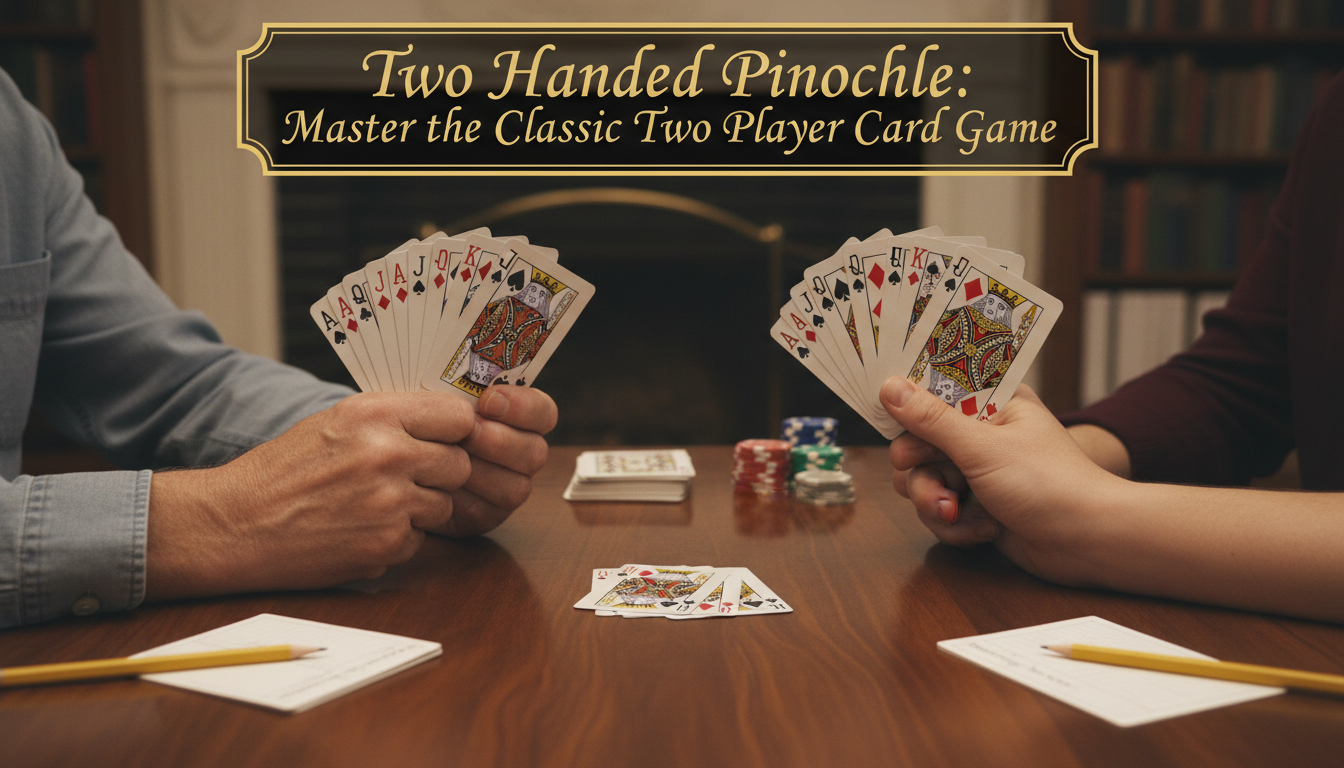
Two Handed Pinochle is the original and most fundamental version of this beloved trick-taking card game, played exclusively between two opponents using a specialized 48-card deck. It combines the melding satisfaction of Gin Rummy with the trick-taking strategy of Spades, played across two distinct phases. This strategic card game forces players to rely solely on their individual skills, combining precise bidding, careful melding, and tactical trick capture to accumulate 1,000 points and secure victory.
Table of Contents
What is Two Handed Pinochle?
Two-player Pinochle is one of the richest head-to-head card games available. It represents the original form of this classic card game from which all partnership, auction, and other variants have been derived.
Derived from the historic card game bezique, players score points by taking tricks and forming specific combinations of cards into melds. Unlike partnership variations, two handed pinochle requires players to rely entirely on their own strategy without the safety net of a teammate.
The standard game state evolves continuously. As new cards enter players’ hands from the stockpile, it adds a layer of depth not found in cutthroat or team versions. You are constantly trying to read your opponent’s intentions while concealing your own.
Equipment Needed to Play Two Handed Pinochle
The pinochle deck is unique among classic card games. Instead of a traditional deck, you use a specialized 48-card deck. No special equipment other than these cards and a scoresheet is required.
This distinct deck contains two copies of each card from 9 through Ace in all four suits: Spades, Hearts, Diamonds, and Clubs. This duplication creates opportunities for double combinations that simply wouldn’t be possible with a standard deck.
Card Rankings (High to Low)
Understanding card hierarchy is crucial for mastering trick-taking priorities. The ranking order is unique and must be memorized before playing.
In pinochle, card ranking from highest to lowest is: Ace (high), 10, King, Queen, Jack, and 9 (low) in each of the four suits. The 10 outranks all face cards except the Ace.
The Deal in Two Handed Pinochle
For formal games, it is customary to allow the non-dealer to cut the deck before the deal. The original version of Pinochle involves a partial deal of twelve cards to both players, distributed in sets of four.
The remaining 24 cards form the stockpile, which is placed face-down on the playing surface between the two players. After dealing the initial hands, the next card is turned up and placed on the table.
This face-up card dictates the trump suit for the round. The stockpile is then placed so it partially covers this trump card. The deal alternates between players until a designated point total is reached.
Bidding Phase
Bidding is the heart of pinochle strategy. It determines who becomes the declarer and selects the trump suit. The player to the left of the dealer initiates the bidding process.
In two-handed play, players review their cards and silently count their potential meld points. Bidding typically begins at 150 points and increases in increments of 10. The only communication during bidding should be a numerical value or a “pass”.
If one player passes, the remaining player wins the bid. Successful bidding requires accurately assessing both your meld potential and your trick-taking ability. A good rule of thumb is to bid approximately 100 points higher than your guaranteed meld points.
Remember, if the total points of the bidding winner run less than their bid, they are “set”. This means they score zero for the round and have the bid amount subtracted from their total game score.
Melding Phase and Valid Melds
The melding phase occurs immediately after bidding concludes and before trick-taking begins. Melding consists of displaying specific, valid combinations of cards face-up to earn immediate points.
The winning bidder declares the trump suit. Then, players place their card combinations face-up on the table to tally their scores. Cards used in melds remain in your hand and are fully available to be played in subsequent tricks.
Common Meld Categories in Two Handed Pinochle
- Marriages: A King and Queen of the same suit. A trump marriage is worth more than a regular marriage.
- Flush (Run): An Ace, 10, King, Queen, and Jack all in the trump suit.
- Pinochle: The Jack of Diamonds and the Queen of Spades.
- Arounds: One of each specific face card (or Aces) in all four suits.
The Dix (pronounced “deece”) is the 9 of trump. If a player holds this card, they can exchange it for the face-up trump card at the bottom of the stockpile upon winning a trick, scoring an extra 10 points.
Meld Values and Scoring Summary Table
Most classic rule sets use multipliers of 10. However, many experienced players use a simplified scoring system where trailing zeros are dropped to speed up gameplay. The table below outlines both methods.
| Meld Description | Standard Points | Simplified Points |
|---|---|---|
| Run (Trump Ace, 10, K, Q, J) | 150 | 15 |
| Royal Marriage (Trump K and Q) | 40 | 4 |
| Common Marriage (Non-trump K and Q) | 20 | 2 |
| Pinochle (♠Q and ♦J) | 40 | 4 |
| Double Pinochle (Two ♠Q and Two ♦J) | 300 | 30 |
| Aces Around (One Ace of each suit) | 100 | 10 |
| Kings Around (One King of each suit) | 80 | 8 |
| Queens Around (One Queen of each suit) | 60 | 6 |
| Jacks Around (One Jack of each suit) | 40 | 4 |
| Dix (9 of Trump) | 10 | 1 |
Playing a Trick
Once meld points are tallied and recorded on the scoresheet, players return their meld cards to their hands. The non-bidder leads the first card to initiate trick play.
In the first phase of the game (while the stockpile has cards), players do not have to follow suit. They can play any card. The winner of the trick is determined by who plays the highest card of the led suit, or the highest trump card if trump was played.
After each trick, the trick winner takes the top card from the stockpile. The loser then takes the next card. This process maintains hand sizes until the stock is completely depleted.
Rules for Second Phase and Reneging
Once the stockpile is empty, Phase 2 begins. Rules strictly tighten here. Players must follow suit if possible. If unable to follow suit, they must play a trump card if they possess one.
Failing to follow suit when able is called a “renege” and carries significant penalties. If detected, the offending player is automatically “set”, losing their bid amount from their total score.
Phase 1 Strategy
Advanced players track which cards have been played to anticipate likely draws. Beginners should focus first on recognizing valid melds before advancing to complex bidding strategies.
During Phase 1, focus on capturing high-value “counter” cards like Aces, 10s, and Kings. Win tricks efficiently without heavily depleting your trump reserves. Keep your opponent guessing about the exact contents of your hand.
Proper Dix strategy involves timing the exchange for maximum strategic advantage. Do not necessarily exchange it immediately just because you can. Sometimes holding the 9 of trump is defensively valuable.
Total Scoring
At the end of the round, players count the cards they won in tricks. A simpler counting method assigns 10 points to Aces and 10s, 5 points to Kings and Queens, and zero to Jacks and 9s.
Another classic counting system awards 11 points for Aces, 10 for 10s, 4 for Kings, 3 for Queens, 2 for Jacks, and zero for 9s. Most professional circles recommend playing where Aces, 10s, and Kings are each worth 10 counters, leaving everything else as zero garbage cards.
There are exactly 240 counters available per round from captured cards. Winning the final trick awards a mandatory 10 bonus points. This ensures exactly 250 total points are available during the trick phase.
If the bid winner’s combined trick points plus their meld points equal or exceed their bid, they add the total to their overall score. A match is generally played to 1,000 points or 1,200 points based on agreed house rules.
If both players cross the winning threshold in the exact same hand, the player with the higher total points wins the game.
What Experts Say About Two Handed Pinochle
Mastering this game takes practice and psychological insight. We gathered thoughts from notable professionals in the card-playing community.
“In two-handed pinochle, the most overlooked strategic element is the psychological impact of bidding patterns. Most players don’t realize how much their bidding rhythm reveals about their hand strength. Instead of always bidding in standard increments, occasionally jumping 30 or 40 points above the previous bid disrupts your opponent’s mental calculations.”
— Anthony Collins, National Pinochle Association Member
“Most players underestimate the importance of maintaining voids in non-trump suits during two-handed pinochle. By strategically eliminating one or two suits from your hand early through careful card selection in your melds, you can force your opponent to either waste their trump cards or allow you to win tricks with lower-value cards. This tactical void creation often makes the difference between a successful bid and being set.”
— Joe Andrews, Author of ‘Winning Pinochle Strategies’
Game Variations
While the two player variant is the baseline foundation, the game has evolved into several distinct forms.
Double Deck Pinochle
These larger variations combine two pinochle decks to form a massive 80-card or 96-card play experience. Hand sizes double, average scores inflate, and the minimum bids usually start at a higher threshold.
Five-handed and larger Pinochle
Variations for odd numbers of players normally utilize a “widow” hand (also known as a kitty or talon). This creates a pool of blind cards that the bid winner can claim to strengthen their hand, discarding weaker cards back unseen.
Roundhouse Adjustments
Some localized rules accept a “Roundhouse” meld. This involves having Kings and Queens of every suit at once. Instead of adding them individually for 240 points, a bonus 10 points is applied, awarding a clean 250 points outright.
Extensive FAQ
What happens if I cannot follow suit?
In the second phase of gameplay, if you cannot follow the suit led by your opponent, you are required to play a trump card. If you have no trump cards, you may play any card, but you cannot win the trick unless the opponent played a very low card of a non-trump suit.
What is a renege?
A renege occurs when a player accidentally or purposely misplays during the trick portion of the hand—specifically failing to follow suit when they actually hold a card of the led suit. The penalty is an immediate “set” for the bid winner.
How fast can a game be completed?
A standard game played to 1,000 points normally takes roughly 45 to 60 minutes. Each individual hand takes about 5 to 10 minutes to complete.
Do cards used in melds go to the discard pile?
No. When you show a meld, you score the points immediately. After the melding phase is completed, all cards are picked back up and placed in your hand. They stay fully available to be played in tricks.
Can an Ace be used in multiple melds?
Yes. Any specific card can be used in different types of melds simultaneously. For example, the Queen of Spades can be part of a Pinochle, part of a Royal Marriage, and part of Queens Around all in the same turn. However, it cannot be used twice for the exact same meld type.
How many points is the last trick worth?
The player who wins the final trick of the hand is awarded a flat 10 bonus points. This is added to whatever counter cards were contained inside that final trick.
What determines the trump suit if no one bids?
In strict two-handed play, if the non-dealer passes, the dealer assumes the bid at a default minimum value. The assigned bid winner always maintains the right to look at their hand and declare their strongest suit as trump.