
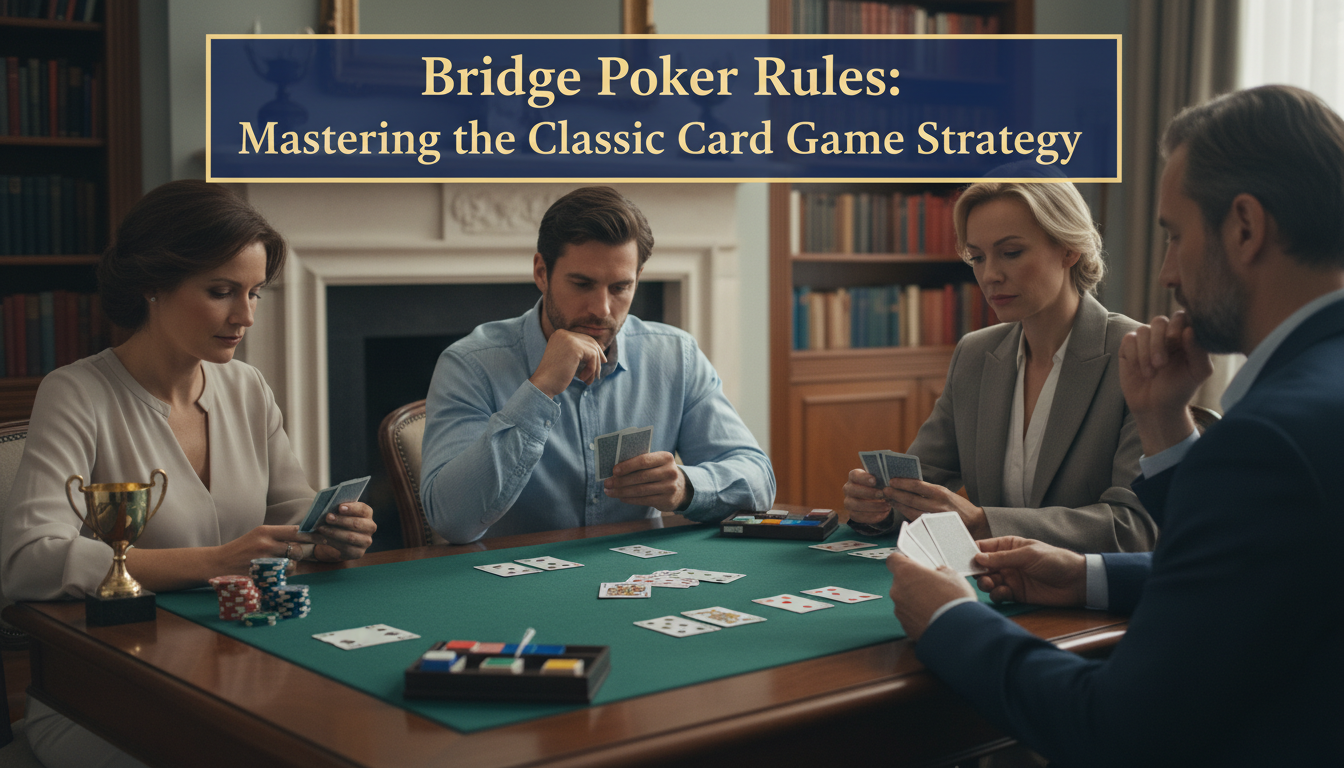
Bridge Poker Rules combine the intense strategic elements of bidding with the classic mechanics of trick-taking card games. This game requires sharp memory, excellent partner communication, and strategic foresight. You must understand the complex bidding systems and precise trick-taking methods to succeed. This complete guide will walk you through every aspect of the game. It is designed to help beginners and experienced players alike to dominate the tables.
Table Of Contents
- Bridge Rules Overview
- Basics of Bridge Rules
- How to Play Bridge (Complete Guide)
- Common Bridge Terms Explained
- Bidding Process
- Role of Declarer and Defenders in Bidding
- Winning Tricks in Bridge
- Scoring in Bridge: A Beginner’s Guide
- What’s the main difference between bridge and poker?
- Bridge Tips and Strategies
- Tournaments
- Play Bridge Online – Best Bridge Apps
- What Experts Say About Bridge Poker Rules
- FAQ
Bridge Rules Overview
Bridge is one of the most popular and strategic card games in the world. Learning how to play bridge is no easy task. This is not a card game you can learn in a few minutes.
In Bridge, the setup involves four players forming two partnerships. The game is traditionally played by four players in pairs or partnerships.
All you will need is a standard deck of cards and three more players. The rules for this game look a little complicated on paper, but it is actually not that bad.
Basics of Bridge Rules
Understanding Basic Bridge Rules
In its basic format, it is played by four players in two competing partnerships. Partners sit opposite each other around a table.
Bridge is played with four players, divided into two partnerships that sit opposite each other. The game uses a standard 52-card deck.
All that is needed in basic games are the cards and a method of keeping score. There is often other equipment on the table. This includes a board containing the cards to be played, bidding boxes, or screens.
Bridge Rules
From the fundamental concepts of dealing and bidding to the intricacies of declaring contracts and mastering advanced plays, we will embark on a comprehensive journey. In bridge, each hand is a narrative of bids, tricks, and partnerships.
Grasping the rules lays the foundation for a satisfying experience at the table. Once the bidding is done, you will know who is the declarer and who is defending.
How to Play Bridge (Complete Guide)
How to Play the Bridge Card Game
The cards are dealt out to the players. Then the players call or bid in an auction seeking to take the contract.
If you are looking for a new card game to try out with your friends, Bridge is a great game to learn together. In this article, you will learn bridge rules and fundamental concepts to give you a head start.
How to Play Bridge
The first card to be played on the table is known as the lead. Once cards are tabled, the partner no longer actively participates in the hand.
Going clockwise around the table, each player must play one card. Understanding the hierarchy of suits, following suit, and strategic bidding are fundamental aspects of the game.
If a player cannot follow suit, they can play any card. This potentially changes the trump suit or creates opportunities for their partner.
Common Bridge Terms Explained
Reading how to play bridge but keep getting confused by all the different terms? We have got you covered.
Here are crucial terms you will see again and again.
- Declarer: The player who attempts to fulfill the contracted number of tricks.
- Dummy: The partner of the declarer. They place their cards face-up on the table and take no active part in the play.
- Trick: A set of four cards played in one turn.
- Trump Suit: The dominant suit for the current hand.
- Opening Bid: The first bid made in the auction.
Bidding Process
Bidding in bridge involves players declaring the number of tricks they expect to win. They also declare the preferred suit or no trump.
Bridge extends the concept of bidding into an auction. Partnerships compete to win a contract.
This contract specifies how many tricks they will need to take. To get points, you will need to reach at least as many tricks as you outlined in your original bid.
Declaring a Contract
The contract specifies the trump suit and the number of tricks you promise to win. For example, a player that bids 3 tricks will actually need to take a total of 9 tricks.
Each player is expected to take 6 tricks, so all bids are added to that base number. The object of the game is to correctly guess how many hands your team will win.
An opening bid of one in a suit indicates the intention to win at least seven tricks in that suit.
The Final Contract
The contract refers to the number of tricks the declaring side has agreed upon. Eventually, the player who bid the highest contract wins the contract.
Any time there is a tie between two bids, the declared trump suit breaks the tie. You remember, you are bidding for the number of tricks you think you will win above six.
Bridge Card Game Tip #2: There Is No Shame in Passing
The auction ends when every other player has passed. The action then proceeds to the play.
If every player has passed and no bid has been made, the round is considered to be passed out. It is not played.
You should only open bidding if you have at least 12 HCP in your hand. In Standard Acol, your opening bid promises at least 12 high card points.
Role of Declarer and Defenders in Bidding
The side trying to make the contract is known as the declarers. The other partnership takes on the defenders’ role.
Once the bidding is done, you will know who is the declarer and who is defending. The player from the declaring side who first bid the denomination named in the final contract becomes declarer.
Understanding Defenders
The opponents can either accept the claim and the round is scored accordingly, or dispute the claim. During the bidding process, your opponents can also call doubles on your contract.
They do this if they believe you cannot make it. Effective communication between defenders is vital.
They strive to take tricks and disrupt the declarer’s plans. As the play progresses, the defenders aim to disrupt the declarer’s plans by taking tricks of their own.
Winning Tricks in Bridge
If a card of the trump suit is led, the usual rule for trick-taking applies. The highest-ranked card of that suit wins.
In a deal with a trump suit, cards of that suit are superior in rank to any cards of any other suit. So if there are three high hearts on the table and Player D plays a two of spades, Player D will win the trick.
Rules For Trick Taking
If a player does not have any cards of the current trick’s suit, that player may play any card of the trump suit. If it is a contract with a trump suit, this includes any trump cards.
So, if the player leads with an Ace of clubs, all players must also play a club. They must do this if they have any clubs in their hands.
In a deal in which the auction has determined there is no trump suit, the trick is won by the highest-ranked card of the suit led. Cards of suits other than the led suit cannot win.
Scoring in Bridge: A Beginner’s Guide
Understanding the scoring system enhances your strategic approach. It adds depth to the gameplay.
Points are earned based on the success or failure of the contracted number of tricks. The below-the-line score is used to determine the winner.
All tricks made for the contract are scored below the line. The score of the game is kept on a piece of paper divided into two columns.
Finishing & Winning the Game
If a partnership takes at least that many tricks, they receive points for the round. Otherwise, they lose penalty points.
Any tricks beyond the contract are scored above the line as bonus points. The purpose of the above-the-line score is simply to determine the margin of victory.
If the Declarer fails to make their contract, the opposing side scores penalty points. This depends on whether the contract was doubled, redoubled, or vulnerable.
| Action | Description | Scoring Effect |
|---|---|---|
| Odd Tricks | Tricks bid and made above six | Points scored below the line |
| Overtricks | Extra tricks won beyond the contract | Points scored above the line |
| Undertricks | Falling short of the contract | Penalty points to the defenders |
| Slam Bonuses | Winning 12 or 13 tricks | Large point bonuses above the line |
What’s the main difference between bridge and poker?
If you are coming from poker and want to try bridge, the bidding is the biggest adjustment. High-level bridge and high-level poker are both extremely demanding.
It is difficult to say one is categorically harder. Poker at high levels has more psychological warfare. Bridge involves no legal bluffing, no betting, and permanent partnerships.
How luck and skill interact
A top player at a table of beginners will win most of the time, not occasionally. Professional poker players make consistent profits because their decisions are better over thousands of hands.
Even in rubber bridge, luck matters much less than in poker over a session. In duplicate bridge, every table plays the same cards, so deal luck is eliminated entirely.
Over any significant sample of hands, bridge results are driven almost entirely by decision quality.
Bluffing in bridge (it exists, but it’s different)
Your partner does not know what you have, but you are not trying to mislead them. You cannot legally deceive your opponents about what your bids mean.
Part of optimal poker strategy is making it as hard as possible for opponents to know what you have. You communicate through bids, and miscommunication destroys hands.
The term preempt refers to a high-level tactical bid by a weak hand. This relies upon a very long suit rather than high cards for tricks.
Memory and counting
A skilled declarer counts each suit around the table. They track how many cards each opponent holds.
This is called counting the hand. At high levels, players know exactly how many cards each opponent holds in every suit by the middle of the hand.
In poker, memory involves tracking betting patterns, previous showdowns, and specific tendencies of opponents. The information you are missing is different.
Bridge Tips and Strategies
Bridge Strategy Tips
Strategic thinking and planning ahead are the keystones to success in Bridge. Anticipating opponents’ moves and envisioning potential card distributions are vital.
Be prepared to adjust your strategy based on the evolving dynamics of the hand. This includes modifying your bidding plans or altering your defense based on new information.
Bridge Game Tips & Tricks
Familiarity with your partner’s bidding style enhances the overall synergy at the table. Establishing a strong partnership understanding enables effective communication.
Stay abreast of new conventions, cardplay techniques, and strategic approaches. Advanced cardplay involves mastering techniques like finessing, squeezes, and establishing long suits.
Winning Bridge
The game is all about your ability to communicate the information to your partner. You must play your hand in the best way possible based on the information you have.
Master the tableau by organizing cards efficiently. Aim to win tricks strategically.
The rule of 15 is a helpful guideline used in the opening bid. It suggests that a hand is suitable for opening if the sum of high card points and the number of spades is 15 or more.
Tournaments
Competitive duplicate bridge has no money component at all. No money is bet during hands, and the game is not structured around pot-building.
At the end of a session, the scores for each deal are compared. The most points are awarded to the players doing the best with each particular deal.
Different Variations of Bridge Rules
The dominant variations of the game are rubber bridge and duplicate bridge. Rubber bridge is more common in social play.
Duplicate bridge enables comparative scoring in tournament play. Chicago bridge is a faster version of rubber bridge.
It grew in prominence in the 1930s. Today it is the variant that you will typically find in club play.
Play Bridge Online – Best Bridge Apps
There are several free and subscription-based services available for playing bridge on the internet. You can get instant feedback from AI systems.
Bid and play real hands completely free, no signup needed. Get instant feedback on real hands and build your game.
Engage in discussions with fellow players online. Attend virtual workshops and analyze hands to glean insights into evolving strategies.
Reader Success Stories
Many beginners start with zero knowledge of the rules. Most bridge teachers estimate 3-6 months of regular play before a beginner is comfortable in a duplicate game.
The more you play, the better you will be able to read the game. This means you will make better decisions over time.
Bridge can be complex, but the more you play, the more you will understand it. The high that comes from winning the game will keep you coming back.
Enjoy All the Intricacies of the Bridge Card Game
If you are really intent on learning how to play bridge, you need to be prepared to put in some serious hours of studying. Learning bridge card game rules is one thing, but making no mistakes is entirely different.
You develop intuitions about how opponents bid. You learn what their hesitations mean, and how aggressively they interpret limited bids.
You will not be ready to sit down and play immediately. However, you will at least have a good idea of where to go next.
What Experts Say About Bridge Poker Rules
Expert Insight: World-class card strategists note that transitioning between poker and bridge requires a massive mental shift. “While poker relies heavily on exploiting psychological weaknesses, bridge rests entirely upon rigorous mathematical calculation and structured partner communication,” explains top-tier tournament directors.
Experts emphasize that a flawless bidding system is non-negotiable. Building trust in your partner’s declared High Card Points (HCP) allows you to confidently chase game and slam bonuses without fear of misdirection.
Tips
- Always count your High Card Points (HCP) before making an opening bid.
- Remember that an opening bid promises at least 12 HCP.
- Do not be afraid to pass if your hand is weak.
- Communicate effectively using standard bidding systems like Standard American or Acol.
- Track the cards played. Practice counting the hand to predict opponent moves.
FAQ
Can you play bridge like poker?
No, you cannot. Bridge involves no legal bluffing, no betting chips, and permanent partnerships. Poker relies on hiding information, whereas bridge relies on legally communicating information to your partner through specific bidding systems.
What is the difference between rubber bridge and duplicate bridge?
Rubber bridge is typically played casually at home. Scores accumulate until one team wins two games (a rubber). Duplicate bridge is used in tournaments. The exact same hands are passed to different tables, eliminating luck entirely and rewarding pure skill.
What are High Card Points (HCP)?
High Card Points are a valuation metric. Aces are worth 4 points, Kings are worth 3, Queens are worth 2, and Jacks are worth 1. A standard deck contains 40 HCP. You usually need at least 12 HCP to open the bidding.
What does the Dummy do in Bridge?
After the first card is led, the declarer’s partner becomes the dummy. The dummy places their cards face-up on the table, sorted by suit. The dummy takes no active part in deciding the play; the declarer calls cards from the dummy’s hand.
What does No Trump mean?
A No Trump contract means there is no trump suit for that hand. The trick is always won by the highest card of the suit that was originally led. It is considered the most difficult way to win tricks.
How many tricks are needed to win a contract?
To find the total tricks needed, add six to the contract bid. If you bid 1 Heart, you must win 7 tricks (6 + 1) with Hearts as trump. A bid of 3 Spades requires 9 tricks (6 + 3).
Can you double an opponent’s bid?
Yes. If you believe the declaring team cannot win their contracted number of tricks, you can double their contract. This increases the penalty points if they fail, but it also increases their bonus if they succeed.