
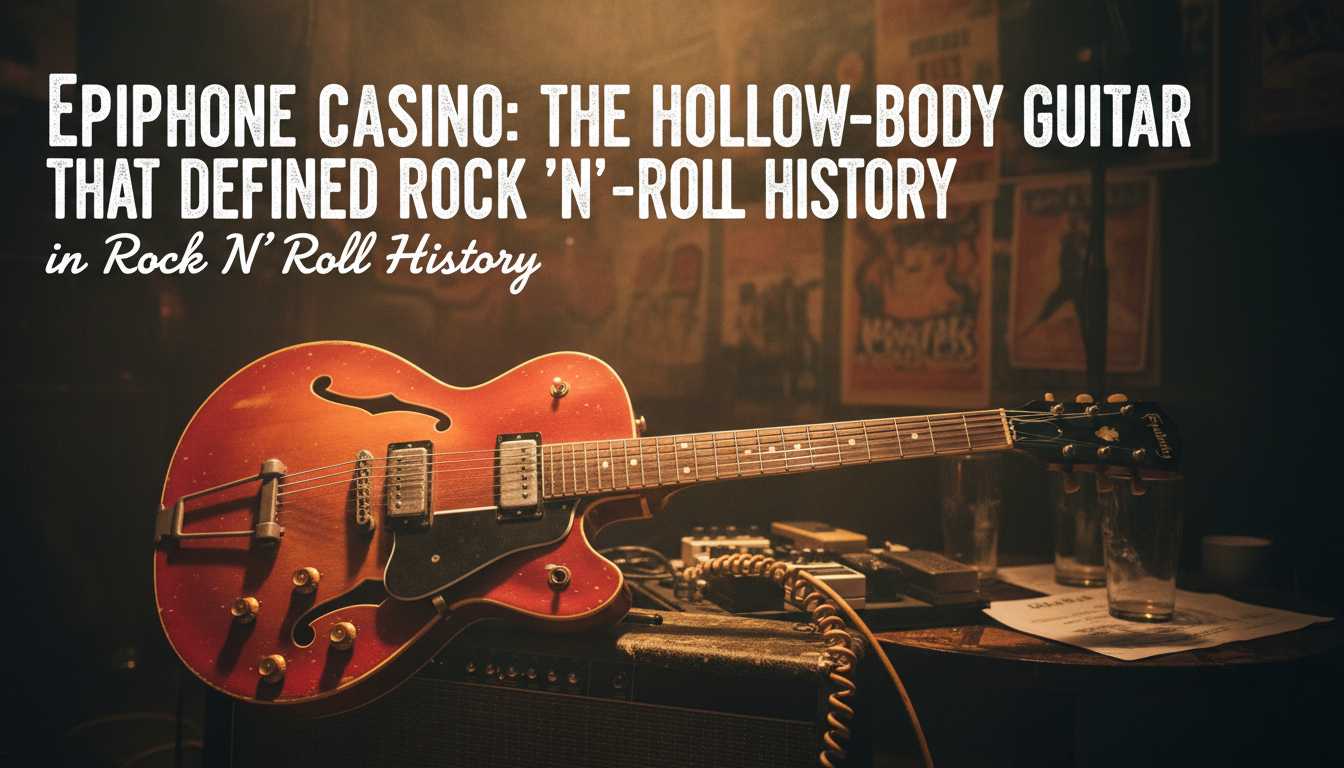
Epiphone Casino is a legendary thinline hollow body electric guitar manufactured by Epiphone. Introduced in 1961, this historic instrument offers a bright tonal profile and massive acoustic resonance. As an expert in online gambling with 10 years of playing experience, I spend a lot of time analyzing odds for casino websites. However, today we are looking at a completely different kind of Casino. This classic Archtop model was adopted by generations of rock royalty. It remains a uniquely versatile workhorse for clean, emotional, and vintage-tinged sounds today.
Epiphone’s Best-Selling Archtop and a Rock ‘N’ Roll Legend
The brand launched its original Casino in 1961. This happened right after Gibson acquired Epiphone. Epiphone was based in New York City for many years. Later, Epiphone guitars were built in Gibson’s Kalamazoo, Michigan factory.
The new line had the effect of creating an ancillary tier to the Gibson lines. The Epiphone Casino was hailed as a brilliant new guitar. It was dramatic in appearance and tonal qualities. The instrument was destined to become a true classic.
The Beatles Era: Timing and Historical Significance
The Beatles played a massive role in inciting gear lust for this guitar. The Beatles and Casino liaison began at the end of 1964. The guitar found its way into the hands of rock royalty at the very peak of their powers.
The historic symbolism underscores a key moment in rock history. Instrument selection shaped the very core of late sixties pop production. Its influence extended far beyond the band’s output. It shaped broader trends in rock and pop for decades to follow.
Who Made the John Lennon Epiphone Casino Famous?
Paul McCartney was the first Beatle to acquire a Casino. He bought a 1962 model in late 1964. McCartney restrung and played it upside down to accommodate his left-handed style. He used it for lead guitar solos on “Ticket to Ride” and “Taxman”.
Lennon and Harrison bought theirs later. At the height of The Beatles popularity, all three guitarists owned one. They used these thinlines for a significant proportion of their time in the studio. Both Keith Richards and Brian Jones of the Rolling Stones also played these exact models.
John Lennon and the Beatles: Legends of the Hollow Body Guitar
John Lennon used the instrument as his main electric guitar holding. He replaced his old Rickenbacker 325. Two prime guitars defined his era. The Gibson J-160E and the Casino are legendary instruments heard on many sessions.
Recording feedback was already a part of their sound. You can hear it heavily fuzzed in the intro to “Revolution”. John also played notable lead fills on “Get Back”. Later, George and John had the sunburst finish stripped off to reveal natural wood. They believed this improved the sound.
Why Lennon Preferred the Casino over Other Guitars
Lennon was astonished by the bright tone and lightweight feel. The airy resonance and unique timbre allowed for remarkable tonal blending. It ranged from woody percussive fingerpicking to biting overdriven leads.
Other players favored bright solid bodies. However, this open tone added texture and warmth. That warmth became essential to The Beatles late sixties compositions. It was a great guitar for rock and roll with a completely different sound.
What makes the Epiphone Casino a special guitar for Beatles fans?
This significance stems from a vivid association with their transformative studio years. Listen to tracks like “Paperback Writer” or “She Said, She Said”. You will hear how nuanced a basic chord can sound.
Beatles fans revere the instrument as a tribute to Lennon’s genius. This depth of documentation lends it incredible gravitas. For collectors, it is an inspiring tool for musical growth.
What Makes the Epiphone Casino Special for Players and Collectors?
Collectors and players love the historical gravity of the guitar. Over the years, the model went in and out of production. It was initially discontinued in 1970. It reappeared later in Japanese-made lines during the eighties.
A good model delivers plenty of sonic complexity. It can segue seamlessly from sweet pop to throaty jazz to raw rock. It remains a versatile workhorse providing working musicians with incredible inspiration.
Identifying Genuine Models: Vintage vs. Reissue
Collectors should scrutinize serial numbers and original hardware. Vintage models often lack the mass-market serial printing found on reissues. Original tuners and P-90s are essential elements.
Up until 1970, the headstock was set at a 17-degree angle. Substantive later models feature a 14-degree angle. You must also check the top wood. Vintage tops were made of five laminated layers including maple and birch.
Construction
The construction defines the incredible tone of this instrument. It is a full hollowbody electric guitar. It contains no solid wood center block. Very thin parallel braces support the body top.
This makes the instrument lighter. It is much louder when played without an amplifier. However, it is more prone to feedback at extreme volumes. It uses hand-wired electronics with high quality capacitors.
Body Specifications
| Component | Detail |
|---|---|
| Body Type | Fully Hollow Thinline |
| Body Width | 16 inches at widest point |
| Body Depth | 1.75 inches |
| Top Wood | Pressed three-ply laminated (Maple/Poplar/Maple) |
| Pickups | Dual P-90 Dogear single-coil |
| Bridge | Gibson Tune-o-matic |
Neck Specs
The slim and fast low action neck is highly prized. It is crafted from one-piece mahogany. It is glued to the body using a standard Gibson mortise and tenon joint.
The neck joins the body at the 16th fret. This configuration leaves 16 frets entirely clear of the body. Most models boast a 24-3/4 inch scale length. They also feature a stunning rosewood fingerboard with offset diamond inlays.
Comparing the Casino to Other Musical Instruments
One may take a quick glance and ask if it is just a 335 style guitar. The answer is no. Both are great guitars, but they have major differences.
Unlike the Gibson ES-335, the hollow build lacks a solid center block. The ES-335 delivers more controlled sustain. The Casino provides increased acoustic resonance and airiness. It has lighter body weight and shimmering upper mids.
Casino vs ES-330
It is basically identical to the Gibson ES-330. In 1959, Gibson announced the 330 as an economy priced professional guitar. Differences between the actual Epiphone and the 330 were mostly cosmetic. The headstock shape and fretboard inlays were the distinct visual differences.
Epiphone Casino Electric Guitar in Vintage Sunburst
The vintage sunburst nitrocellulose lacquer finish is an absolute classic. It honors the early Kalamazoo factory days. Early examples featured black plastic pickup covers.
Nickel plated metal covers replaced the plastic by 1963. The vintage sunburst displays the wood grain beautifully. A few rare custom colored models show up occasionally. Silver Fox is one highly sought after custom color.
Epiphone Casino, Left-Handed, Vintage Sunburst
Finding left-handed variants can be quite challenging. Paul McCartney famously restrung a right-handed model. Left-handed models are highly requested by the modern market.
Some limited runs are released. They offer the exact same 16-inch wide hollow body geometry. They simply mirror the cutaways and pickguard placement for optimal left-handed play.
How to Set Up and Care for a Casino Like Lennon’s
Proper set up ensures maximum playability and minimal feedback. Keep the action low but avoid fret buzz. Adjust the P-90 pickups closely to the strings for maximum bite.
Lennon famously sanded off modern finishes to let his wood breathe. While extreme, keeping the finish clean with a dry cloth retains its natural resonance. Be mindful of stage volume to control feedback looping.
Hands-On Review: My Experience Playing the John Lennon Epiphone Casino
There I was, standing in a dimly lit music shop. My hands trembled as I reached for the guitar. It once echoed the dreams of an entire generation. I instinctively sensed its profound role in shaping rock music.
The P-90 pickup is incredibly touch sensitive. It is perfect for both lead and rhythm sounds. The guitar felt shockingly light. Strumming a basic chord revealed immense acoustic volume.
Latest Gear
The brand recently marked an important 60th birthday in high style. Now made in the USA for the first time in over 50 years. The new USA Collection features a classic maple and poplar body.
They are available in Royal Tan or Vintage Sunburst finishes. The electronics are hand wired using premium Orange Drop capacitors. These models stand alongside modern artist signature runs like the Gary Clark Jr editions.
What Experts Say About Epiphone Casino
“It’s really a perfect electric guitar. It can be clean, it can be gnarly, and it sounds terrific at low volume and feeding back.” – Jim Rosenberg, Former Epiphone President.
“There were other companies at the time like National who were making something similar. But Epiphones were great guitars back then and affordable.” – Walter Carter, Author of The Epiphone Guitar Book and Garry Tallent of the E Street Band.
“This construction makes for a lively instrument with much of the bite and attack of a semi-acoustic electric, and some of the warmth and depth of a bigger archtop jazz-box.” – Tony, Veteran Music Journalist.
Frequently Asked Questions
It is a thinline, fully hollow body electric guitar. It produces a rich, acoustic-like sound combined with the bite of single-coil electric pickups.
No. Unlike semi-hollow guitars, it features no solid wood block running through the center. It only has thin parallel braces to support the top wood.
It uses dual P-90 Dogear single-coil pickups. These deliver a thick, rich, and slightly gritty tone perfect for vintage rock and roll.
The fully hollow body captures sound waves from loud amplifiers. This makes the guitar vibrate, creating an audible feedback loop. This was heavily utilized by The Beatles in the studio.
They are fundamentally the same design. They share the same hollow construction and pickups. The main differences are the headstock shape, the brand logo, and specific fingerboard inlays.
John Lennon, Paul McCartney, and George Harrison are the most famous users. Other notable players include Keith Richards, Gary Clark Jr, and Paul Weller.