
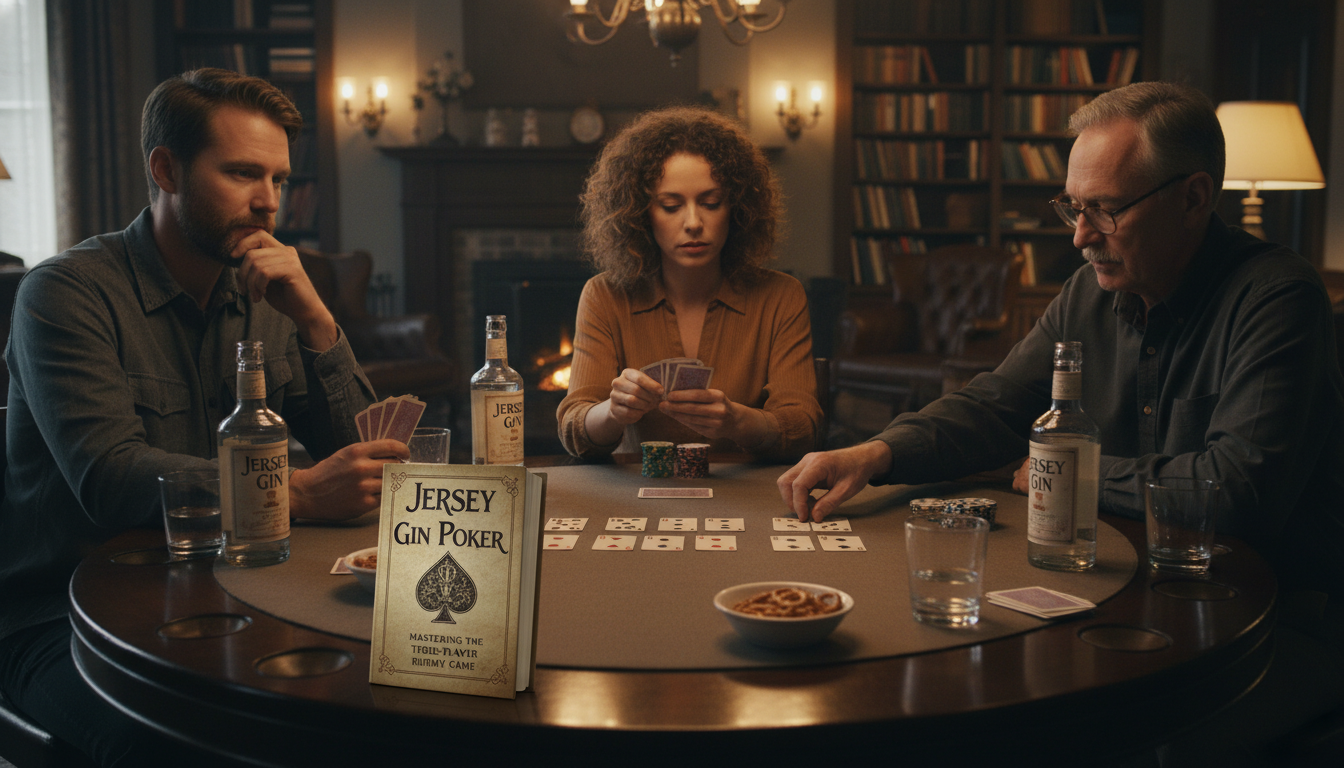
Jersey Gin Poker refers to a highly strategic, three-player adaptation of the classic Gin Rummy card game. Despite common misconceptions in the name, Jersey Gin Poker has no direct connection to poker games. It remains a beloved strategic card game that challenges players with its unique three-way dynamics. This game requires different strategies than traditional two-player Gin Rummy. Players aim to form sets and sequences while minimizing unmatched points. Mastering Jersey Gin Poker requires sharp card management and the ability to adapt to a changing table environment.
Table of Contents
History of Jersey Gin Poker
Gin Rummy itself was invented by Elwood T. Baker and played by his family back in 1910.
Baker’s son Graham was astonished to find the game being played at New York clubs in the 1930s. The digital revolution has brought this game to players worldwide through various online platforms.
Originating in Jersey City, New Jersey, this strategic card game combines elements of standard Gin with unique rules designed specifically for three players.
A Jersey politician brought it into wider recognition. He told game expert John Scarne that three-handed Gin was being played at several political clubs in Jersey City.
Jersey Gin specifically emerged as a solution to the limitations of standard two-player match formats. It became perfect when exactly three people wanted to play.
A large and sprawling family of games
Rummy itself is not so much a specific game as a large family of games. They are all based on a particular way of playing with cards.
Any game based on draw-and-discard and making melds is some sort of Rummy game by definition. In the original and oldest version, the aim is to be the first to get rid of all your cards.
However, its basic principle goes back to earlier card games such as Carousel, Vatikan, and Czech Rummy. The Rummy principle of drawing and discarding appears in Chinese card games in the early 19th century.
One possibility is that such a game first reached the south-western states in the hands of Chinese immigrants. In 1896 Stewart Culin recorded it as being played by Apaches.
Setup and Dealing Procedures for Jersey Gin Poker
Setting up for Jersey Gin Poker requires careful attention to the specific procedures for three players. You will need one standard 52-card deck of playing cards.
Jersey Gin Poker uses a standard 52-card deck without jokers or wild cards. Dealer starts the hand by dealing each player 10 cards face-down.
Cards are dealt one at a time. The player to the left of the dealer goes first.
When the dealing is done, the rest of the deck is placed in the middle of the table. This forms the drawing stock.
The first card from the top is turned over and placed next to the deck. This card is known as the upcard and starts the discard pile.
Card Values in Gin Card Game
Understanding card values and combinations is essential for success in this game. These values are used to calculate a player’s deadwood.
Deadwood points are the values of the cards in your hand that do not belong to a valid meld.
| Card Name | Point Value |
|---|---|
| Face Cards (King, Queen, Jack) | 10 Points |
| Number Cards (2 through 10) | Face Value (2 to 10 Points) |
| Aces | 1 Point |
Aces are considered low. They are scored at 1 point, face cards at 10, and all other cards are scored at their numerical values.
Understanding the Card Basics for Jersey Gin Poker
Both poker and gin involve building the best hand from cards based on suits and values. If you know one of these games, chances are you’ll very quickly pick up the other.
Actually, most of the winning hands in poker are basically just sets and runs in Gin Rummy.
To win, players must eliminate unmatched cards. The basic game strategy is to improve one’s hand by forming melds.
How to Play Gin Rummy Game
Jersey Gin Poker sits within a broader ecosystem of Gin Rummy variants. Each variation has distinct rules and strategic purposes.
The goal for a match is to be the first player to reach 100 points across several hands. A gin card game is usually played to 100 points minimum.
If you’ve played any other form of rummy before, these rules will make perfect sense. You’ll be ready to play your first game in no time.
Gameplay: Step-by-Step in Jersey Gin Poker
Jersey Gin Poker follows a specific sequence of play that differs from standard two-player formats.
- As a non-dealer, you start by facing the top card of stock.
- Once the first card is turned over, the non-dealer gets the first option to take it.
- If they pass, the dealer has the option to take the discarded card.
- If the dealer also passes, the non-dealer draws the top card from the face-down stock.
- When you draw a card, you must discard a card from your hand face up onto the discard pile.
The turn then ends and rotates. Players read information from the discard pile to form combinations.
Forming Melds in Gin
According to basic rules, valid combinations are called melds. All melds must consist of at least three cards.
A player can form any combination of melds within their hand. The hand can contain all sets, all runs, or both.
Additional Gin Rummy Melds
A meld is either three or four cards of the same rank. This is known as a set.
Another option is a run or sequence. This consists of three or more cards of the same suit, right in sequence.
Because aces only count as low, they can only be used at the bottom of sequences. For example, A, 2, 3 of the same suit is a valid run.
However, Q, K, A is entirely illegal. Aces cannot be used at the top of high runs ending with a king.
Unlike other variations, you must form sets and runs in their entirety before laying them down.
More Game Mechanics
The “break” is the most distinctive rule in Jersey Gin Poker. It differentiates it directly from standard forms of the game.
It occurs when the stock is reduced to exactly three cards. This fundamental change shifts the entire gameplay loop.
However, the heart of the scoring system lies in the ‘knock’ action. Before melding, players have the option to conclude a round by knocking.
You’re allowed to knock when the total of your unmatched cards hits ten points or less. You simply discard face down and announce your knock.
Each player then lays their hand face up on the table. Every meld must be identifiably broken out and displayed.
Once the opponent is done adding cards, deadwood is compared. The knocking player then subtracts deadwood points from the defending player.
The Undercut
An undercut occurs if you knock but the defending player has equal or less deadwood points. The opponent scores a 20-point under-knocking bonus.
The knocking player can incur severe penalties. If two players undercut the knocker, specific tie-breaking rules declare the true under-knocker.
How to Win in Gin Rummy – Strategy And Tips
Winning Strategy for Gin Rummy revolves around memory, probability, and timing. Both games rely heavily on the amount of information you can interpret.
Reading opponents and following the discarded hands are extremely important. Skillful players can take the upper hand and undo weaker players consistently.
The discard pile strategy in Gin Rummy is crucial for winning. It influences both offensive and defensive tactics immensely.
Every time you take a discard, you pass free information to your opponent. You must adapt strategies based on the opponent’s approach.
Try to tailor your strategy to get rid of high cards early. Dropping face cards quickly makes unmatched point tallies much simpler to manage.
Strategic melding is equally vital. Players must decide when to lay down sequences to optimize points without revealing too much.
Timing the final knock is critical. A well-timed knock secures victory, while a premature one invites heavy penalties.
Evolution from Standard Gin Rummy
Jersey Gin Poker maintains fundamental rummy mechanics. However, it introduces special gameplay elements like the “breaker” position.
This format uses a sophisticated scoring system. It properly rewards strategic play while penalizing poor deadwood management.
This early innovation made the three-player format strategically sound. It successfully eliminated previous mathematical imbalances from older three-player card games.
Optional Rule and Custom Rules
A large and sprawling family of games means endless rulesets. Custom rules can drastically shift basic gameplay.
Big Gin Variant
If you go gin, you place all your cards on the table in one go. You will immediately automatically receive 20 points.
Big Gin happens when a player melds all 11 cards natively. This means no discard is required, earning extra bonus points.
Oklahoma Gin (aka Gin Rummy)
Oklahoma Gin is incredibly popular. The first upcard dictates the maximum knocking threshold for that specific round.
If a 6 is flipped, players can only knock with 6 points or less. Spade upcards often double the final score for that hand.
Skarney Gin
Since Skarney Gin does not have a discard pile, drawing is distinct.
You must go out by melding all cards in your hand directly. The game completely lacks a regular discard round upon finishing.
What Experts Say About Jersey Gin Poker
Jersey Gin Poker has attracted attention from notable card game experts. Professional players readily recognize its deep strategic significance.
Stu Ungar, one of the greatest poker players of all times, was a highly proficient gin player. He mastered these concepts long before turning his sights to hold’em.
Experts agree that reading hands in this game directly translates to reading poker bluffs. John Scarne heavily publicized the three-handed strategic elements in his gaming literature.
Professional game historians note that managing deadwood in multiple directions increases cognitive load. The best players view the game as a delicate dance of statistical probability.
FAQ
No. Despite the name, it is a three-player adaptation of regular Gin Rummy. It uses standard draw-and-discard mechanics, entirely separate from actual poker betting formats.
Face cards always count as 10 points. Numbered cards retain their face value. Aces are always low and count simply as 1 point.
No. In standard gameplay, aces are strictly low. A sequence of Ace, 2, 3 is perfectly legal. A sequence of Queen, King, Ace is entirely invalid.
A player can knock when the total value of their unmatched deadwood cards reaches 10 points or less.
This is called an undercut. You are heavily penalized. Your opponent gets a 20-point bonus plus the numeric difference between your two hands.
A player earns a 20-point Gin bonus by melding all 10 cards in their hand, leaving exactly zero deadwood points. The opponent cannot lay off cards against a Gin.