
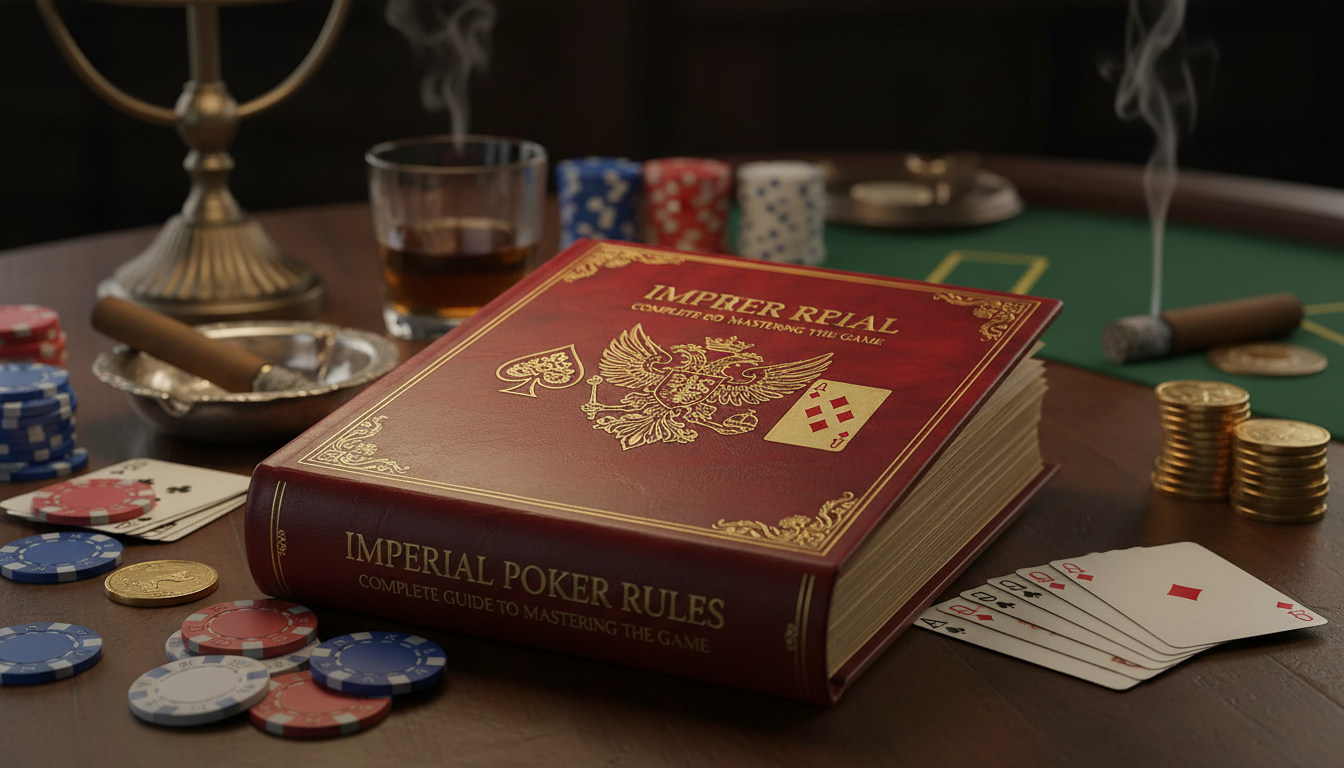
Imperial Poker Rules define a captivating five-card stud game popular in themed casinos. This game blends standard poker hand rankings with unique betting structures. Players receive one card face down and four cards face up. The game features a specialized “bring-in” system where the lowest visible card starts the betting. Mastering these guidelines is crucial for players wanting to succeed. This article covers both the card game and the complex board game that shares its name.
Basic Game Rules
If you are brand new to playing cards, you should learn the most common rules first. The dealer begins with the player on their immediate left. They deal all players a face-down card, moving clockwise around the table.
Each player receives hole cards which they keep hidden. Poker is typically played with two to seven players. Six or seven players is ideal. Heads-up (two-player) matches are also common.
The Basics of Poker
Poker is a versatile game combining skill, psychology, and chance. The foundations are crucial for understanding any format. Whether you play Stud Poker or Texas Holdem, knowing these basics matters.
You must understand hand rankings, betting rounds, and bluffing strategies. Poker is often described as a game that takes a minute to learn but a lifetime to master. Old timers stick with Stud or Draw games to keep up easily.
Imperial Poker Rules
Imperial Poker belongs to a family of variants found in themed gaming environments. It connects directly to the rich history of five-card stud. Cowboys and outlaws sat and gambled this way in old West saloons.
Unlike standard formats, this version maintains traditional rankings but changes table protocols. This game has no direct house edge against players. Instead, the house takes a rake (a small percentage) from the pot.
Basics
In this game, five total cards are dealt per player. One card is hidden, and four are visible to everyone. There are no shared cards.
The structured betting rounds make the game very efficient. After reviewing their initial cards, betting begins. The action moves clockwise until each player makes a decision.
Poker Hand Rankings: The Foundation of Imperial Poker
The ten standard hands form the foundation of all strategy. Card rankings from highest to lowest are A, K, Q, J, 10, 9, 8, 7, 6, 5, 4, 3, and 2. The ace sometimes acts as the lowest card.
If two people have the same hand type, the higher cards win. Suit never breaks ties in standard matching rules. If players have exactly identical hands, they split the pot equally.
| Hand Rank | Description | Example |
|---|---|---|
| Royal Flush | Strongest hand. Same suit sequence to Ace. | 10, J, Q, K, A of Spades |
| Straight Flush | Five sequential cards of the same suit. | 5, 6, 7, 8, 9 of Hearts |
| Four of a Kind | Four cards of the same exact rank. | Four Kings |
Poker Hand Rankings
A Royal Flush represents the strongest possible hand. After that, a Straight flush is the next strongest hand. These high-tier hands are rare but guarantee a strong position.
Fourth Street Strategy
This card, known as fourth street, requires careful observation. The positioning of visible cards dictates action. It creates unique strategic opportunities compared to other formats.
Watching betting patterns during this round reveals valuable information. You learn about potential hand strength from observing opponents. This informs your strategy throughout the rest of the match.
Gambling and Skill Considerations in Imperial Poker
Poker sits at the intersection of gambling and skill. Pure gambling is based on seeing what luck brings you. However, skilled card players outperform novices over time.
This demonstrates a substantial skill component. Industry leaders treat it as a contested game. Both chance and decision-making influence outcomes immensely.
Popular Poker Variants
Many online platforms offer various options. Mixed game environments require players to maintain proficiency across multiple formats. This tests a player’s versatility and broad knowledge.
These formats challenge you to constantly adapt strategies. Rotational Games change the specific type after a set number of hands. Serious players enjoy this challenging but profitable experience.
Poker Variants
Discover a comprehensive guide to various formats. These include Community Card, Draw, 7 Card Stud, and 5 Card Stud. Specialized sites catering to traditional variants often offer great tables.
Learning Popular Poker Variations Related to Imperial Poker
Understanding related variations enhances your skills. You are exposed to different strategic elements. This knowledge is vital for rotations in themed casinos.
Mixed formats like HORSE rotate through Holdem, Omaha, Razz, Stud, and Eight-or-Better. These are increasingly common in premium casino environments.
Card Draw
Card draw mechanics differ widely. In Stud games, you bet based on what is visible. The initial round is particularly crucial for extracting information from opponents.
Draw Poker
Learn the rules and strategies of Five Card Draw. It is the most well-known classic card game. Knowing this helps you understand baseline mechanics before moving to advanced stud variants.
Wild Card Games
Seeking fun variations? Explore here! Variants like Pineapple, Crazy Pineapple, and Razz offer unique twists. They are perfect for spicing up your home games.
These rule adaptations enhance your gameplay. Some players prefer a mix rather than sticking to one single format.
Shared Card Poker
Unlike Shared Card poker where community cards exist, Stud gives individual cards. In Texas Holdem, community cards are placed face up on the table. Imperial Poker players receive their own entirely individual hands.
Imperial Board Game – Learn How To Play
Imperial is also a varied strategy board game without the luck of dice or cards. Players acts as investors who grant bonds to nations. The six Great Powers operate on the gameboard.
These nations include Austria-Hungary, Italy, France, Great Britain, Germany, and Russia. Nations build factories, armies, and fleets while waging wars and collecting taxes. The player who grants the highest credit amount controls that nation’s government.
Gameboard
The core mechanic involves a “rondel” system. Selecting a space on the rondel determines your action. The game piece moves clockwise; remaining in place is not allowed.
You can land on Taxation, Factory, or Investor spaces. When on the Production space, you place fleets and armies into home provinces. The board clearly marks sea regions, land regions, and home provinces.
Distributing The Bonds
At the start, distribute starting money and bonds. Players buy bonds from the repository. Check the back of your nation flag cards for required starting purchases.
Players are not allowed to trade bonds among each other. However, each player who has a Swiss Bank can invest. The sum of all bonds determines who controls the government.
Mastering the Battlefield: Key to Dominance in Imperial
Armies and fleets move across the map. Hostile armies are placed standing upright. They block provinces, stopping production, imports, and taxation.
Friendly armies are laid on their side and lead to no constraints. Armies can travel freely via railway within their nation. Ships can transport armies across connected seas using convoy rules.
Winning
Winning isn’t just about luck. It’s about smart economic maneuvering. Collect taxes and track power points on the scoring track.
A player’s final score equals bond interest multiplied by nations’ Power Factors, plus cash on hand. Manage military upkeep carefully. One million for each army and fleet is subtracted from tax revenue.
Best Imperial Strategies
First, buy bonds in countries you can control. Second, sell at the right time. Use bonds to heavily influence foreign actions.
Support treasuries financially with personal cash when beneficial. Move your nation’s marker effectively on the tax table. Shape your empire to stand the test of time.
Key Takeaways
- Poker is a player-versus-player game requiring intense skill.
- Observe door cards closely to adjust your betting strategy.
- Suit never breaks a tie in standard poker hands.
- In the board game, money and bond majorities dictate control.
- Hostile armies (standing) completely block provincial production.
Pro Player? Enhance Your Strategy
If you are a pro player, elevate your techniques. Balance strong value betting with well-timed bluffs. Understand position, pot odds, and implied odds during every hand.
Mastering betting strategy requires understanding your opponents. Notice how your betting patterns convey information. Skillful players exploit these reads effortlessly.
Imperial – Boardgames4K Review – Still Worth It?
While we appreciate themes and visuals, strategy truly captures the heart. This game removes random dice rolls entirely. It is a pure test of economic planning and diplomacy.
Many online platforms provide a 100% guarantee of fair play. Our trusted strategy guides give insight into advanced techniques. It remains highly recommended for fans of deep strategy.
What Experts Say About Imperial Poker Rules
“A dollar invested in understanding pot odds for Imperial Poker pays outsized dividends compared to many other poker variants.”
“Unlike games with hidden community cards, every decision point reveals new information that the skilled player can exploit. Your strategy isn’t just about your cards—it’s about reading who has to act first based on their visible door card.”
Extensive FAQ
Does Imperial Poker use community cards?
No. Unlike Texas Holdem, this variant does not use shared community cards. Every player is dealt their own individual cards, consisting of one hidden card and four visible cards.
What is a bring-in?
A bring-in is a mandatory partial bet. The player showing the lowest-ranking visible card must initiate the betting round. This forces action and builds the initial pot.
How do you break a tie in hand rankings?
If two players show the same hand type, the highest-ranking individual cards determine the winner. Standard rules dictate that suit never breaks ties. Identical hands split the pot.
How do hostile armies work in the board game?
Hostile armies are placed standing upright in a province. They completely block the province. This stops the native nation from producing units, building factories, or collecting taxes there.
Can players trade bonds in the board game?
No. Players are not allowed to trade bonds among each other. They also cannot relinquish them. You can only purchase new ones from the bond repository during an investment turn.
Is Imperial Poker based mostly on luck?
No. It is a contested game requiring substantial skill. While variance and card draw involve chance, mastering advanced math, pot odds, and opponent reading ensures long-term profitability.