
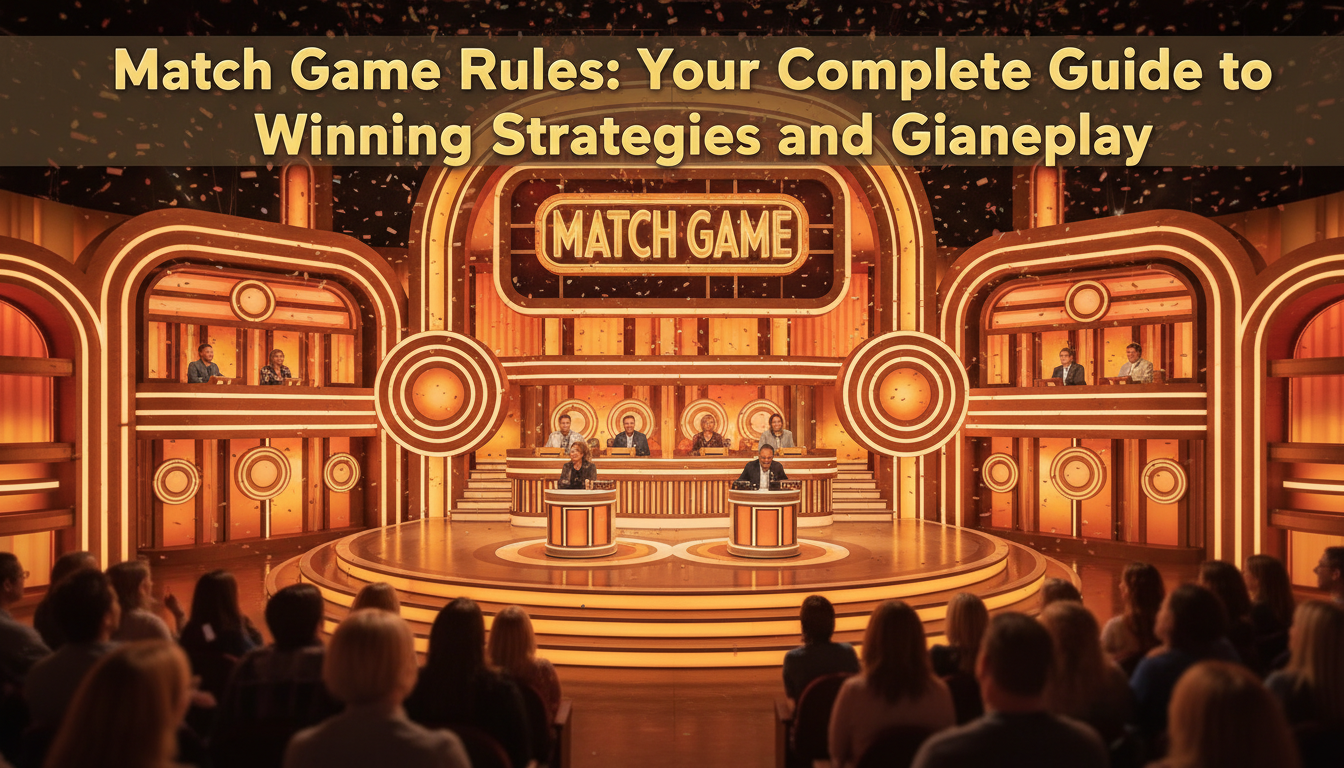
Match Game Rules dictate the simple yet exciting flow of one of the most entertaining formats ever created. Whether you are dealing with classic television wordplay or modern online card matches, the core mechanics remain the same. The primary goal is simple: find a match for a word, picture, or card to earn points and win big prizes. This comprehensive guide covers both the legendary broadcasting formats and the practical card gaming adaptations. As an experienced strategist, I will break down everything you need to know about the rules, rounds, payouts, and strategy behind the game. Read on to master the gameplay.
Match Cards and Game
Matching games are activities that require participants to match similar elements. Participants need to find an identical match for a word, picture, or physical card. The format changes lightly across different mediums, but the overall idea stays the same. The player who has the most matched cards or points wins the session.
What is the card game with two sets of cards?
Pairs is the traditional name of the game. Two players can easily play with a specific deck format. In matching games, players take turns flipping cards to find identical symbols. They usually play cards to a continuously growing discard pile or layout. When players find all the pairs, the game is officially over.
How many cards does each player start the match with?
A complete deck of match cards usually has 48 cards. However, you can also make competitive decks of 12 or 24 cards depending on the variation. For example, two players can play with a deck of 24 cards. This creates 12 distinct pairs or 6 sets of four-of-a-kind. Players must place all cards face down in random order.
What are the rules for card matching game?
The rules focus heavily on memory and spatial awareness. Dobble is another variation where players find common symbols between two cards. If other players make the same pairs as you, they score. In standard memory games, pairs of cards are what players want to collect, or sometimes avoid in specialty variants. The basic rule states whoever makes a certain number of pairs first, wins the overall match.
Players & Equipment
You can use standard cards, custom tiles, or online versions. The Pairs in Pears game involves making pairs of intersecting words that consist of tiles of the same pattern. Each player uses these tiles to form word pairs. One word is aligned up and down, and the other is left and right. They must share a vowel or consonant to count.
Illustrated Rules of the Matching game
Visualizing the board is key to winning. Online and physical table games both require clear turn sequences. All matching games have distinct player phases. Often, they feature a solo mode and a competitive 2-player mode.
How to Make Match Cards
Historically, manufacturing thick decks took a very long time. This meant that cards cost too much money for most people. Today, you can print patterns to make the desired number and sets of cards easily. Make cards using popular blank patterns and markers. Some sets even feature cute Chinese zodiac cartoons to spice up the visuals. You can print blank cards to create your own unique setup tailored for any age group.
Adaptation of the rules for our Online Matching Games:
Online gameplay sequences follow rigid digital structures. Popular sites adapt these mechanics efficiently. Here is how turns process in modern digital matching modules.
Step 2 : Player 1
The first player selects two face-down cards to reveal. The software displays the chosen items. If they do not match, the cards flip back over.
Step 4 : Player 2
It is then the turn of player 2. They attempt the same action. Finding pairs requires paying close attention to previous turns.
Step 6 : Player 1
The turns cycle back. It is now the turn of player 1 again. Here, the player remembers the position of previously revealed cards. He turns over two identical cards to secure a point.
Step 8 : Player 1
Because they found a successful match, their turn continues. The cycle repeats until all items find their perfect pair.
Match Game (1973-82 versions)
Match Game is one of television’s most entertaining and unpredictable shows. It masterfully blends wordplay, humor, and celebrity chemistry. The show returned to CBS in 1973 with a significantly changed format. It became a major daytime success featuring expanded panels and larger cash payouts. Production moved to Studio 33 at CBS Television City in Los Angeles.
Staffing and ratings
Gene Rayburn hosted the series, utilizing his signature long-thin telescoping microphone. Mark Goodson and Bill Todman produced the legendary series. The show quickly surpassed records as the most popular daytime program ever. It attracted a record 11 million daily viewers. This massive success triggered a network overhaul that essentially ended the rural purge.
How many celebrity panelists are on Match Game?
Each show featured a panel of six celebrities. These stars sat arranged in two rows of three. Regulars included Richard Dawson, Brett Somers, and Charles Nelson Reilly. Panelists often rotated, appearing in week-long blocks due to tight taping schedules.
The Main Game Rounds
Two contestants competed to see who could match the most celebrities. There were usually two main rounds in the standard daylight game. The host reads a statement and leaves out a specific word. Six celebrities then write down their answers to secretly fill in the blank.
Gameplay
The contestant would then give their own verbal answer. Afterward, they watched to see how many celebrities recorded responses that precisely matched their own. Points are awarded based on how many accurate overlaps occur. Two rounds of fill-in-the-blank questions were played securely.
- Scoring: Each exact celebrity match earned points.
- Ties: If the score tied, a sudden-death tiebreaker was played.
- Goal: The player with the highest total advanced to the endgame.
Front Game Rules (1973-82 versions)
The front game focused strictly on direct matches without extra bonuses. Gene Rayburn read the statement carefully. Next, the six celebrities wrote their answers on large index cards. A slide whistle sound effect playfully dubbed over audible mistakes or bleep censors.
The contestant gave their verbal response only after the stars locked in. Match Game rewards players who think like the majority rather than trying to be complex. The maximum score a contestant could achieve remained exactly six points. Matched celebrities did not play subsequent question rounds for that contestant.
Front Game Rules (1962-9 version)
The oldest version had different parameters. The Match Game in its original version ran on NBC’s daytime lineup. Production spanned from 1962 until 1969. The show originally aired in black and white before moving to vibrant color later. Arlene Francis and Skitch Henderson starred as the original two celebrity panelists.
The front format was slightly non-humorous and very fast-paced. Typically, it required the contestant and celebrity to choose from familiar phrases. For instance, questions resembled “Baseball _____” expecting answers like “game” or “diamond.” Both teams were given a question and each player privately wrote down their response.
Front Game Rules (1998-9 version)
Years later, a modern revival attempted to capture the magic. It only lasted one season, running from late 1998 to 1999. The producers significantly retooled the format to be faithful to the 1970s program. Rules and gameplay were essentially identical, but payouts saw adjustments. Each correct panelist match was worth 50 points.
Match Game PM (1975–81, weekly syndication)
Simultaneous to daytime airings, an evening version dominated television. On September 8, 1975, the first syndicated version called Match Game PM premiered. The series sold to ABC affiliates and independent stations nationwide. The best ratings this version saw hit an incredible 12.5 rating.
Format
Episodes of Match Game PM were totally self-contained. There were no returning champions here. Two completely new contestants began each individual match. The front game expanded slightly. Instead of two rounds, a third round was added because regular games proved too short for nighttime schedules.
Also, the maximum prize was bumped massively. Day series maximums capped at $10,000, but Match Game PM allowed successful champions to win up to $20,000. In PM rules, a time-saving variant of tiebreakers reversed standard gameplay slightly if time ran short.
The Match Game-Hollywood Squares Hour (1983–84, NBC)
Match Game returned to NBC in 1983 as part of a massive crossover event. The rules underwent minor shifts for this short-lived daytime block. Gameplay straddled classic matchmaking with tic-tac-toe logic. Due to combined budgets, the format featured a panel of only five celebrities instead of the usual half-dozen.
Contestants faced an interesting twist here. Two contestants won money directly by making matches early on, rather than just scoring abstract points. The high scorer became the eventual champion at the culmination of the game. Payout rules updated slightly, offering $50 for any unsuccessful match.
What is the Super Match on Match Game?
The Super Match is the high-stakes finale. After qualifying points were tallied, the winning player advanced to this crucial phase. The structure featured massive cash bonuses and required a precise blend of popular sentiment alongside celebrity luck.
The Super Match Bonus Round
This round had two distinct parts: the Audience Match and the subsequent Head-to-Head match. First, the contestant picks three celebrities to help answer a targeted survey question. The host asks for a specific word that fills a short blank. The contestant uses these suggestions to formulate their final pick.
The contestant attempts to match one of three hidden top surveys. Making a successful connection pays out varying cash prizes.
| Audience Rank | Standard Prize Value |
|---|---|
| Top Popular Answer | $500 |
| Second Popular Answer | $250 |
| Third Popular Answer | $100 |
| No Match | $50 Consolation |
Next comes the head-to-head showdown. This final stage multiplied the audience winnings dramatically. The contestant selected one celebrity for an exact word-for-word match. The selected star secretly wrote down an answer. The contestant then declared their chosen word aloud. If they aligned flawlessly, they won 10 times the amount secured previously.
Star Wheel
The Star Wheel was introduced to add pure variance to the stakes. Following the audience survey, the contestant spun a giant physical wheel heavily divided into celebrity names. The wheel spin determined exactly which star they had to partner with.
Certain sections held a golden star slot. If the flapper landed on a golden star, the final winnings doubled instantly. The multiplier could range highly, setting a massive cash ceiling. To win the ultimate top prize, the stakes demanded an exact linguistic match. Plural variations were accepted, but synonyms were strictly forbidden.
What Experts Say About Match Game Rules
– Marcus T. Vance, Game Theory & Probability Specialist
– Elena Rostova, Digital Casino Content Strategist
Extensive FAQ
Yes. According to official rules, singular and plural pairs (like “Game” and “Games”) are universally accepted as direct matches. However, synonyms, derivatives, and slang variations are entirely rejected.
Do I need special equipment to play the printable version?
No. You can easily make a deck using blank templates and standard markers. A typical household setup requires either 24 or 48 paper units depending on how long you want the session to last.
How long did the most successful TV variation air?
The daily syndicated version produced 525 episodes, operating seamlessly for exactly three years initially, but ran hundreds of episodes across different networks and franchise eras until final cancellations.
What happens if the scores are tied at the end of the front game?
If contestants share the identical score at the conclusion of standard rounds, a sudden-death tiebreaker is played. A new blank statement is read. The first player to successfully share an answer with any remaining star panelist immediately takes the win.
Is the audience matching segment based on real surveys?
Yes. Similar to modern polling games, producers asked regular people for the first associated word that came to mind. Playing the mathematical odds by guessing the most common societal response guarantees the best payout.
Can I play matching card variations solo?
Absolutely. Most digital variants and printed physical tiles offer a dedicated single-player mode. The main goal shifts from beating an opponent to clearing the board with the lowest amount of moves or fastest possible time.