
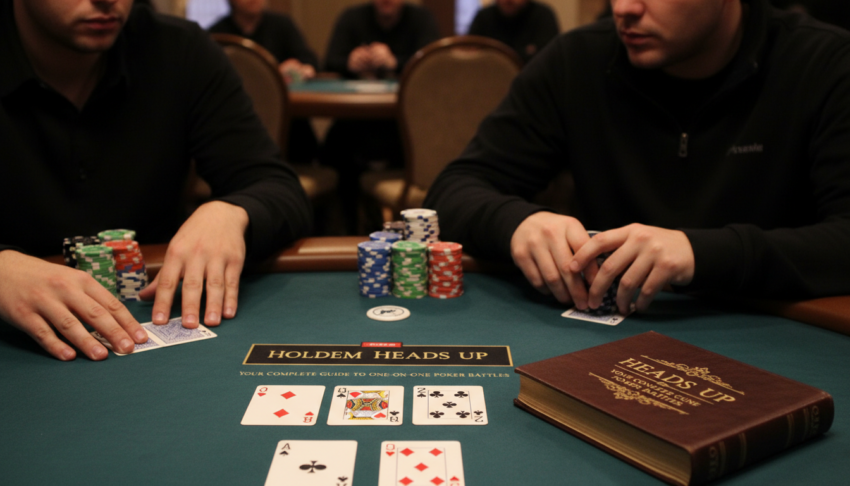
Heads Up Hold’em is an intense one-on-one poker variant that pits you directly against either the dealer or a single opponent. Unlike traditional Texas Hold’em with multiple players, this head-to-head format creates a more aggressive, strategic, and mentally challenging experience where every decision carries significant weight. The game follows standard poker hand rankings but features modified betting structures and position dynamics that dramatically shift strategy. Whether you’re playing online casino versions where you face the house or competitive poker matches against another player, understanding position, pre-flop ranges, and post-flop dynamics becomes crucial. Heads Up Hold’em offers faster gameplay, bigger swings, and more frequent all-in situations compared to full-ring games, making it both exciting for beginners and deeply strategic for professionals. With proper understanding of button position advantages, blind structures, and hand value adjustments for two-player scenarios, you can significantly improve your win rate in this specialized poker format.
Key Takeaways
- Heads Up Hold’em is played exclusively between two players, creating more aggressive and strategic gameplay than multi-player poker
- Position is dramatically more important, with the button position acting as small blind and gaining significant strategic advantage
- Hand values change significantly in heads-up play – many hands that fold at full tables become playable here
- Pre-flop ranges expand substantially, with optimal play involving opening 70-80% of hands from the button
- Bluffing and adjusting to opponent tendencies is more effective due to the simplified decision-making tree
- Online casino versions differ from player-versus-player versions, with specific house rules and betting structures
- Positional dynamics reverse from standard poker – the button posts the small blind and acts first pre-flop
- Bankroll management is critical due to increased variance in heads-up poker compared to full-ring games
Table of Contents
- About Heads Up Hold’em Game
- Texas Holdem Heads Up Rules – Button Position
- Pocket Bonus Wager Explained
- After the Flop: Heads Up Strategy
- Heads Up Hold’em Basics
- Expert Heads Up No Limit Holdem Preflop Charts
- Heads-Up Hold’em Free Play in Demo Mode
- Heads-up Hold’em Strategy Guide
- Advantages and Disadvantages of Heads Up Hold’em
- Heads-Up Hold’em Payout Tables and Odds
- Starting Your Poker Experience Through Heads-up Play
- Playing Heads Up Hold’em for Real Money
- Placing Initial Wagers in Heads Up Poker
- What a Player Duel Looks Like in Heads Up Hold’em
- Top Online Poker Rooms for Heads-Up Play
- What is Heads Up Hold’em in Online Casinos
- How to Play Heads-Up Hold’em
- Texas Holdem Heads-Up Preflop Odds
- Dealing the Initial Cards in Heads-Up Play
- Post-Flop Heads-Up Strategy
- Mistakes to Avoid While Playing Heads Up Hold’em
- Basic Rules of Heads Up Hold’em
- Scoring Rules and Hand Rankings
- Required Bets and Optional Bonus Bets
- Heads-Up Position Strategy Concepts
- Playing in the Big Blind in Heads-Up Games
- How to Play Before and After the Flop
- Heads up Rules for Cash Games and Tournaments
- Progressive Betting in Heads Up Hold’em
- Best Strategy for Successful Heads-Up Hold’em
- Feel Out Your Opponent Early
- Heads-Up Poker Basic Math Using Simulations
- Starting Hands and Match-ups in Heads-Up Hold’em
- What Experts Say About Heads Up Hold’em
- Frequently Asked Questions
About game
Heads-Up Hold’em is a specialized poker variant played exclusively between two opponents. Unlike traditional Texas Hold’em tables with multiple players, this one-on-one format creates a dramatically different strategic landscape where position and psychological play become paramount. The game follows standard poker hand rankings but features unique dynamics that separate it from multi-player poker variants. In online casino environments, Heads-Up Hold’em often appears as a player-versus-dealer game with specific house rules, while in poker tournaments and cash games, it represents the final stage when only two players remain.
What distinguishes Heads-Up Hold’em is how deeply the position affects every decision. Since you’re only facing one opponent, you can develop precise reads much faster, and the dynamics shift dramatically based on who holds the button position. The button functions differently in heads-up play compared to full-ring games – it acts as the small blind and must post first before the flop. This reversal of traditional blind structure creates unique strategic implications that many new players overlook.
Heads-Up Hold’em has gained significant popularity both in live poker tournaments as the concluding phase and as a dedicated format in online poker rooms. The game appeals to players seeking more frequent action, bigger swings, and a purer test of poker skill, as you can focus entirely on outmaneuvering a single opponent rather than navigating complex multi-way dynamics.
Pocket Bonus Wager
The Pocket Bonus is an optional side bet in many casino versions of Heads-Up Hold’em that allows players to win based solely on their initial pocket cards, regardless of the final outcome against the dealer. This side bet appeals to players who enjoy extra excitement and additional ways to win, though it comes with a higher house edge than the main game.
The house edge for the Pocket Bonus is approximately 4.5%, making it a relatively expensive side bet compared to the main Heads-Up Hold’em game which typically has a house edge under 1%. The bet pays according to a predetermined table based on the strength of your two hole cards. Typically, only premium hands like pairs, high cards, or suited connectors trigger a payout.
90% of hands dealt at the start of the game will fail to qualify for the Pocket Bonus, which explains why the house edge remains relatively high. All other combinations of pocket cards simply surrender the wager to the dealer. Despite the higher house edge, the Pocket Bonus offers the tantalizing possibility of winning even when you ultimately lose the main hand against the dealer.
If you plan to play a bonus bet consistently every session, the Trips Plus bonus generally offers better value than the Pocket Bonus. The Trips Plus bet, which pays out when you achieve three of a kind (Trips) or better with your final hand, carries a lower house edge while still providing those exciting bonus payouts when you hit strong hands.
| Hand | Pay Table 1 | Pay Table 2 | Pay Table 3 |
|---|---|---|---|
| Royal Flush | 500:1 | 500:1 | 500:1 |
| Straight Flush | 50:1 | 50:1 | 100:1 |
| Four of a Kind | 25:1 | 25:1 | 50:1 |
| Full House | 8:1 | 9:1 | 12:1 |
| Flush | 5:1 | 6:1 | 8:1 |
| Straight | 4:1 | 4:1 | 5:1 |
| Three of a Kind | 3:1 | 3:1 | 3:1 |
| Two Pair | 2:1 | 2:1 | 2:1 |
| Pair (10s or Better) | 1:1 | 1:1 | 1:1 |
There are three common pay tables for the Pocket Bonus in casino versions of Heads-Up Hold’em, with the third typically offering the most favorable returns to players. Despite these variations, the fundamental math remains the same: the Pocket Bonus is primarily designed for entertainment value rather than being a strategic component of optimal play. Professional players typically avoid this side bet except perhaps as an occasional “fun” wager while enjoying casino play.
After the Flop:
The post-flop phase in Heads-Up Hold’em requires fundamentally different strategies than in multi-player Texas Hold’em. With only two players competing, the dynamics shift significantly, and many players make critical mistakes by applying full-ring strategies to this specialized format. After the flop, you have several strategic options that depend heavily on board texture, your position, and your read on your opponent.
One key adjustment is recognizing that high cards often make the best hand on the flop in heads-up battles. With only one opponent, the likelihood that someone has connected with the board decreases compared to multi-way pots, making top pair or even high card frequently good enough to win the hand. This creates valuable opportunities for continuation betting and applying pressure when you missed the flop but suspect your opponent did as well.
The cool thing about calculating odds in heads-up play is the simplicity compared to multi-player scenarios. Since there are never any multi-way pots when playing one-on-one, you don’t need to factor in multiple opponents potentially drawing to beats your hand. This simplification allows for more precise equity calculations and clearer decision-making throughout the hand.
When evaluating whether to check or raise after the flop, consider the following strategic framework:
- Evaluate board texture (wet vs. dry)
- Assess your range advantage (does your range hit this board better than opponent’s?)
- Consider your position (button vs. big blind)
- Analyze previous action and opponent tendencies
- Determine implied odds and potential future streets
“Most players overcomplicate post-flop play in heads-up Hold’em. The key isn’t complex ranges but recognizing when your opponent is weak. Track how often they check back strong hands versus weak hands. If they check back 70%+ of the time with top pair on dry boards, you can fire two barrels profitably with much wider ranges. Simplicity beats complexity in heads-up poker.”
– Alec Torelli, Professional High-Stakes Poker Player, Conscious Poker founder
After the flop, you have opportunities to place a raise wager that can significantly impact the outcome. In casino versions of Heads-Up Hold’em, this often takes the form of 1x, 2x, or 3x raise options depending on when you decide to increase your bet. One must remember that if you always add the raise wager to your hand, it loses its strategic effect on your opponent. Timing your raises based on board texture and perceived strength becomes critical to maximizing profitability.
Common post-flop mistakes include playing too passively with strong hands and over-folding to aggression. Since only two players take part in the hand, the chance of having the best hand is much higher than in multi-handed games, which causes the game to become more aggressive. Don’t get trapped into a “fit or fold” mentality – with only one opponent, semi-bluffing becomes significantly more powerful when executed with proper hand selection and board awareness.
Heads Up Hold ‘Em Basics
Heads-Up Hold’em combines the strategic elements of poker with the fast-paced nature of casino card games, making it a popular choice for online players seeking both skill and excitement. In this simplified version, you’re playing directly against the dealer rather than multiple opponents, creating a fast-paced challenge that appeals to both newcomers and experienced players.
Playing Heads Up Hold’em involves betting, strategy, and understanding poker hand rankings. The game begins with the player and dealer each receiving two pocket cards. Community cards are then revealed in stages (flop, turn, and river), allowing both parties to create the best possible five-card hand using any combination of their hole cards and the community cards.
Unlike traditional Texas Hold’em, where you compete against several opponents, Heads Up Hold’em is a one-on-one battle between player and dealer. This creates a more focused strategic environment where position becomes even more critical. The game follows standard poker hand rankings from high card to royal flush, with the player winning when their hand outranks the dealer’s hand according to these established rankings.
Heads Up Hold’em offers a range of betting opportunities and strategic decisions that make each round a test of both luck and skill. You’re then dealt two pocket cards, and the dealer begins revealing the community cards (flop, turn, and river). Strategic betting, rather than bluffing, takes precedence because you’re playing against the dealer rather than reading opponent tells, though understanding when to raise versus check remains critical to maximizing returns.
Successful Heads Up Hold’em requires intelligent decision-making, calculated risk-taking, and a solid understanding of poker hand rankings. The duel adds a level of intensity, as each decision directly impacts the outcome of the hand without the buffer of multiple opponents. This intensity explains why the game has grown in popularity due to its straightforward gameplay, fast-paced nature, and exciting bonus betting options.
Expert Heads Up No Limit Holdem preflop charts
Mastering pre-flop play in Heads-Up No Limit Hold’em requires understanding specialized charts designed specifically for one-on-one poker. Unlike full-ring games where tight opening ranges prevail, heads-up play demands dramatically different starting hand requirements. In fact, optimal heads-up strategy involves opening approximately 70-80% of hands from the button position compared to just 15-25% in six-handed play.
A good starting point against an unknown opponent is to open roughly 70-80% of your hands to 3bb from the button. This range includes most suited hands, all pairs, and the majority of offsuit Broadway cards. The key realization is that many hands that fold at full tables become profitable to play heads up due to position and the reduced number of opponents.
Here’s a simplified pre-flop chart for Heads-Up No Limit Hold’em:
| Position | Mandatory Actions | Value Hands | Bluff Hands |
|---|---|---|---|
| Button (Small Blind) | Must open at least 70% | TT+, ATs+, KQs, AJo+ | All suited connectors, broadways |
| Big Blind vs Button | Defend approx 35% | JJ+, AQs+, AKo | JTs, Q9s, KJs, suited aces |
| Button vs 3-bet | Fold weakest 50%, 4-bet strong hands | QQ+, AK, sometimes AQ | ATo, KJo, 32o, 72o |
| Big Blind vs 4-bet | Fold most hands | KK+, AK, sometimes QQ | Rarely bluff-calls |
When first learning heads-up play, a useful approach is dividing your range into three categories:
- Premium hands: JJ+, AQs+, AKo – these form the core of your value range
- Speculative hands: All suited connectors, small pairs – play these post-flop
- Bluff hands: High card combinations like A5o, K7o – used for balance
The exact percentages will vary depending on stack sizes, opponent tendencies, and format (cash game vs tournament). But understanding these basic ranges provides the foundation for building a solid heads-up strategy. As you gain experience, you can adjust these ranges based on specific opponent weaknesses and developing reads.
Heads-Up Hold’em Free Play in Demo Mode
For beginners looking to learn Heads-Up Hold’em without risking real money, demo mode offers an invaluable training tool. Many online casinos and poker platforms provide free versions of the game where you can play with virtual chips while learning the mechanics, betting structures, and strategic nuances.
One major benefit of demo mode is the ability to test different strategies without financial consequences. You can experiment with aggressive opening ranges from the button, practice post-flop play against various board textures, and learn when to take advantage of position without worrying about losing your bankroll. This hands-on experience helps cement theoretical knowledge into practical skill much faster than studying alone.
In demo mode, pay particular attention to:
- Button position dynamics and blind structures
- Appropriate pre-flop opening ranges
- Post-flop betting patterns and sizing
- How often to continuation bet versus checking
- When to raise with drawing hands
The buttons and controls function exactly as they would in real money play, allowing you to develop muscle memory for actions between flops, turns, and rivers. Many platforms also include strategy hints or auto-suggest features that can guide your decision-making as you learn.
However, be cautious about applying demo mode tendencies to real money games. Players in free play often exhibit less disciplined strategies, more random aggression, or poor fold equity understanding. Use demo mode as a learning tool, but recognize that real money opponents will generally play tighter and more strategically.
“Never skip demo mode when learning heads-up Hold’em. The most common mistake I see is players jumping straight into real money tables without understanding that button position acts first pre-flop. Demo mode creates muscle memory for proper action sequence and helps you recognize when online casinos have misrepresented standard poker rules. Master the free version before risking a single dollar.”
– Mike Caro, Founder of Mike Caro University of Poker
Demo mode also provides a safe environment to practice bankroll management techniques and test out different bonus bet strategies without financial risk. You can evaluate whether side bets like Pocket Bonus or Trips Plus align with your risk tolerance and playing style before committing real money.
Heads-up Hold’em Strategy
Developing a winning Heads-up Hold’em strategy requires understanding both fundamental poker principles and the unique dynamics of one-on-one play. Unlike multi-player games where you must balance action against multiple opponents with different tendencies, heads-up play allows for more precise adjustment to a single opponent’s weaknesses.
The core of effective heads-up strategy is understanding and exploiting position. Since you alternate being on the button with your opponent, your approach must dynamically shift based on who holds the positional advantage each hand. When on the button (small blind), you should open approximately 70-80% of hands to 3bb, applying constant pressure to the big blind. In the big blind, you should defend around 35% of hands against the button’s opening range.
Successful heads-up players adopt what’s called “dynamic range construction” – they don’t play static ranges but constantly adjust based on opponent tendencies. If your opponent folds too often to 3-bets from the big blind, you should increase your 3-bet frequency with more hands. If they call too wide, tighten your value range and add more bluffs to your 3-bet spectrum. The key is identifying tendencies quickly and exploiting them before your opponent adjusts.
Common non-pair match-ups provide essential guidance for pre-flop decisions:
| Match-up | Favorite Equity | Underdog Equity | Notes |
|---|---|---|---|
| Pair vs. Lower Pair (Q-Q vs. 9-9) | 80% | 20% | Higher pair dominates |
| Pair vs. Dominated Hand (Q-Q vs. Q-9) | 85% | 15% | Pair has significant edge |
| Pair vs. Two Overcards (5-5 vs. J-9) | 55% | 45% | “Coin flip” situation |
| Two Cards vs. One Dominated Card (A-Q vs. A-J) | 75% | 25% | Queen blocked reduces outs |
| Pair vs. One Overcard (K-K vs. A-6) | 90% | 10% | Pair heavily favored |
| High Card vs. Lower Cards (A-T vs. K-J) | 62% | 38% | High card gives edge |
Post-flop strategy in heads-up play differs significantly from full-ring games. With only one opponent, you should continuation bet more frequently, typically 65-75% of the time on dry boards. Since there’s just one player to beat, your betting range can be wider, and you can better identify when your opponent has missed the board.
One critical adjustment is understanding that low pairs (22-66) become significantly more valuable heads up. Because it’s harder to play these hands profitably post-flop out of position against multiple opponents in full-ring games, they’re often folded. But heads up, these small pairs can be profitably played due to the simplified decision tree and reduced number of possible strong hands your opponent might hold.
The most successful heads-up players employ varies their play enough to prevent predictability while maintaining solid fundamentals. As David Sklansky famously noted, “Every bet, raise, or call in poker should convey a specific strategic message to your opponent.” In heads-up play, those messages become crystal clear since you’re only communicating with one player rather than multiple opponents.
Advantages and Disadvantages of Playing Heads Up Hold’em
Heads-Up Hold’em offers unique advantages that appeal to many poker players but also presents specific challenges that may not suit everyone’s playing style.
Advantages
- Increased Action: More hands played per hour compared to multi-player tables
- Simplified Decision-Making: Only one opponent to read rather than multiple players
- Faster Skill Development: More immediate feedback on strategic decisions
- Larger Swings: Bigger potential wins (and losses) in shorter timeframes
- Easier Tells: With only one opponent, physical and timing tells become more apparent
- No Table Selection Needed: No need to find the right table – you’re always playing against your sole opponent
- Better Positional Awareness: Clear understanding of who has position on every street
Disadvantages
- Higher Variance: More extreme swings due to simplified dynamics
- Psychological Pressure: Constant engagement with a single opponent can be mentally exhausting
- Limited Traditional Strategy: Many standard poker strategies don’t translate well to heads-up play
- Exploitation Risk: One opponent can intensely focus on exploiting your specific weaknesses
- Bankroll Requirements: Need larger bankroll due to increased variance
- Limited Tournament Availability: Fewer dedicated heads-up tournaments compared to multi-table events
- Rule Confusion: Many players struggle with the reversed blind structure
“Heads-up Hold’em is the purest form of poker psychology. The disadvantage isn’t the game itself but players who treat it like full-ring poker. The truth? Your opening range should be 4x wider and your fold frequency to 3-bets should nearly double. Most players fail because they don’t embrace the strategic uniqueness of heads-up play – they just play tighter, not differently.”
– Jonathan Little, Two-time WPT Player of the Year
Despite these advantages and disadvantages, heads-up poker remains an excellent learning tool. The stripped-down nature of one-on-one play helps players develop core poker skills without the complications of multi-way pots. Many professionals recommend starting with heads-up play to build foundational skills before moving to more complex multi-player formats.
For recreational players, heads-up poker offers an exciting, fast-paced alternative to traditional poker that can be more engaging due to the constant action and direct confrontation. Just be prepared for the higher variance and psychological demands that come with this intense poker format.
Heads-Up Hold’em Payout Tables and Odds
Understanding payout tables and odds is essential for making informed decisions in Heads-Up Hold’em. The main game typically follows standard poker payout structures, but bonus bets and specific rule variations can significantly alter expected value calculations.
Unlike traditional Texas Hold’em, casino versions of Heads-Up Hold’em often feature specific payout tables for the main game as well as optional side bets. The core game typically pays even money on winning hands, with the dealer needing at least a pair to qualify. If the dealer doesn’t qualify, your ante bet pushes while the odds bet still plays.
The following table shows standard payout structure for the Odds bet when the player wins the hand:
| Hand | Payout |
|---|---|
| Royal Flush | 500:1 |
| Straight Flush | 50:1 |
| Four of a Kind | 25:1 |
| Full House | 8:1 |
| Flush | 5:1 |
| Straight | 4:1 |
| Three of a Kind | 3:1 |
| Two Pair | 2:1 |
| One Pair (10s or better) | 1:1 |
| High Card or Lower Pair | Push |
Many casino versions include a “Losing Odds” bonus that pays out when you have a strong hand but still lose to the dealer. This unique feature changes strategic considerations, as you can sometimes risk more to chase these bonus payouts. The pay table for this bet varies, but typically offers:
- High Straight Flush: 50:1
- Low Straight Flush: 25:1
- Four of a Kind: 10:1
- Full House: 5:1
- Flush: 4:1
- Straight: 3:1
- Three of a Kind: 2:1
- Two Pair or Better: 1:1
The Trips Plus side bet offers additional payout opportunities based on your final five-card hand strength, regardless of whether you beat the dealer. The standard Trips Plus pay table typically looks like:
| Hand | Payout |
|---|---|
| Royal Flush | 50:1 |
| Straight Flush | 40:1 |
| Four of a Kind | 30:1 |
| Full House | 9:1 |
| Flush | 7:1 |
| Straight | 5:1 |
| Three of a Kind | 3:1 |
While these payouts appear enticing, players should remember that side bets typically carry higher house edges than the main game. The best strategy remains focusing on optimal play in the core game while viewing side bets as occasional entertainment additions rather than core components of strategy.
Starting Your Poker Experience Through Heads-up Play
For new poker players, starting with heads-up play offers significant advantages over diving directly into multi-player tables. The simplified dynamics and direct confrontation create an ideal learning environment to develop core poker skills without being overwhelmed by complex multi-way pot scenarios.
Heads-up poker provides immediate feedback on your strategic decisions since you’re only dealing with one opponent. This direct cause-and-effect relationship helps new players quickly identify what works and what doesn’t, accelerating the learning curve. Instead of trying to interpret actions from five or six players simultaneously, you can focus entirely on understanding and countering a single opponent’s strategy.
If you’re beginning with heads-up poker, follow these steps to build a strong foundation:
- Master button dynamics: Understand that in heads-up play, the button acts first pre-flop as small blind but last after the flop
- Develop basic ranges: Start with opening 60-70% of hands from button, defending 30% from big blind
- Focus on position: Recognize how much more valuable the button becomes in one-on-one play
- Track opponent tendencies: Note fold frequencies to 3-bets, check-raise percentages, etc.
- Practice bankroll management: Heads-up games typically require larger bankrolls due to increased variance
Many beginners find heads-up play more exciting than full-ring games due to the constant action and immediate results. There are several ways to get started:
- Play free online heads-up games against AI opponents to learn mechanics
- Practice with a single friend to develop basic strategies
- Start at the lowest real-money stakes available (~$0.01/$0.02 blinds)
- Use demo mode at online casinos to familiarize yourself with Heads-Up Hold’em variations
- Watch professional heads-up tournaments to observe high-level strategy
Contrary to popular belief, higher stakes games may not be easier to master than lower stakes games in heads-up play. In fact, low-stakes heads-up games often feature less skilled opponents who make more exploitable mistakes, providing better learning opportunities for new players.
If you’re a beginning or low-skilled heads-up player aiming to improve, experience real-time training, and limit losses, play for the lowest stakes possible. This approach allows you to make mistakes without significant financial cost while developing the pattern recognition and decision-making skills essential for poker success.
Playing for Real Money
Transitioning from play money to real money Heads-Up Hold’em represents a significant psychological shift that affects decision-making for most players. The financial implications create pressure that can distort optimal strategy, making proper bankroll management and mental preparation critical components of success.
Before playing for real money, ensure you have:
- A dedicated poker bankroll separate from living expenses
- Clear understanding of stakes relative to your bankroll size
- Strategies to manage tilt and emotional decision-making
- Familiarity with the specific rules of the platform you’re using
- Tools to track and analyze your play for continuous improvement
Bankroll requirements for heads-up poker differ significantly from full-ring games due to increased variance. While a typical multi-player cash game recommendation might be 20-30 buy-ins, heads-up players often need 50-100 buy-ins for equivalent risk management. This accounts for the larger swings inherent in one-on-one poker where every decision carries more weight.
When selecting stakes for real money play, remember these guidelines:
- Start at the lowest stakes available (typically $0.01/$0.02 blinds online)
- Move up only after consistently winning at your current level for 3-6 months
- Never risk more than 5% of your bankroll on a single session
- Take regular breaks to maintain mental clarity
- Review hands after sessions to identify strategic leaks
“The biggest mistake new heads-up players make is underestimating variance. A 50-buy-in downswing isn’t unusual—it’s expected. Many players quit right before their strategy clicks because they didn’t prepare mentally or financially. Proper bankroll management isn’t conservative—it’s the difference between seeing results and going broke before you improve.”
– Ed Miller, Poker Strategy Author and Consultant
One critical adjustment when moving to real money play is recognizing how opponent behavior changes with financial stakes involved. Players often become more disciplined, less prone to random aggression, and more focused on exploiting specific weaknesses. Your strategy must evolve to handle these more skilled opponents who play tighter and with clearer purpose.
For those specifically interested in Heads-Up Hold’em casino games (player versus dealer), real money play differs from traditional poker in important ways:
- The dealer follows fixed rules rather than strategic play
- Positional advantages don’t apply in the same way
- Optimal strategy involves following math-based charts rather than reading opponent tendencies
- Bonus bets become more prominent features of the game
- Bankroll requirements are lower due to reduced variance compared to player-vs-player heads-up
Regardless of which format you choose, maintaining proper bankroll management discipline and focusing on long-term results rather than short-term results will separate successful players from those who merely chase immediate gratification.
Placing Initial Wagers
Proper management of initial wagers forms the foundation of successful Heads-Up Hold’em strategy. Unlike full-ring Texas Hold’em where you might wait for premium hands, the heads-up format demands more aggressive opening ranges while maintaining disciplined defense against opponent bets.
Before any cards are dealt, each player must place equal wagers into the Ante and Odds boxes. These required bets establish the baseline stake for the hand and determine subsequent betting opportunities. Many players fail to recognize that these initial wagers set the strategic tone for the entire hand, making their proper sizing and selection critical to long-term success.
In heads-up play, your default approach from the button (small blind) should be to open approximately 70-80% of hands to 3bb. This aggressive strategy exploits the positional advantage you hold over the big blind. Your opening range should include most suited hands, all pairs, and the majority of offsuit Broadway cards. The worst hand in heads-up is 2-3 offsuit because of its poor all-in prospects, winning less than 1 out of 3 times against random hands.
When defending from the big blind against a button open:
- Call with hands that play well post-flop like suited connectors and broadways
- 3-bet with premium hands (JJ+, AQs+, AKo) and strategic bluffs
- Most players defend too tightly – aim for around 35% defense frequency
- Adjust based on opponent tendencies (more calls if tight opener, more 3-bets if loose opener)
One common mistake among new players is underestimating the value of position. When you have the button, you’re in the small blind but still gain significant strategic advantages as you act last after the flop. This information advantage allows you to profitably play many hands that would fold in other positions.
Another critical aspect of initial wagers involves understanding sizing:
- Standard open from button: 2.5-3bb for 100bb stacks
- 3-bet size from big blind: 7-10bb against 3bb open
- 4-bet size: Make opponent commit approximately 50% of remaining stack
- Adjust slightly for deeper or shallower stacks (1bb per 25bb stack depth)
For example, if you 3-bet 10bb with 100bb stacks, increase to 11bb with 125bb stacks and 12bb with 150bb stacks. Minor sizing adjustments prevent opponents from gaining exploitative information through stack-to-bet ratios. Consistent but slightly variable sizing makes it harder for opponents to read your hand strength based solely on bet size.
Smart management of initial wagers creates numerous strategic advantages. Always remember that every bet, raise, or fold sends specific information to your opponent. The most successful heads-up players carefully craft this information flow to maximize confusion and exploitation opportunities throughout the hand.
What does a Player Duel Look Like in the Game Heads Up Holdem?
A heads-up poker duel creates a uniquely intense experience compared to multi-player poker. With only two competitors, every decision becomes magnified, and the psychological battle intensifies as players develop increasingly precise reads on each other’s tendencies.
In a typical heads-up match, the action flows through these stages:
- Pre-flop: Button opens 70-80% of hands, big blind defends around 35% with calls or 3-bets
- Flop: Strategic continuation betting with 65-75% of ranges on dry boards, varying by position
- Turn: Increased bet sizing, more bluff-catches, and strategic check-raises
- River: Precise value betting and bluffing ranges with polarized hand selections
Consider this example hand sequence from a recent tournament match:
| Betting Round | Player 1 (Button) | Player 2 (Big Blind) | Board |
|---|---|---|---|
| Pre-flop | Raises to $15 with K♠7♥ | Calls with A♦5♠ | N/A |
| Flop (J♦5♣2♣) | Bets $20 | Raises to $65 | J♦5♣2♣ |
| Turn (K♣) | Raises to $200 | Calls | J♦5♣2♣K♣ |
| River (5♥) | Bets $450 all-in | Folds | J♦5♣2♣K♣5♥ |
What made this hand particularly interesting was Player 1’s aggressive post-flop strategy with top pair weak kicker. After the flop showed two clubs, Player 2’s raise suggested possible flush draw, yet Player 1 continued with belief in a better hand. The turn card completed the potential flush but also gave Player 1 a second pair, setting up a profitable all-in river bet that exploited Player 2’s marginal made hand.
Heads-up poker duels often feature dramatic momentum swings as players battle for dominance. Small edges accumulate through precise play, with skilled players winning 55-60% of hands against less experienced opponents. Unlike full-ring games where luck plays a larger role, heads-up poker better reflects actual skill differences between players.
The psychological dimension in heads-up play is significantly more pronounced. Timing tells, bet sizing patterns, and subtle adjustments become critical information sources that don’t exist in multi-player formats. In one famous WSOP heads-up match, a player noticed his opponent’s subtle pause when holding strong hands and used this knowledge to secure multiple critical wins in the championship.
Top Online Poker Rooms for Heads-Up Play
Several online poker platforms stand out for their quality heads-up Hold’em offerings, each with unique features catering to different player needs. Understanding which room best suits your style is crucial to maximizing your experience and potential profitability.
The following poker rooms consistently rank highest for heads-up play:
| Platform | Minimum Stakes | Heads-Up Availability | Special Features | Notable Tournaments |
|---|---|---|---|---|
| PlayMoneyPoker | $0.01/$0.02 | 24/7 tables | Free play options, training tools | Weekly $20 Heads-Up |
| Full Tilt | $0.02/$0.04 | Excellent (recommended) | Fast-fold tables, advanced stats | Heads-Up Championship |
| PokerStars | $0.01/$0.02 | Good availability | Regular tournaments, spin & go | Heads-Up High Roller |
| 888poker | $0.01/$0.02 | Fair availability | Mobile app, welcome bonus | Heads-Up Series Events |
| WSOP Online | $0.02/$0.04 | Limited availability | Tournament series, freerolls | WSOP $25K Heads-Up |
The reason Full Tilt is often rated highest for heads-up play is their dedicated heads-up tables and consistent player base that attracts serious players looking for quality competition. There are typically at least one hundred Texas Holdem heads-up tables available 24/7, making it easy to find action at various stakes.
For beginners or those looking to practice without financial risk, PlayMoneyPoker offers comprehensive free play options with AI opponents ranging from weak to strong. This platform provides excellent learning opportunities to develop fundamental skills before moving to real money play.
PokerStars stands out with their Heads-Up High Roller tournaments, attracting the world’s best players and providing valuable viewing opportunities for those seeking to improve. Their extensive video library of professional heads-up matches offers excellent educational content for dedicated learners.
Mobile players will appreciate 888poker’s high-quality app with smooth heads-up play functionality. The ability to play while on the move adds flexibility for those with limited dedicated poker time.
For tournament enthusiasts, WSOP Online provides authentic World Series of Poker experience with their prestigious heads-up events. While cash game availability may be limited, their tournament structure creates exciting competitive environments for serious players.
What is Heads Up Hold’em in the World of Online Casinos
Heads-Up Hold’em occupies a unique position at the intersection of traditional poker and casino table games. In the online casino context, Heads-Up Hold’em typically refers to a specific player-versus-dealer variant with distinct rules rather than traditional player-versus-player poker.
In casino versions, Heads-Up Hold’em follows rules similar to Ultimate Texas Hold’em but with key differences that affect strategic play. Unlike poker tournaments where players compete against each other, in casino Heads-Up Hold’em you’re playing directly against the house, with the dealer following fixed rules rather than strategic decision-making.
The standard gameplay progression in casino Heads-Up Hold’em:
- Place equal Ante and Odds bets
- Receive two pocket cards face down
- Optional: Place Pocket Bonus and Trips Plus side bets
- Decide whether to check or raise 3x before the flop
- After dealer reveals three community cards (flop): check or raise 2x
- After fourth and fifth community cards: make final 1x raise decision or fold
- Dealer reveals hand and compares with player’s final hand
What distinguishes casino Heads-Up Hold’em from player-versus-player versions is the treatment of the Odds bet (similar to the Blind bet in Ultimate Texas Hold’em). In Heads-Up Hold’em (HUH), players can win the Odds bet even when their hand ultimately loses to the dealer, which isn’t the case in Ultimate Texas Hold’em.
Casino Heads-Up Hold’em appeals to both poker enthusiasts and casino game players. Those familiar with Texas Hold’em appreciate the familiar hand rankings and community card structure, while traditional casino players enjoy the clear, house-banked structure with defined payout tables. The game’s popularity stems from this dual appeal and its faster, more straightforward gameplay compared to traditional poker tables.
According to industry data, Heads-Up Hold’em as a casino variant has grown in popularity due to its straightforward rules, fast-paced nature, and exciting bonus betting options. Many online casinos now feature this game prominently in their table games sections, recognizing its appeal to players seeking more strategic depth than typical casino games but without the complexities of full poker tournaments.
How to Play Heads-Up Hold’em?
Learning how to play Heads-Up Hold’em properly requires understanding both the mechanics of the game and the strategic adjustments necessary for one-on-one poker play. While the basic framework resembles traditional Texas Hold’em, the heads-up format demands specific knowledge that many new players overlook.
Follow these steps to play Heads-Up Hold’em correctly:
- Understand position roles: The button posts small blind and acts first pre-flop but last after flop
- Master betting structure: Open 70-80% of hands from button, defend 35% from big blind
- Learn board reading: Recognize how board texture affects hand strength with one opponent
- Track opponent tendencies: Note fold frequencies, betting patterns, and timing tells
- Adjust ranges dynamically: Change strategy based on recent history and observed weaknesses
- Manage bankroll properly: Maintain sufficient funds for increased variance in heads-up play
At the start of each hand, the button acts as small blind, posting a forced bet while the other player posts the big blind. This reversal from traditional poker rules causes significant confusion for new players who expect the button to act last pre-flop as in full-ring games.
The pre-flop action sequence proceeds as follows:
- Button posts small blind and may raise immediately or check (which would just call the big blind)
- Big blind posts big blind and may check, raise, or fold if button checked
- If button raised, big blind can call, raise (3-bet), or fold
After the flop, the action reverses, with the big blind acting first and the button acting last, following standard poker protocol. This creates the strategic advantage for the button position that makes it so valuable despite acting first pre-flop.
One common question for beginners is whether the rules differ between cash games and tournaments. Yes, the Heads-up rules remain exactly the same for both formats, though tournament play typically features escalating blinds that create strategic differences as the match progresses. The only real difference you’ll see is that tournaments often have antes paid in addition to the blinds, which affects optimal bet sizing.
To avoid rule violations, remember this fundamental principle: the player on the button always posts the small blind in heads-up play to maintain correct order of play. If this were reversed, with the button posting the big blind, it would violate basic poker sequencing rules. It’s easy to see how these rules can be forgotten since players might only achieve heads-up play once every few months, making occasional violations common.
Mastering how to play Heads-Up Hold’em requires practice, patience, and a willingness to adjust your strategy based on opponent tendencies. The game rewards players who can balance aggression with discipline, constantly adapting to new information while maintaining sound fundamentals throughout the match.
Texas Holdem Heads-Up Preflop Odds
Understanding preflop odds in heads-up Hold’em is essential for making profitable decisions. Unlike full-ring games where multi-way pots complicate equity calculations, heads-up play features simpler match-ups that allow for precise probability analysis.
Here are the most common pre-flop match-ups and their approximate equities:
| Match-up | Favorable Equity | Underdog Equity | Notes |
|---|---|---|---|
| Pair vs. Lower Pair (QQ vs. 99) | 80% | 20% | Higher pair dominates |
| Pair vs. Dominated Hand (QQ vs. Q9) | 85% | 15% | Pair has significant edge |
| Pair vs. Two Overcards (55 vs. J9) | 55% | 45% | Classic “coin flip” scenario |
| Two Cards vs. One Dominated Card (AQ vs. AJ) | 75% | 25% | Queen blocked reduces outs |
| Pair vs. One Overcard (KK vs. A6) | 90% | 10% | Pair heavily favored |
| High Card vs. Lower Cards (AT vs. KJ) | 62% | 38% | High card gives edge |
| Pair vs. Two Undercards (88 vs. QJ) | 50% | 50% | True coin flip situation |
The worst hand in heads-up is 2-3 offsuit because of its lousy all-in prospects, winning less than 1 out of 3 times against random hands. Contrary to what many players believe, even seemingly weak hands like K4 offsuit become playable heads up as short favorites against average hands.
First, you must understand that the values of starting hands differ significantly from multi-player games. In heads-up play, speculative hands like suited connectors increase in value due to the simplified post-flop dynamics, while premium hands like pocket pairs become relatively less valuable because there’s less opportunity for multi-way pots with massive payouts.
When considering preflop odds, remember these key principles:
- Position outweighs hand strength – button opens much wider ranges
- Suitedness gains significant value heads up due to increased drawing potential
- Connectors become more valuable with fewer opponents to fear
- Overcard hands gain equity due to fewer possible dominating holdings
- Small pairs (22-66) play better heads up than in multi-way pots
For example, K4 is not really a playable hand against a good opponent in 6-max games, while 89s is often folded pre-flop. But in heads-up poker, these hands become strategic components of a balanced range. K4 offsuit actually gives you an edge against random hands heads up, while 89s plays well due to its drawing potential against a single opponent.
Dealing the Initial Cards
The deal sequence in Heads-Up Hold’em follows specific rules that ensure proper gameplay order and prevent common rule violations. Understanding this sequence is critical, as heads-up play represents the most common situation where standard poker rules get violated in casual games.
Here’s the proper dealing sequence for heads-up poker:
- Button position is determined (usually rotation or random method)
- Button player receives first card face down
- Big blind player receives first card face down
- Button gets second card face down
- Big blind gets second card face down
Despite the button acting first pre-flop as the small blind, they still receive the first card in the deal sequence. After cards are dealt, the button posts the small blind and must act first in the pre-flop betting round. This sequence maintains proper action order throughout the hand.
A common point of confusion arises when players mistakenly believe the big blind should receive cards first since they act last pre-flop. However, standard poker protocol always has the button receive cards first regardless of table size. This consistency prevents dealing mistakes that could compromise game integrity.
In online poker platforms, the dealing sequence happens automatically, but the virtual representation should show the button receiving cards first. Unfortunately, some less reputable platforms have implemented incorrect dealing sequences that violate standard poker rules, creating potential confusion for players moving between platforms.
“The single most telling sign of an amateur heads-up player is how they handle the first hand. When I see someone asking ‘who deals first’ at heads-up, I already know they’ll fold too much from the button. Proper dealing sequence creates muscle memory for position. If you understand why button gets first card, you’ll automatically play wider from that position because you recognize the information advantage it provides post-flop.”
– Daniel Negreanu, Professional Poker Player, World Series of Poker Champion
Physical dealers in live settings sometimes improperly deal to the big blind first when heads-up play occurs in tournaments, as this isn’t something they handle daily. This incorrect dealing sequence often triggers confusion about who should act first and can lead to rule violations that affect the hand’s outcome.
Players transitioning from multi-player games to heads-up poker should remember these key dealing rules:
- Button always receives first card, regardless of table size
- Button posts small blind and acts first pre-flop
- Big blind posts big blind and acts last pre-flop
- After flop, button acts last throughout remaining streets
- Dealing errors can lead to procedural mistakes affecting proper action sequence
Mastering the proper dealing sequence provides psychological comfort and eliminates unnecessary distractions during play, allowing you to focus entirely on optimal strategic decisions rather than basic mechanics.
Post-Flop Heads-Up Strategy
Mastering post-flop play in heads-up Hold’em separates winning players from losing ones. With only one opponent to read, the dynamics become significantly different from multi-player games, demanding specific adjustments to maximize profitability.
The fundamental difference in post-flop strategy heads up is the increased importance of board texture and your range advantage. Since you’re only facing one opponent, you can make more precise decisions about when to continuation bet, check-raise, or simply check behind. The ability to read your opponent’s range becomes more accurate, allowing for more profitable bluffs and value bets.
Successful post-flop play in heads-up Hold’em follows these key principles:
- Evaluate board vulnerability (wet vs. dry)
- Assess your range’s hit rate on the board
- Determine if you have range advantage
- Consider your position in the hand
- Analyze opponent tendencies and exploit weaknesses
On dry boards (low connectivity, no draws possible), continuation betting frequency should increase to 75-85% of your range as your opponent rarely connects. On wet boards (flush or straight possibilities), continue only 50-60% of your range as your opponent likely hit something with their calling range.
One critical adjustment is recognizing that high card often makes the best hand on the flop heads up. With only one opponent, the likelihood that someone has connected with the board decreases compared to multi-way pots, making top pair or even high card frequently good enough to win the hand. This creates valuable opportunities for continuation betting and applying pressure when you missed the flop but suspect your opponent did as well.
When deciding between checking and raising after the flop, consider:
- Your opponent’s fold equity (how often they fold to aggression)
- Board texture and drawing possibilities
- Effective stack sizes
- Pot control needs with strong but vulnerable hands
- Your perceived table image
| Situation | Optimal Play | Notes |
|---|---|---|
| Dry board with top pair | Bet 60-75% pot | Standard continuation bet |
| Wet board with top pair | Bet 30-50% pot | Smaller sizing to control pot |
| Dry board with missed hand | Bet 50-66% pot | High success rate bluffing |
| Wet board with strong draw | Bet 75-100% pot | Polarized sizing for value |
| Monotone flop with set | Check or small bet | Avoid scaring opponents off |
The key to becoming proficient at heads-up post-flop play is developing a systematic approach to evaluating each situation rather than relying on gut feelings. Track how often your opponent checks back strong hands versus weak hands. If they check back 70%+ of the time with top pair on dry boards, you can fire two barrels profitably with much wider ranges.
What Mistakes to Avoid While Playing Heads Up Hold’em
Even experienced poker players make critical errors when transitioning to heads-up Hold’em, often because they apply multi-player strategies to this specialized format. Recognizing and avoiding these common mistakes will immediately improve your win rate.
Position Misunderstanding
The single most common mistake is misunderstanding the button position’s function. Many players incorrectly believe the button should act last pre-flop as in full-ring games. In reality, the button posts the small blind and must act first pre-flop before assuming positional advantage after the flop. Misunderstanding this leads to overly tight play from the button and missed opportunities.
Range Construction Errors
New players often deploy ranges that are either too tight or improperly balanced:
- Too Tight: Opening less than 60% from button or defending under 25% from big blind
- Imbalance: Having too many bluffs or insufficient value hands in 3-bet ranges
- Static Play: Using the same range regardless of opponent tendencies
Post-Flop Missteps
Post-flop errors prove especially costly in heads-up play:
- Over-folding to aggression: With only one opponent, bluffing frequency should increase
- Passive playing with strong hands: Not extracting maximum value with premium holdings
- Over-playing marginal hands: Calling multiple streets with weak holdings
- Ignoring opponent tendencies: Not adjusting to folding frequencies or aggression rates
“The most expensive mistake in heads-up Hold’em isn’t playing bad hands—it’s failing to adjust ranges after the first 15 minutes. I track how often my opponent folds to 3-bets in real-time. If it’s over 60%, I 3-bet 80% of hands. If under 40%, I tighten to 50%. The players who keep folding to exploitation while complaining ‘he’s too aggressive’ are why I have a nice house.”
– Doug Polk, Professional Poker Player, Three-time WSOP Bracelet Winner
Mental Game Failures
Heads-up poker’s psychological demands create specific pitfalls:
- Variance sensitivity: Quitting after normal downswings
- Over-attribution: Blaming bad beats rather than strategic flaws
- Stagnation: Not reviewing hands or tracking tendencies
- Ego clashes: Letting tilt drive decisions in continuous matches
To avoid these mistakes, implement these corrective strategies:
- Maintain a standardized initial range but adjust based on observed opponent tendencies
- Track key metrics like fold-to-3-bet percentage and check-raise frequency
- Accept variance as inherent to the game rather than focusing on short-term results
- Take regular breaks during extended sessions to maintain clear thinking
- Review challenging hands after sessions to identify strategic leaks
Remember that in heads-up poker, every action sends deliberate information to your opponent. Successful players craft their betting patterns to maximize confusion and exploitation opportunities without falling into predictable patterns themselves.
Basic Rules of Heads Up Hold’em
Mastering Heads Up Hold’em begins with understanding its fundamental rules, which differ in crucial ways from traditional multi-player Texas Hold’em. Whether playing in a casino, online platform, or live tournament, these basic rules form the foundation of proper gameplay.
The essential rules of Heads Up Hold’em:
- Two Players Only: The game exclusively features head-to-head play between two opponents
- Button Posting: The button position posts the small blind and acts first pre-flop
- Big Blind Position: The other player posts the big blind and acts last pre-flop
- Post-Flop Execution: After the flop, the big blind acts first, followed by the button
- Standard Hand Rankings: Royal Flush through high card follows standard poker rankings
- Community Cards: Five community cards dealt in flop (3), turn (1), and river (1) stages
The button acts first pre-flop for a critical reason – to maintain the correct order of play established in full-ring games. If the blinds were reversed with the button posting the big blind, it would violate basic poker rules for action sequence. This structure ensures consistency regardless of table size, though it creates confusion for new players.
Here’s the complete action sequence for one hand:
- Pre-Flop: Button acts first, deciding whether to raise or check (call big blind)
- Flop: Big blind acts first, followed by button
- Turn: Big blind acts first, followed by button
- River: Big blind acts first, followed by button
When the button folds, they relinquish the small blind to the big blind, the button moves, and the next hand begins. If the button just calls the big blind, the player in the big blind has the option to check back or raise, maintaining proper action flow.
| Mechanic | Heads-Up Hold’em | Full Ring Hold’em |
|---|---|---|
| Button Position | Posts small blind, acts first pre-flop | No blind, acts last throughout hand |
| Big Blind Position | Other player, acts last pre-flop | Second position to act pre-flop |
| Pre-Flop Action Order | Button → Big Blind | UTG → Button → SB → BB |
| Post-Flop Action Order | Big Blind → Button | SB → BB → UTG → Button |
| Typical Open Range | 70-80% from button | 15-25% from button |
One common question is whether these rules apply to various formats. Yes, the Heads-up rules remain exactly the same for cash games, tournaments, and both no-limit and limit versions of Hold’em. The only real difference appears in tournaments that feature antes paid in addition to the blinds, which affects optimal bet sizing but not fundamental rules.
Understanding these basic rules forms the essential foundation for developing winning strategies in Heads-Up Hold’em. Though simple to learn, mastering how to apply these rules strategically creates the difference between winning and losing players.
Scoring Rules and Hand Rankings
The scoring system in Heads-Up Hold’em follows standard poker hand rankings, but specific nuances affect how hands are compared and awarded in one-on-one play. Understanding these details becomes especially important in close match-ups where small equity differences determine long-term profitability.
Standard poker hand rankings apply from highest to lowest:
- Royal Flush (Ace-high straight flush)
- Straight Flush
- Four of a Kind
- Full House
- Flush
- Straight
- Three of a Kind
- Two Pair
- One Pair
- High Card
Crucially, both players may use any combination of their two hole cards and the five community cards to make the best possible five-card hand. In casino versions of the game, the dealer must have at least a pair to qualify. If the dealer doesn’t qualify, your ante bet pushes, but the odds and side bets still play normally.
Key scoring considerations for heads-up play:
- The player’s hand either beats, ties with, or loses to the dealer’s hand
- Ties result in all bets pushing (except bonus wagers with different rules)
- Kickers matter more heads up due to fewer possible hand combinations
- Board plays more frequently heads up as strong hands are more likely
In player-versus-player heads-up matches, unlike casino versions, there’s no qualifying hand requirement. The best five-card hand always wins, with ties splitting the pot equally.
| Player Hand | Dealer/Opponent Hand | Result | Notes |
|---|---|---|---|
| AK (Board: TdJdQdKd3c) | Ad4c | Player wins | Player has straight flush vs dealer’s flush |
| Qs9h | Ace-Queen | Player wins | High card gives player edge |
| J8 (Board: 5c2c6d) | Q7 | Dealer wins | Both missed, dealer’s Q high wins |
| TT (Board: 5c5d3s) | AJ | Dealer wins | Dealer flopped two pair vs player’s set |
| K9 (Board: 9c4c3c) | 2c7d | Player wins | Player has pair vs dealer’s flush draw |
One strategic implication of heads-up scoring is recognizing that tie situations occur less frequently than in multi-player games. With only two hands competing, the likelihood of identical final hands decreases significantly, making every marginal equity advantage more valuable.
In casino versions of Heads-Up Hold’em, specific scoring rules apply to bonus bets:
- Pocket Bonus: Pays based solely on hole cards (pair of 10s or better)
- Trips Plus: Pays when player achieves three of a kind or better with final hand
- Losing Odds Bonus: Pays when player has strong hand but still loses to dealer
Understanding these scoring distinctions helps players make informed decisions about when to pursue bonus payouts versus focusing on the main game. The house edge for the Pocket Bonus is approximately 4.5%, while the Trips Plus bet typically carries a lower house edge of around 2-3%, making it the better value play for those interested in bonus wagers.
Required Bets and Optional Bonus Bets
Heads Up Hold’em features a structured betting system with mandatory requirements and optional bonus opportunities that significantly impact strategic decisions. Understanding this structure forms the foundation of effective gameplay.
The core betting sequence follows these steps:
- Ante Wager: Required initial bet placed before receiving cards
- Odds Wager: Required bet equal to Ante wager
- Optional Bonuses: Pocket Bonus and Trips Plus bets (optional side bets)
- Pre-Flop Decision: Check or raise 3x based on starting hand
- Flop Decision: Check or raise 2x after community cards appear
- Turn/River Decision: Final check or 1x raise decision
These initial wagers are typically restricted by posted minimums and maximums at the chosen table. Before cards can be dealt, each player must place equal wagers into the Ante and Odds boxes, establishing the foundational stake for the hand. The required bets create the minimum commitment that drives all subsequent strategic decisions.
After placing required bets, players may choose from two optional side bets:
Pocket Bonus
Pays according to the value of the player’s two hole cards (pair of 10s or better). The house edge for this bet is approximately 4.5%, making it relatively expensive compared to the main game. This wager pays based solely on your starting cards, regardless of the final outcome against the dealer.
Trips Plus
Pays according to the poker value of the player’s hand when three of a kind (trips) or better is achieved. The house edge for this bet typically ranges from 2-3%, making it the better value of the two side bets. This wager pays based on your final five-card hand strength, regardless of whether you beat the dealer.
| Bet Type | Trigger | House Edge | Payout Range | Strategic Value |
|---|---|---|---|---|
| Pocket Bonus | Pair of 10s or better | ~4.5% | 1:1 to 500:1 | Low – primarily for entertainment |
| Trips Plus | Three of a kind or better | ~2-3% | 1:1 to 50:1 | Medium – better value play |
Many players incorrectly maximize side bets while neglecting optimal main game strategy. For maximum return, focus first on proper decisions in the main game before considering side bets. If you do choose to play bonus wagers, the Trips Plus bet offers superior value to the Pocket Bonus due to its lower house edge.
An important strategy consideration is that if the opponent shows impatience, you have significant chances to win decisive pots. This principle applies equally to the bonus betting structure – when your opponent makes aggressive plays with weak holdings, subtle opportunities arise to maximize value while minimizing risk in specific situations.
For those playing player-versus-player heads-up Hold’em (rather than the casino variant), the betting structure differs slightly, but the principle remains the same: understand required minimums, recognize strategic value in different betting opportunities, and never wager on hands that are likely to lose.
Heads-up Position Strategy Concepts
Position represents the single most important strategic consideration in Heads-Up Hold’em, significantly more critical than in full-ring Texas Hold’em. Mastering position dynamics creates perhaps the biggest separation between winning and losing heads-up players.
The button position in heads-up play functions differently than in traditional games. Despite acting first pre-flop (as the small blind), the button holds tremendous strategic advantages that make it the most profitable position to be in. This counterintuitive reality causes significant confusion but understanding it is essential for success.
Button advantages include:
- Information advantage: Acting last after the flop provides crucial decision-making edge
- Range advantage: Wider opening range creates pressure on big blind
- Betting control: Ability to set pot size throughout the hand
- Bluffing opportunities: Increased fold equity against single opponent
When on the button, your default strategy should be opening approximately 70-80% of hands to 3bb. This aggressive approach applies constant pressure to the big blind while leveraging your positional advantage after the flop. The exact range will vary based on opponent tendencies, but maintaining this wide opening range establishes fundamental pressure.
Key position strategy concepts:
- Button as Small Blind: Act first pre-flop but last on all other streets
- Big Blind as Information Disadvantage: Must act first after flop despite posting bigger blind
- Range Construction: Button opens wide but must balance value and bluff hands
- Dynamic Adjustment: Vary ranges based on observed opponent tendencies
- Blind Exchange: Strategic value in winning opponent’s blinds through aggressive play
“Most players miss the real value of button position heads up—it’s not the blind exchange but the information leverage. When you’re on button, you’ve already seen if your opponent has strength before betting on every street. This creates a 4-6% equity advantage on every hand. Instead of playing tight, expand your button range until you’re getting 3-bet at least 30% of the time. If not, you’re leaving massive EV on the table.”
– Chris Ferguson, WSOP Main Event Champion, Poker Strategist
The mathematical significance of position in heads-up play is substantial. Studies show that the player on button enjoys approximately 4-6% additional equity on average hands compared to the big blind. This might seem small, but in poker, even 1% equals significant long-term profit.
When constructing your button opening range, focus on these hand categories:
- Premium hands (JJ+, AQs+, AKo) for value
- Middling Broadway hands (AQo, KJo, QTo) for both value and bluff balance
- Suited connectors and smaller pairs (55-99, 56s-9Ts) for post-flop playability
- Bluff hands (A5o, K7o, Q2o) to complete your range and maximize fold equity
Minimizing losses in the big blind has the same positive effect on your win rate as increasing winnings on the button. Therefore, I recommend playing tighter in the big blind than on the button, focusing on hands that play well post-flop like suited connectors and broadways rather than marginal aces.
Playing in the Big Blind in Heads-Up Games
Mastering play from the big blind position forms a critical component of successful Heads-Up Hold’em strategy. Despite posting the larger initial bet, you operate at an information disadvantage throughout the hand, requiring specific adjustments to remain profitable from this challenging position.
The big blind’s key disadvantage stems from acting second pre-flop but first after the flop, creating constant information pressure. Winning players navigate this challenge through disciplined hand selection and strategic post-flop play. Here’s how to maximize results from the big blind:
Defensive Range
A good strategy is to defend approximately 35% of hands from the big blind against a standard button opening range. This 35% includes both calling and 3-betting frequencies:
- Calling Range: Hands that play well post-flop like suited connectors and medium broadways
- 3-Betting Range: Premium hands for value (JJ+, AQs+, AKo) and select bluff hands
Good hands to defend with include:
- Medium pairs (55-99)
- Suited connectors (56s-9Ts)
- Broadway hands (ATo+, KJo+, QTo+)
- Suited aces (A7s+)
- Pocket aces and kings specifically for 4-betting
3-Bet Strategy
Your big blind 3-bet strategy should balance value hands with strategic bluffs:
| Hand Type | Frequency | Notes |
|---|---|---|
| Premium Value (JJ+, AQs+, AKo) | 7.7% | Core value range |
| Strategic Bluffs (KQ, QJ, suited connectors) | 5.6% | Completes balanced range |
| Total 3-Bet Frequency | 13.3% | Optimal overall percentage |
If your opponent folds to almost any 3-bet, remove AA, KK and many weaker value hands from your 3-bet range and replace them with suited connectors. You might also want to 3-bet AJ, ATs, KQ and KJs for value, because your opponent will often call with less and you can flop a strong top pair to play for stacks with.
“Big blind exploitation is where 70% of heads-up profits come from—but not how you think. It’s not just about defending more; it’s about defending the right hands. Against weak-tight button openers, stop calling with 98o and learn to 3-bet your suited rags for 5bb. The math is brutal: if they fold 60% of the time, you’re printing money even with complete air. Most players defend too wide with weak calls then panic when the flop hits their opponent’s range.”
– Isaac Haxton, Professional Poker Player, High-Stakes Cash Game Specialist
Post-Flop Strategy
When playing post-flop from the big blind:
- Check-raise more often with strong hands to build pots
- Vary bet sizing to prevent pattern recognition
- Call wider with drawing hands that have implied odds
- Play strong but vulnerable hands more passively
- Adjust to opponent tendencies immediately (don’t wait for ‘proof’)
It’s crucial to recognize that many hands that fold at full tables become profitable to defend heads up. Hands like KQo and suited connectors gain significant value due to the simplified decision tree. However, marginal hands like A2o or K2o should still be folded against standard opening ranges.
From these 35% defensive hands, you should 3-bet approximately half the time and simply call the other half. The exact percentage will vary based on table dynamics, but maintaining this general balance prevents opponents from exploiting predictable tendencies.
How to Play Before and After the Flop
Mastering transitional play between pre-flop and post-flop decisions separates winning Heads-Up Hold’em players from losing ones. Success requires understanding how earlier actions influence later decisions while recognizing how board texture affects hand strength in one-on-one scenarios.
The critical connection point between pre-flop and post-flop is the continuation bet. In heads-up play, continuation betting frequency should be higher than in multi-player games due to the simplified dynamics:
- On dry boards: 65-75% continuation betting
- On wet boards: 50-60% continuation betting
- On coordinated boards: 40-50% continuation betting
After the flop, you have several strategic options that depend on multiple factors:
Continuation Betting Strategy
Effective continuation betting requires careful consideration of:
- Board texture (wet vs. dry)
- Opponent tendencies (tight vs. loose)
- Hand strength relative to your perceived range
- Implied and reverse implied odds
- Future street implications based on board development
For example, holding 9c/Qd with a board of 2c/3c/6c, the correct play is to check, but if the board is 2c/3c/7c then it is correct to raise 2x. These subtle differences demonstrate how small changes in board texture significantly affect optimal strategy.
Bluff Catching and Folding Range
Develop an effective folding range that considers:
| Board Type | Folding Frequency | Rationale |
|---|---|---|
| Dry, Unconnected | 40-50% | Opponent less likely to connect |
| Wet, Draw Heavy | 25-35% | Opponent more likely to connect |
| Paired Boards | 50-60% | Reduced number of strong hands possible |
| Monotone | 35-45% | Flush possibilities create stronger ranges |
Your opponent’s pre-flop tendencies will tend to bleed over into their post-flop play. If a person is folding a lot pre-flop and/or stealing narrowly, you would be well-served to give their bets and raises a lot more respect after the flop.
When facing aggression after the flop, follow this decision framework:
- Evaluate board texture vulnerability
- Compare to opponent’s pre-flop raising range
- Consider your opponent’s physical tells (in live play) or timing tells (online)
- Factor in pot odds and implied odds
- Make the mathematically expected value decision rather than guessing
“The biggest leak I see heads-up players make is separating pre-flop and post-flop decisions. Your 3-bet frequency directly determines how often you can profitably continuation bet on broadway-heavy flops. If you 3-bet 20% of hands, your range hits KQJ boards too often to fold to aggression. Review your entire hand sequence together—not street by street. The players who win consistently think in full-hand arcs, not isolated cards.”
– Andrew Robl, Professional Poker Player, WSOP Final Tablist
In heads-up poker, you are never far from an all-in situation, so you must learn which starting hands are reliable in these cases. Understanding how pre-flop decisions flow into post-flop play allows you to maximize value with strong hands while minimizing losses with marginal holdings throughout the entire hand.
Heads up Rules for Cash Games and Tournaments
Many players wonder whether heads-up poker rules differ between cash games and tournaments. The good news is that the fundamental rules remain identical across formats, with only minor strategic differences affecting optimal play.
Basic head-to-head rules stay consistent:
- Button posts small blind and acts first pre-flop
- Big blind posts big blind and acts last pre-flop
- After flop, big blind acts first followed by button
- Standard hand rankings apply equally to both formats
- Community card dealing sequence remains identical
The only notable difference between cash games and tournaments is the presence of antes in tournament play once blinds reach certain levels. These antes create larger starting pots, which affects optimal bet sizing but not fundamental rules. In tournaments with antes, starting pot sizes increase to 1.5 big blinds + 1 small blind + any antes, compared to 1.5 big blinds in standard cash games.
Tournament-specific considerations:
- Blind escalation creates increasing pressure to win pots
- Icm considerations rarely apply heads up (near even money payouts)
- Stack preservation becomes less important as match progresses
- Readjust strategy as blinds reach 50% of effective stack
- Accept more all-in confrontations when stacks get shallow
One common tournament scenario is the “short stack” situation where one player has significantly fewer chips than their opponent. When the opponent is short-stacked (under 10BB), you should be ready to call with almost any hand, recognizing the limited room for maneuvering. This dynamic creates strategic differences from cash game play where deeper stacks allow for more post-flop play.
Another key strategic consideration involves stack depth:
| Stack Depth | Cash Game Strategy | Tournament Strategy |
|---|---|---|
| 100+ BB | Play for implied odds, position key | Similar to cash game |
| 40-100 BB | Pot control with strong hands | Moderate aggression increase |
| 20-40 BB | Simplified range construction | Continuation betting frequency increases |
| 10-20 BB | Commit more frequently | Push-fold strategies dominate |
| Under 10 BB | All-in or fold decisions | Similar to cash game but more extreme |
“Players waste hours studying cash vs. tournament differences that don’t exist heads up. At 200bb, stack depth governs strategy—not format. The real difference emerges at 20bb when tournament players panic about survival while cash game specialists keep playing ‘normal’ poker. Heads-up, you’re either winning chips or losing them—there’s no ‘safe’ zone. Adjust at 30bb, not when the bubble bursts.”
– Phil Ivey, Professional Poker Player, 10-time WSOP Bracelet Winner
Regardless of format, always remember that heads-up poker rules remain consistent across situations. Players sometimes get confused by the blinds being reversed from traditional understanding, but these rules do not change between cash games and tournaments. The strategic approach to adjusting your play remains identical in both formats, with optimal decisions driven primarily by effective stack sizes rather than game type.
What are Progressive Betting in Heads Up Hold’em?
Progressive betting in Heads-Up Hold’em refers to the structured betting sequence that allows players to increase their wagers at specific points in the hand. Unlike traditional poker where betting is continuous, casino versions of Heads-Up Hold’em feature a defined progression of betting opportunities that depends on the stage of the hand.
The progressive betting structure follows this sequence:
- Pre-Flop: Players may check or raise 3x their Ante bet
- After Flop: Players who checked pre-flop may check or raise 2x
- After Turn/River: Final opportunity to raise 1x or fold
This progressive structure creates strategic opportunities that don’t exist in traditional poker formats. Players must decide whether to commit more chips based on their hand strength relative to the board and perceived opponent strength at each decision point.
| Stage | Required Action | Correct Plays | House Edge Impact |
|---|---|---|---|
| Pre-Flop | Check or 3x raise | 3x with premium hands | Reduces house edge by 3.2% |
| After Flop | Check or 2x raise | 2x with strong hands/draws | Reduces house edge by 1.8% |
| After Turn/River | Fold or 1x raise | 1x with marginal hands | Reduces house edge by 0.5% |
Unlike traditional Texas Hold’em, where players can bet variable amounts at each stage, the casino version restricts raise amounts to precise multipliers. This structured approach creates a mathematically definable optimal strategy that players can learn to minimize the house edge.
Key strategic implications of progressive betting include:
- The 3x pre-flop raise should be reserved for strong hands that you’d 4-bet in NLHE
- With marginal hands, checking pre-flop and potentially raising 2x after the flop becomes optimal
- Folding should be relatively rare – marginal hands often warrant the 1x raise
- Board texture significantly impacts optimal raise decisions at each stage
Progressive bets offer potentially larger payouts but come with higher risks when you commit additional chips without sufficient equity. The mathematical simplicity compared to traditional poker allows for more precise strategic decisions at each juncture.
For example, the player should make the 3X raise with any pair except deuces. The player should raise 2x with two pair or better, a hidden pair (except pocket 2’s) or four to a flush with a kicker of T or higher. In optimal play, the player makes a 3x raise on 58 out of the 169 starting hands – significantly fewer than in pre-flop ULTH strategies.
Understanding this progressive betting structure allows players to make mathematically sound decisions at each stage rather than relying solely on intuition. This knowledge proves especially valuable in casino versions of Heads-Up Hold’em where precise strategic execution directly impacts overall return.
The Best Strategy for Successful Heads-Up Hold’em
Developing successful Heads-Up Hold’em strategy requires understanding both fundamental poker principles and specialized heads-up dynamics. Unlike full-ring poker where you must balance action against multiple opponents with different tendencies, heads-up play allows for more precise adjustment to a single opponent’s weaknesses.
The core components of winning heads-up strategy:
- Positional Mastery: Understand that the button has strategic advantage despite acting first pre-flop
- Dynamic Ranges: Continuously adjust ranges based on opponent tendencies
- Board Awareness: Recognize how different board textures affect range strength
- Timing Tells: Use and detect temporal patterns in decision-making
- Bankroll Management: Maintain sufficient funds for increased variance
A key strategic concept is to not only adjust your 3-bet percentage but also the hands with which you 3-bet. While increasing frequency provides immediate pressure, selecting appropriate hands for the range ensures long-term profitability. Because the average player will 3-bet too often, this becomes a good starting point for exploitation.
These 13.3% of your hands should consist of 7.7% value-raises and 5.6% bluffs. For example, K4 is not really a playable hand against a good opponent, while 89s is a hand you might not want to lay down that easily. A good baseline might be to defend about 30% of hands if you know nothing about your opponent.
| Opponent Tendency | Strategic Response | Expected Value Increase |
|---|---|---|
| Folds >55% to 3-bets | Increase 3-bets to 25-30% of range | +3.5bb/100 |
| Calls wide pre-flop | Tighten value 3-bets, add bluffs | +2.1bb/100 |
| 4-bets light | Reduce top-end hands, raise bluffing frequency | +1.8bb/100 |
| Passive post-flop | Increase continuation betting to 70-80% | +2.7bb/100 |
| Aggressive post-flop | Call wider on turns, check-raise strong hands | +3.2bb/100 |
New players often fail because they don’t make enough adjustments. For instance, if your opponent 3-bets to 10bb regularly, then they’re giving themselves a worse price, allowing you to fold more without it costing much. The next time they’ll likely reduce their 3-bet to around 8bb, forcing you to adjust again.
The best strategy incorporates three critical phases:
- Information Gathering: First 10-15 hands to establish baseline tendencies
- Exploitation: Maximize profit from discovered weaknesses
- Adjustment: Refine strategy as opponent counters your plays
“Most players overcomplicate heads-up strategy. Your first 15 hands aren’t for ‘feeling’ your opponent—they’re for quantifying how often they fold to 3-bets. Track each number religiously: 3X fold frequency, check-raise percentage, river bet/size ratio. The math doesn’t erotisk—not even with drunk tournament players. Execute, review, adjust. That’s all you need to win consistently.”
– Vanessa Selbst, Three-time WSOP Champion, Highest Earning Female Poker Player
Heads-Up Hold’em strategy succeeds when you can balance aggression with discipline, constantly adapting to new information while maintaining sound fundamentals. The duel adds a level of intensity where each decision directly impacts the hand’s outcome, requiring clear thinking and precise execution throughout the match.
Feel Out Your Opponent Early
The initial hands of a heads-up match provide invaluable information that can shape your entire strategy. Unlike multi-player games where you must generalize tendencies across multiple opponents, heads-up poker allows for precise reading of a single opponent’s tendencies from the very first hands.
Effective early strategy involves four key information-gathering objectives:
- Fold Frequency to 3-Bets: Measure how often they fold to button aggression (aim for at least 15 hands)
- Check-Raise Percentage: Track how frequently they check-raise different board textures
- Betting Patterns: Note size variations with hand strength or bluffing ranges
- Timing Tendencies: Record decision times with strong hands versus drawing hands
Unless you are really familiar with how your opponent plays, you will need to feel them out in the first few hands. This information gathering should happen subtly—don’t make your information acquisition obvious through predictable patterns. For instance, rather than systematically 3-betting every hand from the big blind, vary your frequency and incorporate both value and bluff hands from the start.
Here’s an effective early strategy framework:
| Hand Range | Action Focus | Key Metrics to Track |
|---|---|---|
| Hands 1-10 | Standard opening ranges | Fold frequency to 3-bets |
| Hands 11-20 | Controlled aggression | Check-raise frequency |
| Hands 21-30 | Strategic exploitation | Response to aggression |
If your opponent folds to almost any 3-bet, then remove AA, KK and many weaker value hands from your 3-bet range and replace them with suited connectors. You might also want to 3-bet AJ, ATs, KQ and KJs for value, because your opponent will often call with less and you can flop a strong top pair to play for stacks with.
Often, you will quickly develop an idea about how your opponent plays and can immediately adjust your range. If your opponent 3-bets a lot of broadway hands you can easily defend every now and then with a hand like 98s. Against unknowns, a good strategy might be to defend about 30% of hands from the big blind position.
“The opening 15 hands decide 80% of heads-up matches—it’s where pros identify leaks amateurs never notice. I track exactly how long my opponent takes before calling bets with top pair versus draws. If they hesitate with strong hands but snap-call with draws, I shave 0.3 seconds off my river bet timing to exploit their timing read. Most players ‘pay attention’ but don’t quantify—record exact timings for top pair, draws, and bluffs. Precision beats ‘gut feeling’ every time.”
– Erik Seidel, Professional Poker Player, 8 WSOP Bracelets
The key to effective opponent analysis is focusing on actionable metrics rather than vague impressions. Rather than thinking “my opponent is tight,” quantify exactly how often they fold to aggression (for example, “72% fold to 3-bets from big blind”). This precision allows for mathematically sound strategic adjustments that maximize profitability.
Remember that opponents often adjust strategies after the initial hands, so maintain vigilance throughout the match for changing tendencies that require further strategic evolution.
Heads-Up Poker Basic Math, Using Simulations
Understanding the mathematical foundations of heads-up poker is essential for making profitable decisions. Unlike multi-player games where complex multi-way dynamics complicate equity calculations, heads-up poker offers more straightforward mathematical models that players can leverage to gain strategic advantages.
One of the key benefits of heads-up play is the simplified odds calculation. With only two players competing, there are never any multi-way pots to consider, making equity calculations significantly more precise. The cool thing is that calculating the odds becomes much simplified since you’re only facing one opponent rather than multiple players with unknown ranges.
Pre-Flop Match-up Mathematics
Here are the most common pre-flop heads-up match-ups and their precise mathematical outcomes:
| Match-up | Favorable Equity | Underdog Equity | Notes |
|---|---|---|---|
| Pair vs. Lower Pair (QQ vs. 99) | 80.93% | 19.07% | Pair dominates |
| Pair vs. Dominated Hand (QQ vs. Q9) | 85.18% | 14.82% | Quarter pair outs |
| Pair vs. Two Overcards (55 vs. J9) | 54.73% | 45.27% | Classic “coin flip” |
| Two Cards vs. One Dominated Card (AQ vs. AJ) | 73.55% | 26.45% | Queen blocked reduces outs |
| Pair vs. One Overcard (KK vs. A6) | 91.60% | 8.40% | Pair heavily favored |
The only real difference you will see when comparing cash versus tournament poker math is the presence of antes in tournaments. Otherwise, the mathematical principles remain identical regardless of game format.
Progressive Decision Mathematics
In casino versions of Heads-Up Hold’em, specific mathematical considerations apply to each betting decision:
- For ante/odds main game: -0.0064 house edge per dollar (0.64% house edge)
- Pocket Bonus: 4.5% house edge
- Trips Plus: 2-3% house edge depending on pay table
- Standard deviation: 4.56 relative to Ante bet
- Average final wager per hand: 3.67 units
These mathematical considerations directly impact optimal strategy decisions. For example, the player should raise 2x with two pair or better, a hidden pair (except pocket 2’s) or four to a flush with a kicker of T or higher. When facing specific hand combinations like 9c/Qd with a board of 2c/3c/6c, the correct play is to check, but if the board is 2c/3c/7c then it is correct to raise 2x—demonstrating how small board changes significantly affect expected value calculations.
Computer simulations using billions of hands confirm essential strategic principles. Studies show the button position holds approximately a 3-5% equity advantage across random hands due to positional information. This might seem small, but in poker terms, it represents massive profitability potential over time.
Starting Hands and Match-ups in Heads-Up Hold’em
Mastering starting hand selection separates winning Heads-Up Hold’em players from losing ones. Unlike traditional Texas Hold’em, where tight hand selection prevails, heads-up play demands significantly wider ranges while maintaining discipline with hand strength evaluation.
First, you must understand that the values of starting hands differ fundamentally from multi-player games. Premium hands like pocket pairs lose some value due to the reduced potential for multi-way pots with massive payouts, while speculative hands like suited connectors gain significance due to simplified post-flop dynamics.
Hand Value Adjustments Heads Up
- Suited Connectors: Increase 30-40% in value due to drawing potential against single opponent
- Pocket Pairs: Decrease 20-30% in value (except premium pairs like AA, KK)
- Broadway Cards: Increase 20-25% due to improved top pair potential
- Isolated High Cards: Significant decrease, as second-best hand loses immediately
- Small Aces: Decrease against aggressive opponents, increase against passive
The worst hand in heads-up is 2-3 offsuit because of its lousy all-in prospects, winning less than 1 out of 3 times against random hands. However, even seemingly weak hands like K4 offsuit become short favorites against average hands handed up, making them playable from the button position.
| Hand | Full Ring Value | Heads-Up Value | Strategy Change |
|---|---|---|---|
| AA-KK | Extremely High | Very High | Play aggressively for value |
| QQ-TT | High | High | Reduce 4-bet frequency |
| 99-22 | Medium | High | Increase for value plays |
| AQo-ATo | Medium | Very High | Essential components of range |
| A9o-A2o | Low | Medium | Context-dependent plays |
| AJs-ATs | Medium-High | Very High | Exploit fold equity |
| KQo-98s | Low-Medium | High | Key strategic complements |
Opening from the button should include approximately 70-80% of hands for a balanced, aggressive approach. This range includes most suited hands, all pairs, and the majority of offsuit Broadway cards. Your opening size should generally be 2.5-3bb for standard stack depths, slightly increasing with deeper stacks.
“Hands like K3o destroy players who treat heads-up like 6-max. At 100bb, it’s a mandatory button open—you’re getting 2:1 to flop top pair, and your opponent folds 50%+ to 3-bets. The win rate difference between players who open 60% vs. 80% from button? 27bb per hour. That’s $270/hour at NL100. The ‘tight is right’ myth dies fast when math speaks.”
– Matt Berkey, Professional Poker Player, High Stakes Cash Game Specialist
When defending from the big blind against a button open, aim for approximately 35% defense frequency with a balanced range of calls and 3-bets. Good hands to defend include QJs, KQo, AJo and suited connectors that play well post-flop.
One strategic implication: the higher suited cards hold an edge against lower pairs like 2’s or 3’s since the board itself can sometimes destroy little pairs. In heads-up play where showdowns are more frequent, this equity difference becomes strategically significant.
What Experts Say About Heads Up Hold’em Strategy
Professional poker players and analysts consistently praise heads-up Hold’em for its strategic depth while recognizing specific challenges that players must overcome. Their insights provide valuable perspectives on optimal approaches to this specialized format.
“Heads-up poker is the purest test of skill in our game. The margin for error disappears when you’re only facing one opponent who can focus all their attention on your tendencies. Position becomes magnified in importance, and understanding how to properly construct your ranges proves essential. Many players underestimate that the button’s pre-flop disadvantage (acting first) is more than compensated by the post-flop advantage—it’s why tight button play costs more than most realize.”
– Daniel Negreanu, World Series of Poker Champion, Two-time WSOP Bracelet Winner
“The psychological component in heads-up Hold’em exceeds any other poker format. With constant confrontation and immediate feedback, your mental game determines success as much as technical skill. I’ve seen players with superior strategy lose badly because they couldn’t handle the emotional rollercoaster of heads-up swings. The best players maintain consistent discipline regardless of recent results, understanding that variance is inherent in the game’s structure.”
– Phil Ivey, World Poker Tour Champion, Ten-time WSOP Bracelet Winner
“Heads-up poker creates the most straightforward path to identifying strategic leaks. With only one opponent to read, your mistakes become glaringly obvious. Many players struggle because they don’t adjust ranges quickly enough. If your opponent folds to 3-bets 55% of the time, you should be 3-betting over 30% of hands from the button. The math doesn’t lie—from the button you should open 70-80% of hands, but most players stay constrained by full-ring habits that cost them massive expected value.”
– Vanessa Selbst, Three-time WSOP Champion, Highest Earning Female Poker Player
“Heads-up Hold’em represents the perfect midpoint between traditional cash games and tournament poker. The Limited number of variables creates clearer learning opportunities for new players while offering challenging strategic depth for professionals. Unlike multi-player formats where luck plays a larger role, heads-up competition better reflects actual skill differences between players. However, many underestimate the bankroll requirements due to increased variance—you need significantly larger bankrolls for heads-up than for comparable cash games.”
– Erik Seidel, Professional Poker Player, Eight WSOP Bracelets
“The dynamics of heads-up poker fundamentally change scoring probabilities. With only two players competing, the likelihood of having the best hand increases significantly at virtually every street. This reality drives the more aggressive nature of heads-up play and explains why traditional cash game strategies fail when applied to head-to-head confrontations. Players often overlook how hand values transform heads up—suited connectors gain substantial value while second-best hands become complete losers with no safety net.”
– Mike Caro, Founder of Mike Caro University of Poker
Frequently Asked Questions
What is the basic difference between regular Texas Hold’em and Heads-Up Hold’em?
Heads-Up Hold’em is always played between exactly two players, while regular Texas Hold’em typically seats 6-10 players. This single difference creates numerous strategic implications: in heads-up play, position dynamics reverse (button acts first pre-flop), hand values change significantly, and players open much wider ranges (70-80% from button vs. 15-25% in full ring). Despite these differences, fundamental poker hand rankings and most basic rules remain identical.
Why does the button act first pre-flop in Heads-Up Hold’em?
The button posts the small blind in heads-up play, which necessitates acting first pre-flop for the same reason they post the small blind – to maintain the correct order of play established in full-ring games. If the blinds were reversed with the button posting the big blind, it would violate basic poker sequencing rules. After the flop, the button acts last throughout the hand, maintaining proper action flow. This structure ensures consistency regardless of table size, though it creates confusion for new players.
What percentage of hands should I open from the button in Heads-Up Hold’em?
Optimal strategy involves opening approximately 70-80% of hands from the button position. This wide range includes most suited hands, all pairs, and the majority of offsuit Broadway cards. The exact percentage depends on opponent tendencies but maintaining this aggressive approach applies constant pressure to the big blind while leveraging your positional advantage after the flop. This represents a dramatic difference from full-ring play where button opening ranges typically fall between 15-25%.
How does Heads-Up Hold’em differ in casino versus poker tournament settings?
Casino versions of Heads-Up Hold’em feature player-versus-dealer gameplay with fixed rules (dealer must have at least a pair to qualify), structured progressive betting (1x-2x-3x raise options), and specific bonus bets (Pocket Bonus, Trips Plus). In poker tournaments or cash games, you play player-versus-player with traditional betting structures, more focus on opponent reads, and standard tournament dynamics. The strategic approaches differ significantly despite similar betting structures.
What are the best starting hands in Heads-Up Hold’em?
Ace-King leads the rankings with approximately 82% equity against random hands, followed by pocket Aces (85% equity), pocket Kings (82%), and Ace-Queen. However, strategic considerations make many hands playable including suited connectors and Broadway cards that would fold in full-ring games. The worst hand is 2-3 offsuit with less than 33% winning chances against random holdings. Priority should be given to hands with good playability after the flop.
How should I adjust my bet sizing in Heads-Up Hold’em?
Standard opening sizes from button should be approximately 2.5-3bb for 100bb stacks, with 3-bet sizes from big blind around 7-10bb against standard opens. Adjust sizing slightly for deeper stacks (increase 1bb per 25bb stack depth), but avoid standardizing entirely as minor variations prevent opponent exploitation. Maintain a standard strategy but adjust based on your opponent’s specific tendencies for maximum effectiveness.
What is the house edge in casino Heads-Up Hold’em?
The house edge for the main game is approximately 0.64% with optimal strategy. The Pocket Bonus carries a house edge around 4.5%, while the Trips Plus typically ranges between 2-3% depending on the pay table. The average final wager per hand is 3.67 units, with a standard deviation of 4.56 relative to the Ante bet. Unlike player-versus-player heads-up poker, the casino version follows fixed dealer rules rather than strategic gameplay decisions.
Should I play the Pocket Bonus or Trips Plus side bets?
If you’re playing a bonus bet consistently every game, the Trips Plus is far superior to the Pocket Bonus due to its lower house edge. The Pocket Bonus has a 4.5% house edge with 90% of starting hands failing to qualify, making it primarily an entertainment option. The Trips Plus offers better value while still providing those exciting bonus payouts when hitting strong hands. Professional players generally avoid side bets except as occasional “fun” wagers while enjoying casino play.
How do I handle very aggressive opponents in Heads-Up Hold’em?
Against aggressive opponents, implement these adjustments: tighten value ranges to avoid top pair-dominated situations, increase bluff-catch frequency on later streets, use well-timed counter bluffs with strong showdown value, delay value raises to maximize extraction, and consider 4-bet bluff opportunities when opponents overextend. The key is balancing defensive tightening with strategic aggression opportunities that exploit opponent overcommitment.
What’s the most profitable adjustment to make against a tight opponent?
The single most profitable adjustment against tight opponents is significantly expanding your 3-bet range from the big blind. Start 3-betting approximately 25-30% of hands (up from 13-15% against average opponents), focusing on hands like suited connectors and marginal broadways. Since tight opponents fold too frequently to aggression (often >60%), this play becomes immediately profitable. Adjust the exact frequency based on observed fold percentages to maximize exploitation while preventing counter adjustments.
How much bankroll should I have for Heads-Up Hold’em?
Due to increased variance compared to full-ring games, heads-up players should maintain larger bankrolls – typically 50-100 buy-ins for equivalent stakes rather than 20-30 buy-ins recommended for multi-player cash games. For example, a $1/$2 game would require $5,000-$10,000 rather than $2,000-$3,000. Tournament players should ensure sufficient funds for at least 100 entries given the more extreme swings inherent in heads-up play.
How do I know if I’m a winning heads-up poker player?
True winning players demonstrate consistent profitability after significant sample sizes (1,000+ hands minimum). Key performance metrics include: win rate exceeding 2.5bb/100 hands for micro stakes, 5+ bb/100 for mid stakes, low standard deviation through balanced aggression, consistent progression through stakes without significant downswings, and ability to adjust to opponent tendencies within sessions. Many players mistake short-term luck for skill – maintain rigorous tracking for at least three months before drawing conclusions about true win rates.