
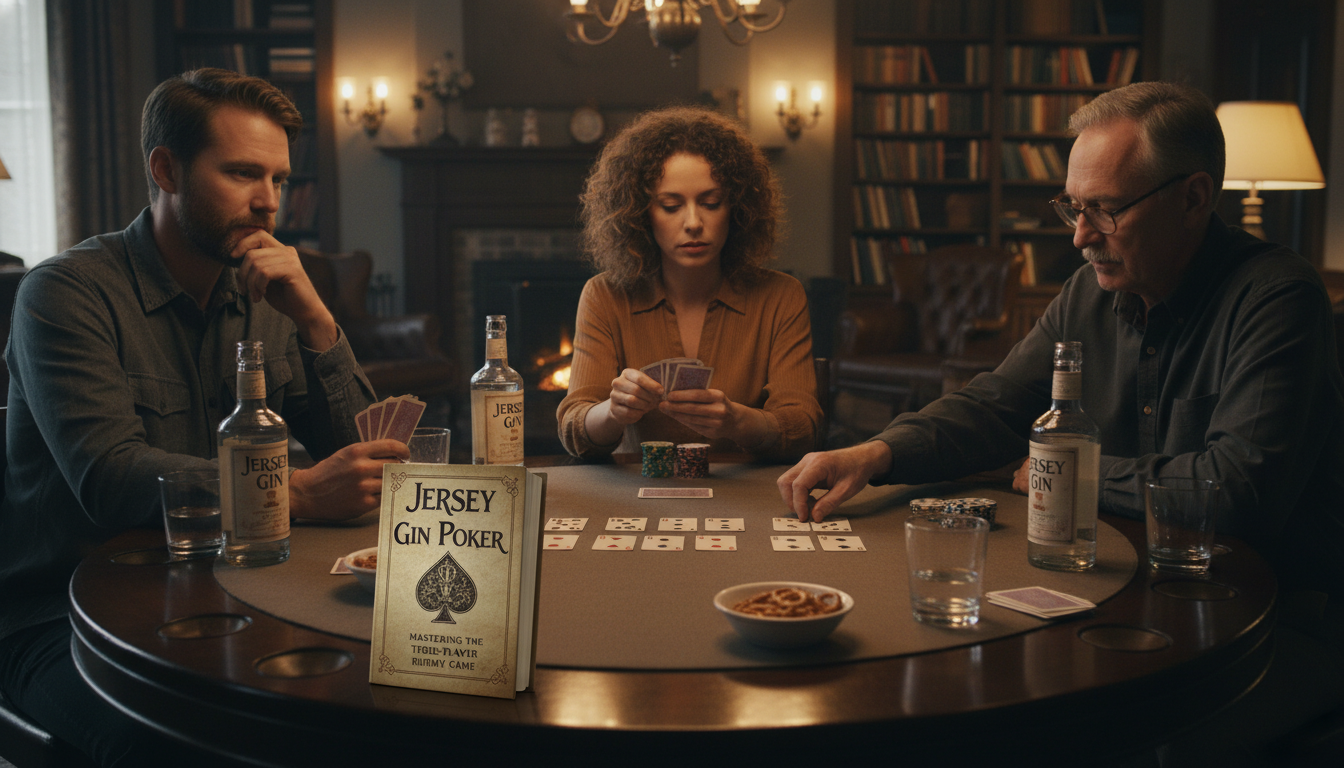
Jersey Gin Poker refers to a popular three-player adaptation of the classic Gin Rummy card game, not actually a poker variant despite its name. Originating in Jersey City, New Jersey, this strategic card game combines elements of standard Gin Rummy with unique rules designed specifically for three players. Jersey Gin Poker maintains the fundamental rummy mechanics of forming melds (sets of three or four of a kind, or sequences of three or more consecutive cards in the same suit), but introduces special gameplay elements like the “breaker” position and modified scoring to accommodate the third player. The game quickly gained popularity in political clubs and social settings throughout the 1930s after being documented by renowned card game expert John Scarne. Despite common misconceptions in the name, Jersey Gin Poker has no direct connection to poker games but remains a beloved strategic card game that challenges players with its unique three-way dynamics, requiring different strategies than traditional two-player Gin Rummy.
- Understanding the format: Jersey Gin is played with three people using a standard 52-card deck without jokers
- Key objective: Be the first to reach 100 points by forming melds and minimizing deadwood cards
- Unique element: The “breaker” role creates distinctive strategic opportunities not found in standard Gin
- Scoring basics: Players earn points from opponents’ deadwood when knocking, with special bonuses for gin hands
- Game flow: Continues through multiple hands until one player reaches the target score, typically 100 points
- Strategic depth: Requires different approach than two-player Gin due to the third opponent’s influence
- Digital availability: Can be played online through various card game platforms with proper Jersey Gin rules
Table of Contents
- History of Jersey Gin Poker
- Understanding the Card Basics
- Setup and Dealing Procedures
- Gameplay: Step-by-Step
- Knocking and Scoring in Jersey Gin
- The Break Concept Explained
- Complete Scoring Details
- Advanced Jersey Gin Strategy
- Comparison with Other Gin Variants
- Playing Jersey Gin Poker Online
- Common Mistakes to Avoid
- What Experts Say About Jersey Gin Poker
- Frequently Asked Questions
History of Jersey Gin Poker
Gin Rummy itself was invented by Elwood T. Baker and played by his family back in 1910. The game remained localized to New York until 1941 when it became popular in Hollywood and spread throughout the United States. Jersey Gin specifically emerged as a solution to the limitations of standard two-player Gin Rummy when three people wanted to play.
A Jersey politician brought it into wider recognition when he told game expert John Scarne that three-handed Gin was being played at several political clubs in Jersey City. As Scarne himself explained: “I drifted over and investigated it, and found first of all that the tossing game in that form was full of mathematical bugs. I’ve undertaken to correct these defects, and the result is the following great game, which I’ve taken the discoverer’s liberty of naming Jersey Gin.”
The Breaker Concept in Historical Context
The “breaker” position was a key innovation in Jersey Gin that distinguished it from previous three-player attempts. In traditional Gin Rummy, when the stock pile is exhausted, the hand ends. However, Jersey Gin introduced the “break” concept where play continues differently once the stock is reduced below a certain threshold. This innovation made the three-player format strategically sound and eliminated previous mathematical imbalances that existed in other three-player rummy games.
Evolution from Standard Gin Rummy
Gin Rummy evolved from 19th-century Whiskey Poker and was created with the intention of being faster than standard rummy but less spontaneous than knock rummy, according to card game historian John Scarne. Jersey Gin specifically built upon these foundations while addressing the mathematical inconsistencies that plagued earlier three-player adaptations:
- Corrected issues with scoring when three players participated
- Introduced the “breaker” role to create balanced gameplay
- Established clear procedures for when the stock runs low
- Maintained the strategic depth while accommodating an additional player
“Many card players want to learn new games to play with their friends, but aren’t sure where to start. Jersey Gin solves this problem by providing a structured three-player alternative that maintains all the strategic elements of classic Gin Rummy while fixing previous mathematical flaws in three-player variants.”
Understanding the Card Basics for Jersey Gin Poker
Jersey Gin Poker uses a standard 52-card deck without jokers or wild cards. Understanding card values and combinations is essential for success in this game. The card deck doesn’t contain Jokers and follows standard playing card ranking from high to low: King, Queen, Jack, 10, 9, 8, 7, 6, 5, 4, 3, 2, Ace.
Card Values and Scoring Fundamentals
Each card in Jersey Gin Poker has specific point values that determine deadwood counts and scoring:
| Card Type | Point Value | Strategic Significance |
|---|---|---|
| Aces | 1 point each | Low deadwood value makes them less risky to hold |
| Number cards (2-10) | Face value | Higher number cards increase deadwood risk when held |
| Face cards (J, Q, K) | 10 points each | High deadwood value creates significant risk when held |
The deadwood count is the sum of the point values of the deadwood cards (cards not part of melds). This calculation is critical because it determines scoring when a player knocks. A player’s second win will be recorded in their columns for both Game One and Game Two, with specific scoring requirements for each victory.
Key Card Combinations in Jersey Gin
Jersey Gin Poker preserves the two primary meld types from standard Gin Rummy, with special considerations for three-player dynamics:
- Sets (or groups): Three or four cards of the same rank but different suits (e.g., 7♠ 7♥ 7♦)
- Sequences (or runs): Three or more consecutive cards of the same suit (e.g., 5♣ 6♣ 7♣)
Important limitations to remember:
- Intersecting melds are not allowed (if a card fits into multiple melds, you must choose one)
- You cannot make “round the corner” melds with Aces (K-A-2 is invalid)
- The Ace can only be played as high (A-K-Q) or low (A-2-3), never both ways in the same game
- Each card in hand counts against you if your opponent goes gin
Setup and Dealing Procedures for Jersey Gin Poker
Setting up for Jersey Gin Poker requires careful attention to the specific procedures for three players. The game begins with these precise steps:
Preparing for Play
- Use one standard 52-card deck with no jokers
- Ensure the deck is in excellent condition (avoid playing with an old or defaced pack)
- Have a scorekeeping method ready (paper and pencil)
- Determine the first dealer through a high card draw
Dealing Process
Jersey Gin Poker follows specific dealing protocols to ensure fair play:
- Any player shuffles the deck first, which must then be cut by another player
- The dealer deals ten cards to each player one at a time clockwise, starting with the player on the left
- Turn the top card of the remaining deck face-up to start the discard pile
- The remaining cards form the stock pile and are placed face down in the center
Protecting Against Crooked Deals
When playing Jersey Gin Poker, especially with unfamiliar players, it’s crucial to protect yourself against potential cheating:
| Common Cheating Method | How to Protect Yourself | Why It Matters in Jersey Gin |
|---|---|---|
| Bottom dealing | Shuffle the deck yourself before the dealer shuffles | Prevents manipulation of “breaker” position cards |
| Second dealing | Insist on the completion of the cut before the deal begins | Ensures fair distribution of cards for all three players |
| Stacked deck | Spread the stack fanwise to verify randomness | Maintains game integrity with three hands involved |
“John Scarne, the famous card game expert and mathematician who documented Jersey Gin, advised: ‘When you play Jersey Gin Poker, always reshuffle the deck when it’s offered to you for a cut. The best Gin player in the country doesn’t stand a winning chance against even the average Gin cheat.’ This precaution is even more critical in three-player games where collusion becomes a possibility.”
Gameplay: Step-by-Step in Jersey Gin Poker
Jersey Gin Poker follows a specific sequence of play that differs from standard two-player Gin Rummy due to the three-player format. Understanding this sequence is crucial for proper gameplay.
The Basic Turn Structure
- The player to the left of the dealer goes first
- Each turn proceeds clockwise around the table
- On each turn, a player must draw either the top card of the discard pile (face-up) or the top card of the stock pile (face-down)
- After drawing, the player must discard one card face-up to the discard pile
- The discarded card cannot be the same card just drawn (except under special circumstances)
The Breaker Position
The “breaker” is the most distinctive element of Jersey Gin Poker:
- The breaker is the first player to draw when the stock is reduced to three cards
- This player’s actions trigger the “break” phase of the game
- The breaker must lay their melds face up, while keeping deadwood concealed
- After the break, players cannot knock until they complete additional steps
Sequence of Play After the Break
- The breaker finishes their turn, laying melds face up and keeping deadwood covered
- The player to the breaker’s left must pick a card and may lay off on the breaker’s melds
- The third player also picks a card and must lay down their melds
- If cards remain in stock, it’s the breaker’s turn again to lay off on any meld
- This rotation continues until the stock is exhausted or someone knocks
Special Rules During Gameplay
Certain nuances exist in Jersey Gin Poker that players must understand:
- At the break and after, a player cannot pick an upcard unless it can be used in a meld
- The discard pile must remain square at all times; looking through discards is prohibited
- Players cannot knock immediately after the break; specific conditions must be met
- If two players other than the breaker tie for low deadwood, the player to the breaker’s left wins
Knocking and Scoring in Jersey Gin Poker
The strategic “knock” is central to Jersey Gin Poker gameplay and scoring. Understanding when and how to knock can make the difference between winning and losing.
Knocking Requirements
In standard Jersey Gin Poker:
- A player must have 10 or fewer points of deadwood to knock
- To knock, the knocking player discards as usual and announces knocking (typically by placing a discard face down)
- The hand is then laid out with melds clearly indicated and deadwood separated
- The knock value can be modified by specific variations (like Hollywood Gin)
“Timing is critical, and understanding the impact on scoring is essential for players to make informed decisions. However, knocking too soon risks penalties if opponents have fewer unmatched points. Deciding when to knock involves consideration of the unmatched points in your hand compared to your opponents.”
Scoring After a Knock
After a player knocks in Jersey Gin Poker:
- The knocking player receives points equal to the difference between deadwood counts
- The two players that didn’t knock may reduce their deadwood by adding cards to opponents’ melds (“laying off”)
- The result is the number of points the knocking player receives from each opponent
- Special bonuses apply for gin hands or undercuts
Example calculation: If the knocking player has 7 deadwood points, opponent A has 15 points (after laying off), and opponent B has 12 points, the knocker scores (15-7) + (12-7) = 13 points total.
Going Gin: The Ultimate Scoring Move
When a player goes gin (knocks with zero deadwood):
- The player scores a gin bonus (typically 25 points)
- Plus the total value of all unmelded cards in each opponent’s hand
- Total gin bonus is 50 points (25 from each opponent) plus both opponents’ deadwood
- The knocking player can never lay off deadwood into defending players’ melds
Underknock Situations
An undercut occurs in Jersey Gin Poker when:
- A player knocks and the defending player’s deadwood points are less than or equal to the knocker’s
- The defending player receives an undercut bonus (usually 25 points)
- Plus the difference in deadwood points between the players
- If two players score an underknock, only one can be legally declared the under-knocker
The Break Concept Explained in Jersey Gin Poker
The “break” is the most distinctive rule in Jersey Gin Poker that differentiates it from standard Gin Rummy. It occurs when the stock is reduced to exactly three cards and fundamentally changes gameplay.
Break Mechanics
When Jersey Gin Poker reaches the break phase:
- Instead of the stock being reduced to zero cards, the break occurs at three cards remaining
- The next player to draw is called the “breaker”
- The breaker must finish their turn, laying melds face up while keeping deadwood covered
- Players cannot knock after the break until specific conditions are met
- If there are still cards left in the stock, it’s the breaker’s turn again to lay off on any meld
Strategic Implications of the Break
The break phase creates unique strategic considerations:
- Players must adjust strategy as the game approaches the break
- The breaker gains positional advantage but also increased risk
- Deadwood management becomes more critical as the break approaches
- Players must watch opponents’ discards more carefully to track cards
Completing Play After the Break
After the break in Jersey Gin Poker:
- The player to the breaker’s left must pick a card and may lay off on the breaker’s melds
- The third player also picks a card and must lay down their melds, and may lay off on both other players
- If cards remain, the breaker’s turn comes again to lay off on any meld
- Should two players score an underknock, only one can be declared the under-knocker
- If two players other than the breaker tie for low, the player to the breaker’s left wins
“According to card game expert Arnold Snyder, who has written extensively about rummy variants: ‘In Jersey Gin Poker, the break phase is when many players make critical mistakes. Watch how your opponents react when the stock nears three cards – their behavior can reveal their deadwood count. The player who best manages their deadwood through the break will win more games than the player with the best starting hand.'”
Complete Scoring Details for Jersey Gin Poker
Jersey Gin Poker uses a sophisticated scoring system that rewards strategic play while penalizing poor deadwood management. Understanding this system is essential for competitive play.
Base Scoring System
Jersey Gin Poker scoring follows these fundamental principles:
| Scoring Event | Points Awarded | Example Calculation |
|---|---|---|
| Regular knock (7 deadwood) | Difference in deadwood counts | Opponent has 15 deadwood: 15-7 = 8 points |
| Going gin | 25 + opponent’s deadwood | First opponent: 25 + 10 = 35 points |
| Big gin (11 cards) | 31 + opponent’s deadwood | Second opponent: 31 + 8 = 39 points |
| Undercut | 25 + difference in deadwood | Opponent knocks with 7, you have 5: 25 + 2 = 27 points |
Bonus Points
Jersey Gin Poker includes several bonus structures:
- Box Bonus: Each player must score 25 points for each hand that they won
- Game Bonus: Awarded when completing all required hands in a game
- Underknock Bonus: 10-point bonus plus normal knock scoring
- Round Scoring: Points accumulate across hands until reaching target score (usually 100)
Hollywood Scoring Variation
A popular Jersey Gin Poker variation uses Hollywood scoring:
- Scoring is kept for three different games simultaneously
- Game One: Standard scoring as described above
- Game Two: Card count bonuses (1 point per card in long sequences)
- Game Three: Special bonuses for face cards in sequences
- Once all three games are finished, totals are added together for final score
Tie-Breaking Procedures
Jersey Gin Poker has specific rules for resolving ties:
- If there’s a tie to hold the breaker position, the breaker wins the tie
- If the other two players tie for low deadwood, the player to the left of the breaker wins
- When two players tie after knock, the player to the knocker’s left wins
- First win is recorded in Game One column, second win in both Game One and Two
Advanced Jersey Gin Strategy for Three-Player Action
Mastering Jersey Gin Poker requires more than understanding the rules; players must develop specialized strategies for the three-player dynamic that differ significantly from traditional two-player Gin Rummy.
Fundamental Strategic Principles
Successful Jersey Gin Poker players adhere to these core strategic principles:
- Careful card tracking: Monitor which cards have been discarded to calculate probabilities
- Deadwood minimization: Keep your potential deadwood count below 10 points to maintain knock options
- Break preparation: Adjust strategy as the game approaches the break phase at three stock cards
- Bluff management: Sometimes keep high deadwood when others seem close to knocking
- Risk assessment: Weigh the risk of knocking against potential undercut penalties
Strategic Discard Management
Your discard choices reveal critical information in Jersey Gin Poker:
- Early in the game, discard cards ranking one or two away from opponent’s previous discards
- Avoid discarding potentially valuable cards like 7s (the most versatile melding card)
- Discard high-value cards (face cards) when possible to minimize deadwood risk
- Watch opponents’ pickup patterns to deduce their meld needs
Optimal Knocking Strategy
Deciding when to knock in Jersey Gin Poker involves careful analysis:
| Knock Timing | Advantages | Risks | Recommended When |
|---|---|---|---|
| Early knock (7-10 deadwood) | Catches opponents with high deadwood | Vulnerable to undercut | Opponents appear to be building long sequences |
| Mid-game knock (4-6 deadwood) | Good balance of safety and reward | May miss opportunity for gin | Confident in opponent’s high deadwood count |
| Late knock (0-3 deadwood) | High scoring potential | Risk of opponent going gin first | Close to gin but opponents show weakness |
| Going gin | Maximum points plus bonus | Exposes your meld pattern | Confident opponents have high deadwood counts |
Advanced Three-Player Tactics
Jersey Gin Poker requires unique considerations due to the third player:
- When to lay off cards on which opponent’s melds for maximum strategic benefit
- Understanding the positional advantage of being to the left of the breaker
- Recognizing when two opponents might temporarily align against you
- Adapting strategy when approaching the critical break phase
Daniel Negreanu, renowned professional poker player and card game strategist, notes: ‘While Jersey Gin isn’t poker, the psychological elements are similar. Watch your opponents’ physical reactions when the stock reaches seven cards – their tension will reveal how close they are to knocking. And remember: in three-player Jersey Gin, the player who talks the most about their ‘great hand’ is usually the one with the highest deadwood count. Silence often equals strength.'”
Comparison with Other Gin Variants
Jersey Gin Poker sits within a broader ecosystem of Gin Rummy variants, each with distinct rules, strategies, and purposes. Understanding these differences helps players appreciate Jersey Gin’s unique position.
Jersey Gin vs. Standard Gin Rummy
Key differences between these two popular variants:
| Feature | Jersey Gin Poker | Standard Gin Rummy |
|---|---|---|
| Number of players | Three players required | Two players only |
| Stock exhaustion | Game doesn’t end when stock runs out | Game ends if stock runs out |
| Break phase | Occurs at three stock cards remaining | No break phase |
| Scoring structure | Three simultaneous games in Hollywood scoring | Single game scoring |
| Knocking rules | Modified after break phase | Consistent throughout game |
Jersey Gin vs. Oklahoma Gin
Oklahoma Gin modifies the knock threshold based on the first upcard. Jersey Gin preserves standard knock values but adds three-player mechanics:
- Oklahoma Gin bases knock value on first upcard (e.g., 4 means knock at 4 or below)
- Jersey Gin uses standard 10-point knock threshold, regardless of upcard
- Both games prohibit “round the corner” melds (K-A-2)
- Jersey Gin includes the unique breaker position not found in Oklahoma
- Jersey Gin’s Hollywood scoring adds multi-column point tracking
Jersey Gin vs. Straight Gin
Straight Gin requires players to go gin (zero deadwood) to win, which significantly alters strategy:
- Straight Gin players must play until one can go gin (no knocking)
- Jersey Gin allows knocking with 10 or fewer deadwood points
- Straight Gin has longer, higher-stakes hands
- Jersey Gin offers more opportunities for strategic knocking
- Both games use the same card values and meld definitions
Playing Jersey Gin Poker Online
The digital revolution has brought Jersey Gin Poker to players worldwide through various online platforms, though finding sites with proper Jersey Gin rules can be challenging.
Top Platforms for Jersey Gin Poker
Several reputable sites offer Jersey Gin Poker or close variants:
| Platform | Jersey Gin Availability | Player Base | Distinguishing Features |
|---|---|---|---|
| CARDGAMES.IO | Standard Gin Rummy | Global, casual players | Simple interface, no registration required |
| Partypoker | Poker focus, no Jersey Gin | 250,000+ monthly players | Dedicated poker tournaments, not rummy games |
| RummyCircle | Indian variants, some Jersey-like | Strong in India/South Asia | Specialized rummy platform |
| Local card clubs | Custom Jersey Gin tables | Region-specific | Players often create custom Jersey Gin rooms |
Finding Authentic Jersey Gin Rules Online
Many online platforms claim to offer Jersey Gin Poker but actually provide standard Gin Rummy for two players. To ensure you’re playing proper Jersey Gin:
- Confirm the platform explicitly supports three-player games
- Check for the “break” rule when stock reaches three cards
- Verify the scoring system includes simultaneous game tracking
- Look for specific reference to John Scarne’s rules in the documentation
- Join discussion forums to get recommendations from experienced players
Creating a Jersey Gin Room Online
If proper Jersey Gin Poker isn’t readily available:
- Look for platforms that allow custom room creation
- Set game parameters to accommodate three players
- Configure house rules to include the break at three stock cards
- Establish clear scoring protocols following Scarne’s guidelines
- Invite friends to join your custom Jersey Gin Poker room
Common Mistakes to Avoid in Jersey Gin Poker
Even experienced card players make critical errors when first trying Jersey Gin Poker due to its unique three-player dynamics and special rules.
Strategic Missteps
Avoid these common Jersey Gin Poker strategy errors:
- Ignoring the break phase: Failing to adjust strategy as the stock approaches three cards
- Discarding valuable 7s: The seven is the most versatile melding card in the deck
- Misjudging knock timing: Knocking too early or waiting too long for gin
- Overlooking opponent patterns: Not tracking which cards others are picking/discarding
- Poor deadwood management: Holding high-value cards too long when knock is possible
Rule Misunderstandings
Many players incorrectly apply standard Gin Rummy rules to Jersey Gin Poker:
| Misconception | Reality | Why It Matters |
|---|---|---|
| Game ends when stock runs out | Game continues through the break phase | Affords additional strategic opportunities after break |
| Same knock rules throughout game | Special knock restrictions after break | Requires adjusted endgame strategy |
| Normal laying off rules apply | Modified laying off sequence after break | Changes scoring potential significantly |
| Standard two-player scoring | Hollywood scoring with three simultaneous games | Alters long-term strategic thinking |
Advanced Player Errors
Even experienced players fall victim to these subtle Jersey Gin Poker mistakes:
- Breaker overconfidence: The breaker position creates a false sense of advantage
- Misreading opponent coordination: Two opponents may temporarily cooperate against the leader
- Incorrect deadwood calculations: Especially critical during close scoring situations
- Improper Hollywood scoring: Mixing point totals between the three game columns
- Tie-break misunderstandings: Incorrectly applying tie-resolution protocols
What Experts Say About Jersey Gin Poker
Jersey Gin Poker has attracted attention from notable card game experts and professional players who recognize its strategic depth and historical significance in the world of card games.
John Scarne, the legendary card game authority who documented and refined Jersey Gin, observed: “I drifted over and investigated it, and found first of all that the tossing game in that form was full of mathematical bugs. I’ve undertaken to correct these defects, and the result is the following great game, which I’ve taken the discoverer’s liberty of naming Jersey Gin.” Scarne viewed Jersey Gin as a significant improvement over previous three-player attempts at Gin Rummy, which often suffered from scoring imbalances.
Card game historian David Parlett, while skeptical of Scarne’s attribution of Gin Rummy’s origins, acknowledges Jersey Gin’s merit: “While I find Scarne’s theory about Gin’s development to be highly implausible, the Jersey Gin variation demonstrates thoughtful consideration of how to adapt standard two-player mechanics to three players without compromising strategic integrity.”
Even poker legend Stu Ungar, renowned for his exceptional skills in both poker and Gin Rummy, understood Jersey Gin’s significance. Though Ungar focused primarily on two-player Gin matches early in his career, he recognized Jersey Gin’s role in the game’s evolution: “Back when I was making my living at Gin in New York, I saw Jersey Gin being played at various political clubs. It wasn’t the game I mastered, but I respected its complexity and the way it preserved the strategic heart of Gin while adapting to three players.
Mathematician Arnold Snyder, who has analyzed card game probabilities extensively, notes: “Jersey Gin solves the three-body problem of Gin Rummy. Standard Gin is a perfect two-player game, but adding a third player fundamentally changes the probability calculations. The break rule and Hollywood scoring create an elegant solution that maintains competitive balance while preserving the core strategic elements that make Gin so compelling.”
Frequently Asked Questions About Jersey Gin Poker
What is Jersey Gin Poker, and how is it different from regular poker?
Despite the name, Jersey Gin Poker is not actually a poker variant but rather a three-player adaptation of Gin Rummy. It uses standard playing cards but follows rummy-style mechanics of forming sets and sequences rather than poker’s hand ranking system. The “poker” in the name is a historical misnomer that has persisted, but the game has no connection to Texas Hold’em, Omaha, or other poker variants.
How many players are required for Jersey Gin Poker?
Jersey Gin Poker specifically requires exactly three players. This distinguishes it from standard Gin Rummy, which is strictly a two-player game. The three-player structure is fundamental to Jersey Gin’s unique rules, particularly the “breaker” position and modified scoring.
What happens during the “break” in Jersey Gin Poker?
The break occurs when the stock pile is reduced to exactly three cards. Instead of the game ending when the stock runs out (as in standard Gin), Jersey Gin has specific procedures: the next player becomes the “breaker,” lays down their melds while keeping deadwood concealed, and the game continues with modified rules. Players cannot knock immediately after the break and must follow a specific sequence for laying off cards.
Can Jersey Gin Poker be played with Hollywood scoring?
Yes, Hollywood scoring is a popular variation for Jersey Gin Poker. It involves tracking three separate games simultaneously: Game One uses standard scoring, Game Two awards bonuses for long sequences (1 point per card), and Game Three provides bonuses for face cards in sequences. Once all columns are completed, scores are added together for the final result.
How do you deal with an undercut in Jersey Gin Poker?
An undercut occurs when a player knocks but has deadwood equal to or higher than an opponent’s. The defending player receives an undercut bonus (typically 25 points) plus the difference in deadwood points. If two players undercut the knocker, only one can be legally declared the under-knocker, with specific tie-breaking rules determining which player receives the bonus.
What’s the best strategy for the breaker position in Jersey Gin Poker?
When you become the breaker (first to draw when stock reaches three cards), your optimal strategy includes: completing your most valuable melds first, retaining flexibility in your deadwood cards, watching opponents’ reactions closely, carefully selecting which cards to lay off on opponents’ melds, and positioning yourself to take advantage of the special post-break gameplay sequence. Many experts consider the breaker position both powerful and vulnerable.
Do I need special cards to play Jersey Gin Poker?
No, Jersey Gin Poker uses a standard 52-card deck with no jokers. The card deck doesn’t contain Jokers and follows standard playing card rankings from high to low: King, Queen, Jack, 10 through 2, with Ace counting as 1 point for scoring purposes. Many players prefer using two decks with different colored backs to simplify scorekeeping in Hollywood scoring variations.
How does Jersey Gin Poker handle ties?
Jersey Gin Poker has specific tie-breaking rules: if there’s a tie for the breaker position, the breaker wins the tie; if two players other than the breaker tie for lowest deadwood count, the player to the breaker’s left wins; and when scoring after a knock, certain scoring columns may produce ties that follow similar positional resolution principles. These protocols prevent scoring disputes that could arise in three-player competition.
What’s the minimum deadwood required to knock in Jersey Gin Poker?
Like standard Gin Rummy, Jersey Gin Poker requires players to have 10 or fewer points of deadwood to knock. However, certain variations like Oklahoma Gin modify this threshold based on the first upcard, while Straight Gin eliminates knocking entirely and requires going gin (zero deadwood) to win the hand.
Can I play Jersey Gin Poker online with the correct rules?
While many platforms offer standard Gin Rummy for two players, finding authentic Jersey Gin Poker online can be challenging. Some specialized rummy sites and customizable card game platforms allow players to set up Jersey Gin rooms with proper three-player rules, break mechanics, and Hollywood scoring. CARDGAMES.IO offers standard Gin Rummy but not the specific three-player Jersey Gin variant with its unique break rule.
