
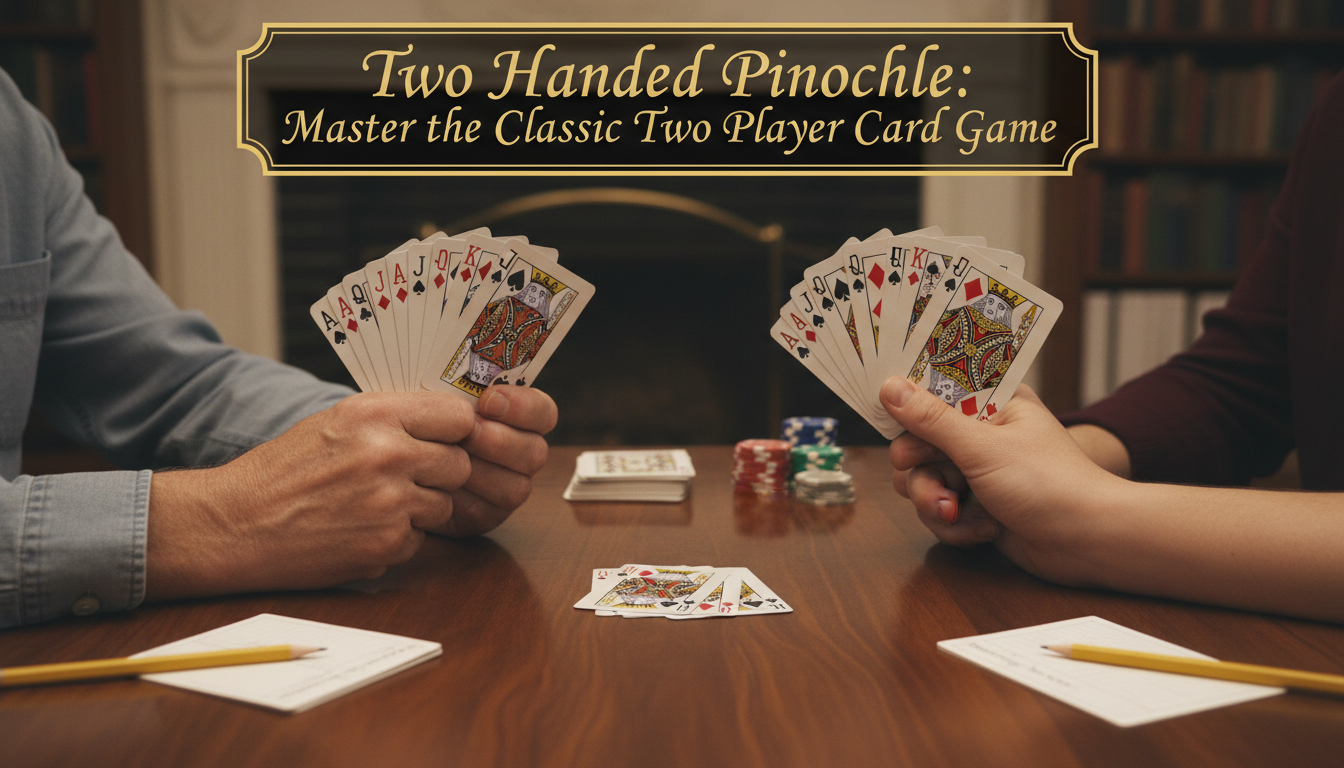
Two handed pinochle is the original and most fundamental version of this beloved card game, played exclusively between two opponents using a specialized 48-card deck. This strategic trick-taking game combines elements of bidding, melding specific card combinations, and tactical play to accumulate points. Unlike partnership variations, two handed pinochle requires players to rely solely on their individual skills without the advantage of a partner. The game features a partial deal of twelve cards to each player, with the remaining 24 cards forming a stockpile that players draw from during gameplay. During the critical bidding phase, players compete to determine who will declare trump, then proceed through a melding phase where valuable card combinations are scored before entering the trick-taking stage. With its perfect balance of skill and strategy, two handed pinochle has maintained popularity for generations and remains one of the most challenging yet rewarding two-player card games available.
Key Takeaways
- Two handed pinochle is played with 12 cards dealt to each player from a specialized 48-card deck
- The remaining 24 cards form a stockpile that players draw from after each trick
- Bidding determines who becomes the declarer and selects the trump suit
- Melding phase occurs before trick-taking, where specific card combinations score points
- Trump cards beat cards of any other suit during trick-taking
- Scoring involves both meld points and points from captured cards
- Advanced strategies include careful bid calculation, optimal meld selection, and trump management
- The standard winning score is typically 1,000 points, though casual games often use 500
Table of Contents
- What is Two Handed Pinochle?
- Understanding the Pinochle Deck
- Equipment Needed to Play Two Handed Pinochle
- Setting Up the Game
- The Deal in Two Handed Pinochle
- Bidding Process Explained
- Melding Phase and Valid Melds
- Trick-Taking Phase
- Scoring System
- Essential Rules for Two Handed Pinochle
- Advanced Strategies to Win Two Handed Pinochle
- Common Mistakes to Avoid
- Two Handed Pinochle vs. Other Variations
- What Experts Say About Two Handed Pinochle
- Frequently Asked Questions
What is Two Handed Pinochle?
Two handed pinochle represents the original form of this classic card game from which all partnership, auction, and other variants have been derived. Originally developed from the German game Binokel (itself derived from Bezique), this two-player version maintains the core mechanics that make pinochle unique among trick-taking games. Unlike standard card games that use a traditional 52-card deck, pinochle employs a specialized 48-card deck with two copies of each card from 9 through Ace in all four suits.
The allure of two handed pinochle lies in its perfect balance between complexity and accessibility. While beginners can learn the basic mechanics within minutes, mastering the strategic depth requires years of practice and analysis. Joe Andrews, recognized as the master of most trick-taking games and author of various books for the U.S. Playing Card Company, explains: “Two handed pinochle is the purest form of the game where your decisions directly impact your success without the variable of partner play.
“Most players underestimate the importance of maintaining voids in non-trump suits during two-handed pinochle. By strategically eliminating one or two suits from your hand early through careful card selection in your melds, you can force your opponent to either waste their trump cards or allow you to win tricks with lower-value cards. This tactical void creation often makes the difference between a successful bid and being set.”
— Joe Andrews, Author of ‘Winning Pinochle Strategies
Understanding the Pinochle Deck
The pinochle deck is unique among card games, consisting of 48 cards rather than the standard 52. It contains two copies of each card from 9 through Ace in all four suits (spades, hearts, diamonds, and clubs). This duplication creates opportunities for special melds like “arounds” (one of each face card across all suits) and double combinations that simply wouldn’t be possible with a standard deck.
Unlike traditional card games where suits carry equal value, pinochle assigns specific point values to cards that differ from conventional ranking:
| Card | Point Value | Notes |
|---|---|---|
| Ace | 11 points | Most valuable card in trick scoring |
| 10 | 10 points | Second most valuable trick card |
| King | 4 points | Important for marriages and scoring |
| Queen | 3 points | Used in pinochle meld and marriages |
| Jack | 2 points | Part of pinochle meld with queen |
| 9 | 0 points | Often called “duds” due to no point value |
This unusual point distribution creates strategic considerations unseen in other trick-taking games. For example, the 10 becomes the second most valuable card in the deck for scoring points in tricks, while the 9 serves primarily as a filler card with tactical implications.
Equipment Needed to Play Two Handed Pinochle
To play two handed pinochle, you’ll need:
- A standard pinochle deck (48 cards as described above)
- Paper and pencil for scorekeeping, or a traditional wooden pinochle scorekeeper
- A flat surface for playing
- Two players (obviously!)
Optional equipment includes:
- A card shuffling machine for faster gameplay
- A designated “meld area” for placing scored combinations
- Chip counters for gambling variants
It’s worth noting that many experienced players use a simplified scoring system where trailing zeros are dropped (e.g., 150 becomes 15), which speeds up game play and record keeping. This practice stems from the fact that all scores in pinochle are multiples of 10.
Setting Up the Game
Before dealing the cards, players must determine who deals first. This is typically done by dealing one card to each player from a shuffled deck, with the player receiving the highest card becoming the dealer. In pinochle, card ranking for this purpose is Ace (high), 10, King, Queen, Jack, and 9 (low) in each of the four suits.
Once the dealer is determined, shuffle the deck thoroughly and prepare to deal. The dealer may give the deck one last shuffle before beginning the deal. For formal games, it’s customary to allow the non-dealer to cut the deck before dealing.
Two handed pinochle follows a specific dealing pattern designed to maintain the strategic balance of the game:
- The dealer gives 12 cards to each player, non-dealer first
- Cards are dealt in packets of three or four at a time (never singly)
- The remaining 24 cards form the stockpile
- Place the stockpile face down between the players
After dealing, the non-dealer has the privilege of making the first bid in the bidding phase that follows.
The Deal in Two Handed Pinochle
The deal in two handed pinochle follows a precise pattern that maintains the strategic balance inherent to the game. Unlike some trick-taking games where cards are dealt singly, pinochle requires cards to be dealt in packets. This prevents players from gaining insights about their opponents’ potential holdings through the dealing pattern.
When dealing, the dealer must:
- Deal cards clockwise, beginning with the non-dealer
- Deal in packets of three or four cards at a time
- Complete the deal without interruption
- Maintain careful control of the deck until completely dealt
One common error among beginners is misdealing, which occurs when two cards stick together or when an incorrect number of cards is dealt to a player. The rules for dealing errors vary, but typically:
- If discovered before bidding begins, the hand is redealt
- If discovered during bidding, the hand may continue but with potential scoring adjustments
- Some variants require the entire round to be voided
After the deal is completed correctly, each player has 12 cards and the stockpile contains 24 cards that will be drawn from during the trick-taking phase.
Bidding Process Explained
Bidding is the heart of pinochle strategy, determining who becomes the declarer and selects the trump suit. In two handed pinochle, the bidding process begins with the non-dealer and proceeds clockwise to the dealer. The opening bid is typically 150, but can be higher depending on house rules or player agreement.
During the bidding phase:
- Each player silently evaluates their hand’s meld potential and trick-winning capacity
- The non-dealer makes the first bid or passes if they have less than 20 meld points
- Players must bid in increments of 10 points (e.g., 150, 160, 170)
- Each subsequent bid must be higher than the previous one
- A player may pass but cannot re-enter the bidding once they’ve passed
The highest bidder wins the auction, becomes the declarer, and gains the right to:
- Declare the trump suit
- Take the top card from the stockpile (in some variations)
- Determine the strategy for melding and trick-taking
A bidding novice might be tempted to bid conservatively, but strategic players understand that aggressive bidding can force opponents into difficult positions. Anthony Collins, champion pinochle player and author of “Winning Pinochle Strategies,” explains: “In two handed pinochle, understanding when to push the bidding beyond conventional wisdom often separates winners from losers. Many players fail to recognize that your bid isn’t just about your hand strength, but also about your opponent’s potential weaknesses.”
“In two-handed pinochle, the most overlooked strategic element is the psychological impact of bidding patterns. Instead of always bidding in standard increments, occasionally jumping 30 or 40 points above the previous bid disrupts your opponent’s mental calculations. This forces them to either overcommit with a risky bid or pass when they might have had a winning hand. Most players don’t realize how much their bidding rhythm reveals about their hand strength.”
— Anthony Collins, National Pinochle Association Member
After the winning bid is established, the declarer must attempt to score at least that many points through melds and tricks combined. If successful, they add their bid amount to their score; if unsuccessful (being “set”), the bid amount is subtracted from their score.
Melding Phase and Valid Melds
The melding phase occurs immediately after the bidding concludes and before trick-taking begins. This is when players publicly display and score specific card combinations that represent the unique character of pinochle compared to other trick-taking games.
In two handed pinochle, the winner of the bid (the declarer) has the privilege of melding first. Each player must display all valid melds they hold, with points scored immediately. Cards used in melds remain available to be played in tricks unless they’ve been set aside as discards.
Common Meld Categories in Two Handed Pinochle
Pinochle has three primary classes of melds, and a card can be part of more than one meld of different classes but only a single meld of a given class. The main meld categories include:
- Arounds (one of each face card across all suits)
- Marriages (King and Queen of the same suit)
- Runs (Ace, 10, King, Queen, Jack of the trump suit)
Here’s a comprehensive table of standard pinochle meld combinations and their point values:
| Meld Type | Card Combination | Simplified Score | Standard Score |
|---|---|---|---|
| Pinochle | Queen of Spades + Jack of Diamonds | 4 | 40 |
| Double Pinochle | Two Queens of Spades + Two Jacks of Diamonds | 30 | 300 |
| Marriage | King + Queen (same non-trump suit) | 2 | 20 |
| Marriage in Trump | King + Queen (trump suit) | 4 | 40 |
| Jacks Around | One Jack from each suit | 4 | 40 |
| Kings Around | One King from each suit | 8 | 80 |
| Queens Around | One Queen from each suit | 6 | 60 |
| Aces Around | One Ace from each suit | 10 | 100 |
| Run in Trump | A, 10, K, Q, J of trump suit | 15 | 150 |
| Double Run | Two complete runs in trump suit | 150-250 | 1500-2500 |
One critical rule many beginners miss is that a card can be used in multiple melds as long as they’re of different types. For example, the King of Spades could be part of a Royal Marriage (when spades are trump) and also part of Kings Around. However, the same card cannot be counted twice in the same meld type.
Trick-Taking Phase
Following the melding phase, the trick-taking portion of two handed pinochle begins. This phase determines the majority of points for the hand, as players compete to capture valuable cards through strategic play.
The trick-taking process follows these fundamental rules:
- The non-dealer leads the first card to the first trick
- Players must follow suit if possible
- If unable to follow suit, players must play a trump card if possible
- If unable to follow suit or trump, players may play any card
- The highest card of the suit led wins the trick, unless trumped
- The winner of each trick leads the first card of the next trick
- After each trick, both players draw from the stockpile, starting with the trick winner
Unlike many trick-taking games, two handed pinochle has a unique element where the leader of a trick isn’t required to play a trump to win a trick once trump has been established. This creates interesting strategic opportunities where a player might deliberately lead with a non-trump suit to bait opponents into wasting valuable trump cards.
One particularly important rule: when another suit is led, the card led wins the trick (unless a higher card of the same suit or a trump is played). When trump is led, it wins the trick (unless a higher trump is played). This creates strategic depth in how players choose which cards to lead with during gameplay.
Failing to follow suit when able is called a “renege” and carries significant penalties if detected. Reneges can be established anytime after a trick is finished and before the next card is played, with consequences typically including automatic loss of the bid for the offending player.
Scoring System
Pinochle’s scoring system combines meld points with trick points for a comprehensive assessment of each hand’s value. Unlike many card games that focus solely on trick-taking, pinochle rewards both strategic meld formation and tactical trick capture.
Scoring From Tricks
After meld points are counted, players score points for cards captured in tricks using this system:
- Ace: 11 points
- 10: 10 points
- King: 4 points
- Queen: 3 points
- Jack: 2 points
- 9: 0 points
Additionally, the player who wins the last trick scores an extra 10 points. There are 250 total points available in the trick phase (240 from captured cards plus 10 for the last trick).
“One of the most misunderstood aspects of pinochle scoring is the relationship between meld points and trick points. Many players focus exclusively on high-scoring melds, but forget that 250 points are available in tricks alone. In two-handed pinochle, I never bid based solely on my meld points—always calculate both your potential trick points and your opponent’s likely trick points to determine whether a bid is truly makeable.”
— Tobor Leigh, Founder of The Cambridge Pinochle Association
Scoring Summary Table
| Category | Maximum Points | Notes |
|---|---|---|
| Meld Points | ~1,000+ | Highly variable based on hand strength |
| Trick Points (Cards) | 240 | Fixed value (A=11, 10=10, K=4, Q=3, J=2) |
| Last Trick Bonus | 10 | Fixed value |
| Total Possible | ~1,250+ | Combined meld and trick points |
The typical winning score for a game of two handed pinochle is 1,000 points, though casual games often use 500 points for quicker play. Many experienced players use a simplified scoring system where trailing zeros are dropped (e.g., 150 becomes 15) to speed up game play and record keeping.
Essential Rules for Two Handed Pinochle
Certain rules are fundamental to proper two handed pinochle gameplay. Understanding these core mechanics is essential for both beginners and experienced players who want to avoid common mistakes.
The Dix Rule
The Dix (pronounced “deece”) is the 10 of trump and represents a special meld opportunity. The holder of the dix has the right to exchange it, upon winning a trick, for the trump card that was turned up at the beginning of the hand. This exchange can be made only once per hand and only when winning a trick. When properly executed, the Dix meld scores 10 points.
Trump Rules
Trump cards beat cards of any other suit. When trump is played to a trick, it takes the trick unless a higher trump is played. Players must follow suit if possible, and if unable to follow suit, must play a trump if possible.
Card Ranking in Pinochle
Within each suit, cards rank from highest to lowest as:
Ace (high), 10, King, Queen, Jack, 9 (low)
This unusual ranking (with the 10 ranking above the King) is critical to understanding trick-taking dynamics in pinochle.
Game End Conditions
The standard game ends when one player reaches 1,000 points. However, there are specific conditions that can affect game completion:
- If both players reach 1,000+ points in the same hand, the higher scorer wins
- If scores are tied at or above 1,000, additional hands are played
- Some variations include a “shoot the moon” option (taking all tricks)
- Games can also end if a player is “set” below zero (in some variants)
Advanced Strategies to Win Two Handed Pinochle
Mastering two handed pinochle requires understanding not just the rules, but the nuanced strategies that separate casual players from serious competitors. Here are several advanced techniques:
Bidding Strategy
Successful bidding requires accurately assessing both your meld potential and your trick-taking ability. A good rule of thumb is to bid approximately 100 points higher than your meld points, recognizing that you’ll typically score around 150 points from tricks. However, this baseline must be adjusted based on:
- Trump suit strength (number of trump cards held)
- Balanced distribution across suits
- Presence of high-value meld combinations
- Opponent’s likely hand strength based on bidding
Meld Optimization
Choosing which melds to display can significantly impact your trick-taking ability:
- Prioritize high-scoring melds that don’t weaken your trick-taking potential
- Avoid melding cards that would create voids in suits you need for tricks
- Consider hiding some meld combinations to strengthen trick-taking positions
- Save marriage melds in non-trump suits for later in the hand when they might become more valuable
Trick-Taking Tactics
Advanced trick-taking involves several strategic considerations:
- Lead with lower-value cards in suits where you hold strength to preserve high cards
- Trap your opponent’s high cards by leading strong suits when they’re likely void
- Manage your trump cards carefully—don’t exhaust them early unless necessary
- Track which high cards have been played to anticipate remaining strength
- Force your opponent to lead suits where you hold strength
The Stockpile Strategy
Since players draw from the stockpile after each trick, pay attention to card distribution:
- The player winning the trick draws first, giving them a slight advantage
- Plan your play based on expected card draws from the stockpile
- Track which cards have been played to predict likely draws
- Consider how your meld choices affect the timing of valuable card draws
Common Mistakes to Avoid
Even experienced card players new to pinochle often make these common errors:
Overbidding Based Solely on Meld Points
Many beginners calculate only their meld points and bid accordingly, forgetting that trick points constitute over half the available points in a hand. Remember that 250 points are always available in the trick phase.
Misunderstanding Card Rankings
Forgetting that the 10 ranks above the King in pinochle leads to poor trick-taking decisions. This unusual ranking is fundamental to pinochle strategy.
Inefficient Meld Selection
Displaying melds without considering how they weaken your trick-taking position. For example, melding all your Kings might score points but leave you vulnerable in trick-taking.
Trump Card Mismanagement
Using trump cards too early or too conservatively. Finding the right balance is crucial for victory in two handed pinochle.
Neglecting the Dix Opportunity
Many players forget about the Dix potential until it’s too late. Tracking the trump suit and planning for the Dix exchange can provide critical bonus points.
- Expert Tip: “When holding the Dix, plan your trick-taking strategy around the optimal moment to exchange it. Don’t assume you must exchange immediately—you might gain more advantage by waiting until later in the hand when the exchange provides maximum strategic benefit.” (Walter B. Gibson)
Two Handed Pinochle vs. Other Variations
While two handed pinochle is the original version, several variations exist for different numbers of players:
| Feature | Two Handed | Partnership (4-player) | Cutthroat (3-player) | Double-Deck (4+ players) |
|---|---|---|---|---|
| Deck Type | Single deck (48 cards) | Single deck (48 cards) | Single deck (48 cards) | Double deck (80 cards) |
| Cards per Player | 12 | 12 | 15 | 20 |
| Minimum Bid | 150 | 250 | 150 | 500 |
| Winning Score | 1,000 | 1,000 | 1,000 | 1,500+ |
| Partner Communication | None | Significant | Minimal (solo play) | Significant |
| Stockpile | 24 cards | None | None | None |
| Special Feature | Drawing from stock | Card exchange with partner | Widow/kitty selection | Larger meld potential |
Two handed pinochle stands apart from other variations due to its unique stockpile mechanism, where players draw from the remaining cards after each trick. This creates a dynamic where the game state evolves as new cards enter players’ hands, adding strategic depth not found in partnership or cutthroat versions.
Key Differences Impacting Strategy
When transitioning from two handed to other pinochle variations, players should note these strategic adjustments:
- Information Flow: In two handed pinochle, you have less information about your opponent’s hand compared to partnership games where you can coordinate with a partner
- Meld Priority: Two handed prioritizes melds that maintain trick-taking strength, while double-deck emphasizes high-scoring melds due to reduced trick points
- Bidding Precision: Two handed requires more precise bidding since you’re solely responsible for making the contract
- Trump Management: Less critical in partnership games where you can rely on your partner’s strength
What Experts Say About Two Handed Pinochle
Walter B. Gibson, renowned magician, author, and pinochle expert from the 1970s, wrote extensively about two handed pinochle in his book “Pinochle, How to Play, How to Win” (1974). He emphasized the strategic depth of the two-player version, stating: “Two handed pinochle represents the purest form of the game where every decision directly impacts your success. Without the variable of partner play, you must master the complete strategic landscape to consistently win.
Tobor Leigh, founder of The Cambridge Pinochle Association and winner of numerous card tournaments, particularly praises the two-handed version for its balance of luck and skill: “What makes two handed pinochle special is how it reveals a player’s true ability. In partnership games, a strong partner can carry you through weak hands, but in two-handed, you’re completely exposed. It’s the ultimate test of pinochle mastery.”
Joe Andrews, recognized as an authority on trick-taking games and head of Grand Prix Tournaments—”The World Series of Pinochle”—notes the historical significance of the two-handed version: “Modern players often jump straight to partnership pinochle, but they’re missing the foundation. Two handed pinochle teaches all the core skills you need before adding the complexity of partner play. It’s how serious players develop their strategic thinking.”
Anthony Collins, champion pinochle player and National Pinochle Association member, emphasizes the psychological aspects: “Two handed pinochle is the chess of card games. You’re constantly trying to read your opponent’s intentions while concealing your own strategy. The best players understand it’s not just about the cards you hold, but how you manipulate your opponent’s perceptions throughout the hand.”
Frequently Asked Questions
Is two handed pinochle hard to learn?
Two handed pinochle has a moderate learning curve. The basic rules can be learned in 15-20 minutes, but mastering the strategic depth takes practice. Beginners should focus first on recognizing valid melds and understanding trick-taking priorities before advancing to bidding strategies.
What is the structure of gameplay for two handed pinochle?
The gameplay structure follows these phases: 1) The Deal, 2) Bidding, 3) Melding Phase, 4) Trick-Taking Phase (with drawing from stock after each trick), and 5) Scoring. Each hand typically takes 5-10 minutes to complete, with games to 1,000 points requiring approximately 10-15 hands.
What are the basic rules for playing two handed pinochle?
Basic rules include: 12 cards dealt to each player, 24-card stockpile, bidding starting at 150, melding after bidding, trick-taking with strict follow-suit requirements, drawing from stock after each trick, and scoring based on meld points plus trick points. The player reaching 1,000 points first wins.
Are there any variations in rules when playing pinochle with just two people?
Yes, two handed pinochle has specific rules not found in other versions: the stockpile mechanism (drawing after each trick), specific bidding structures starting at 150, and special considerations for meld optimization given the solo nature of play. The simplified scoring (dropping trailing zeros) is also more common in two-handed games.
What strategies should be considered when playing pinochle one-on-one?
Critical one-on-one strategies include: accurately assessing both meld AND trick potential before bidding, maintaining strategic voids in non-trump suits, optimizing meld selection to preserve trick-taking strength, managing trump cards carefully throughout the hand, and tracking cards to predict likely draws from the stockpile.
What is the highest possible score in two handed pinochle?
Theoretically, the highest possible score would involve a double run (1,500 points), double aces around (200 points), double kings around (160 points), double queens around (120 points), double marriages (80 points), double pinochle (600 points), plus maximum trick points (250 points), totaling approximately 2,830 points. However, most hands score between 200-600 points total.
Can you play pinochle with 2 players?
Yes! Two-handed pinochle is not only possible but represents the original version of the game from which all other variations were derived. The two-player version has specific rules tailored to solo play, including the stockpile mechanism where players draw from the remaining cards after each trick.
What two cards are Pinochle?
The fundamental Pinochle meld consists of the Queen of Spades and the Jack of Diamonds. This specific combination scores 40 points in standard scoring (or 4 points in simplified scoring). A Double Pinochle (two Queens of Spades and two Jacks of Diamonds) scores 300 points (or 30 points simplified).
How do you keep score in two handed pinochle?
Score is kept by recording meld points first, then adding trick points after the hand concludes. Many players use a simplified scoring system where trailing zeros are dropped (e.g., 150 becomes 15) to speed game play. Traditional wooden scorekeepers with sliding markers are commonly used, though paper and pencil works equally well.
What is the best strategy for beginners learning two handed pinochle?
Beginners should focus first on recognizing all valid meld combinations and understanding card rankings (remember: A, 10, K, Q, J, 9). Start by bidding conservatively (only when you have 50+ points in meld), and prioritize capturing high-value trick cards (Aces and 10s). As you progress, learn to balance meld selection with maintaining trick-taking ability.
Is there a standard way to start playing two handed pinochle?
Yes, the standard sequence is: 1) Determine dealer by highest card, 2) Deal 12 cards to each player in packets of three or four, 3) Non-dealer makes first bid starting at 150, 4) Highest bidder declares trump, 5) Players display melds, 6) Non-dealer leads first trick, 7) Players draw from stock after each trick, 8) Score meld and trick points at hand’s end.
What is the “Dix” in pinochle and how does it work?
The Dix (pronounced “deece”) is the 10 of trump. The holder of the Dix may exchange it for the face-up trump card when winning a trick. This exchange can be made only once per hand and scores 10 points. Proper Dix strategy involves timing the exchange for maximum strategic advantage, not necessarily doing it immediately.
How important is the stockpile in two handed pinochle strategy?
The stockpile is critically important as it introduces an evolving game state. Since players draw from the stock after each trick (winner first), the cards in hand change throughout the hand. Advanced players track which cards have been played to anticipate likely draws and adjust their strategy accordingly.
What constitutes a misdeal in two handed pinochle?
A misdeal typically occurs when: the deck isn’t properly shuffled, incorrect number of cards is dealt to a player, two cards stick together during dealing, or the same player deals twice in succession. Some house rules consider a hand with five or more nines as a misdeal. Misdeals require the hand to be redealt.
Can you renege (fail to follow suit) intentionally in pinochle?
No, reneging (failing to follow suit when able) is always a violation of the rules with significant penalties. If detected, it typically results in the offending player automatically being “set” (having their bid subtracted from their score). Players must follow suit if possible, and play trump if unable to follow suit.
