
Skip to content
Blackcoin logo
Menu
  • Home
  • Casino Bonus Types & Strategies
  • Casino Games Guides
  • Casino Mobile & App Guides
  • Casino Payment Methods
  • Fast Payout / Instant Withdrawal
  • High Roller & VIP Programs
  • Legal & Responsible Gambling
  • Live Dealer / Live Casino
  • New Zealand Casinos
  • No-Deposit Bonuses
  • Online Casino Reviews
  • UK Casinos
  • US Casinos
  • Australia Casinos
Menu

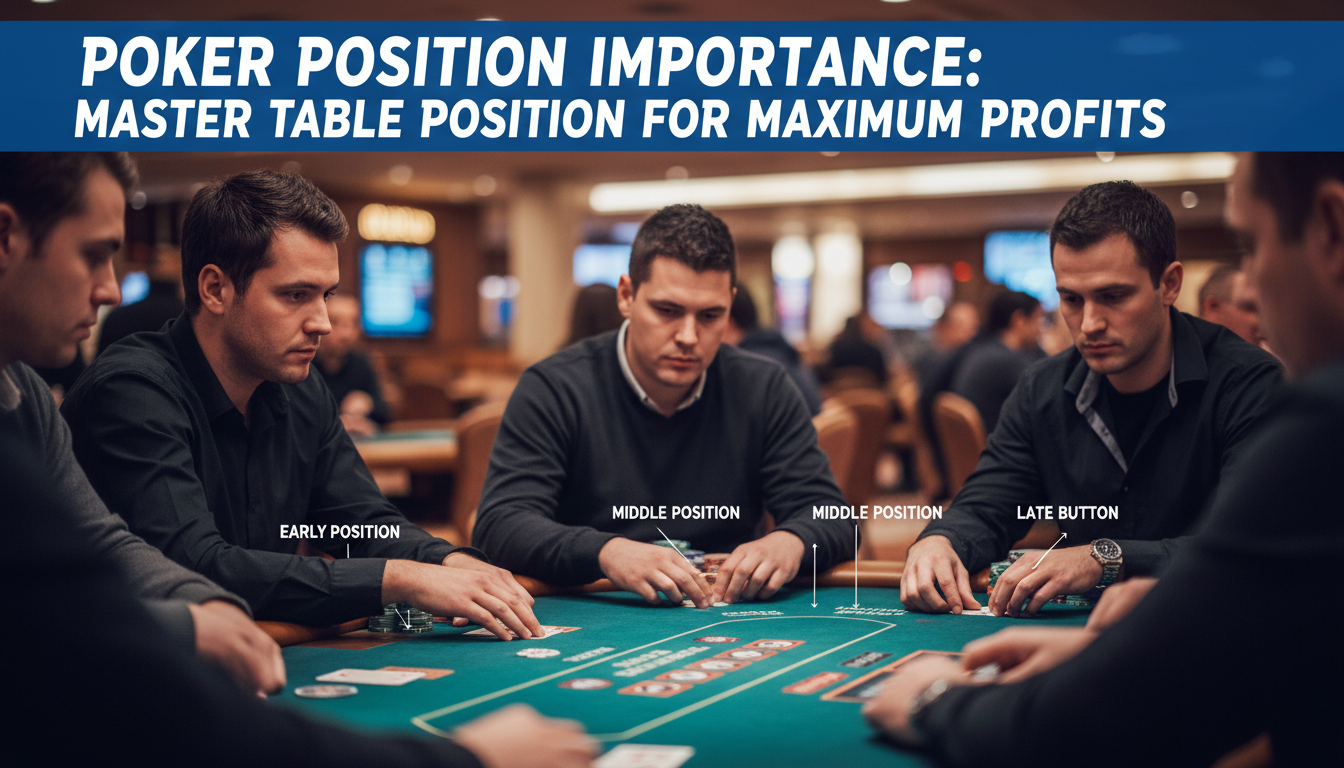
Poker Position Importance: Master Table Position for Maximum Profits

Posted on December 3, 2022

Position in poker is arguably the most critical strategic element that separates winning players from losing ones. Understanding poker position importance gives you a significant edge by providing more information before you have to act, allowing for better decision-making throughout each hand. When you’re in position, particularly on the button, you act last on every betting round after the flop, giving you valuable insight into your opponents’ hands through their actions before you make your move. This information advantage translates directly to increased profitability, with studies showing players in late position win over 60% of hands compared to those in early positions. Proper position awareness affects everything from hand selection and bet sizing to bluffing frequency and pot control, making it the foundation of all effective poker strategy.

  • Information advantage: Acting last provides crucial insights into opponents’ hand strength
  • Hand selection flexibility: Late positions allow you to play significantly wider ranges
  • Pot control: Position lets you dictate the size of the pot based on your hand strength
  • Bluffing effectiveness: Late position creates more believable bluffs with higher success rates
  • Equity realization: Players in position realize 15-20% more equity than those out of position

Table of Contents

  1. What is Position in Poker?
  2. Poker Table Positions Explained
  3. Early Positions Strategy
  4. Middle Positions Strategy
  5. Late Positions Strategy
  6. Blinds Strategy
  7. Impact of Position on Betting Strategies
  8. Position and Hand Selection
  9. The Benefit of Position Post-Flop
  10. Practical Tips for Mastering Poker Positions
  11. What Experts Say About Poker Position Importance
  12. Poker Positions FAQ

What is Position in Poker?

Poker position refers to where you sit relative to the dealer button and how that impacts the order in which you act during a hand. This seemingly simple concept has profound strategic implications that affect every decision you make at the table. When players discuss poker position importance, they’re referring to the significant advantage gained by acting after your opponents rather than before them.

There are two main types of position to understand:

Absolute Position vs Relative Position

Absolute position is your fixed location at the table relative to the dealer button, which determines who acts first preflop. Relative position, however, changes throughout the hand as players fold. For example, if three players remain in a hand, the player to the right of the button has absolute position, but if that player folds, the next remaining player becomes “in position” relative to the others.

The player who acts last on each street has positional advantage, which provides crucial information about how strong their opponents’ hands might be. This information advantage is why the button is considered the most profitable position at the poker table – because you act last on every post-flop betting round.

Players new to poker often underestimate poker position importance, focusing solely on their hole cards while ignoring where they sit at the table. However, experienced players understand that position often matters more than the actual cards you’re dealt, allowing them to play marginal hands profitably when in late position while folding premium hands from early seats.

Expert Advice: Phil Ivey on Value Extraction

“Most players focus too much on their own hand strength and not enough on how to maximize value based on position. When you’re in position with top pair, don’t just automatically bet every street. Sometimes checking back the turn with top pair allows your opponent to bluff into you or improve to a second pair they’ll pay off. The real money is made when you vary your line with strong hands based on position – it’s what separates break-even players from consistent winners.”

Poker Table Positions Explained

Poker table positions are named based on their location relative to the dealer button, which moves clockwise after each hand. This rotation ensures every player experiences each position equally over time. Understanding each position’s strategic implications is essential for developing a winning poker strategy.

How Many Positions Are There at a Poker Table?

The number of poker positions depends on table size:

  • Full Ring (9 or 10-handed): 9 distinct positions
  • 6-Max: 6 distinct positions
  • Heads-Up: 2 positions (button and small blind)

Regardless of table size, positions are categorized into three main groups: early position, middle position, and late position. The strategic approach varies significantly between these categories.

Early Positions

Early positions are the first to act preflop and include:

  • UTG (Under the Gun): First to act after the blinds
  • UTG+1: Second to act
  • UTG+2: Third to act (in full ring games)

These positions have the least information and greatest risk, requiring the tightest hand selection. In 9-handed Hold’em, 7 seats act after UTG, while in 6-max only 3 seats act after UTG.

Middle Positions

Middle positions include:

  • Lojack (LJ): Sometimes called UTG+3 in full ring games
  • Hijack (HJ): Positioned before the cutoff

These seats offer moderate information advantage, allowing for slightly wider hand ranges than early positions. Players in middle position have seen some action before them but still face players acting after them.

Late Positions

Late positions are the most profitable and include:

  • Cutoff (CO): Seat immediately before the button
  • Button (BTN): Most powerful position at the table

Players in late position act after nearly everyone preflop, giving them maximum information before acting. This advantage continues postflop, allowing for sophisticated hand reading and pot manipulation.

The Blinds

The blinds are unique positions with specific strategic considerations:

  • Small Blind (SB): Posts half the big blind, acts first postflop
  • Big Blind (BB): Posts full big blind, acts last preflop but first postflop

Despite acting last preflop, the blinds are actually the worst positions overall because they must act first on every postflop street. Modern tournaments often use a Big Blind Ante (BBA), increasing preflop pot size and slightly raising steal incentives from late position.

Poker Table Positions Diagram

Full Ring Poker Table Positions (9-handed)
Position Type Position Name Description Relative Strength
Early Position UTG First to act after blinds Very Weak
Early Position UTG+1 Second to act Weak
Early Position UTG+2 Third to act (in full ring) Moderately Weak
Middle Position Lojack (LJ) Fourth to act Moderate
Middle Position Hijack (HJ) Fifth to act Strong
Late Position Cutoff (CO) Sixth to act Very Strong
Late Position Button (BTN) Last to act preflop Extremely Strong
Blinds Small Blind (SB) Posts half BB, acts first postflop Very Weak
Blinds Big Blind (BB) Posts full BB, acts last preflop Moderately Weak

Early Positions Strategy

Early positions (UTG, UTG+1, and UTG+2 in full ring games) represent the most challenging seats at the poker table. Players in early position must act with the least amount of information, as most other players still have the opportunity to enter the pot.

Why Early Positions Are Difficult

When you’re in early position:

  • You have no information about how other players will act
  • The likelihood of facing multiple opponents increases
  • Any hand you play will likely be out of position postflop
  • Potentially strong hands can become traps when facing resistance

Acting first means you’re essentially “under the gun” – having to make decisions with minimal information. This is why UTG has the tightest opening range of all positions, typically playing only the top 10-15% of hands.

Early Position Hand Selection Guidelines

Your starting hand requirements should be extremely selective from early positions:

  • Premium pairs: AA, KK, QQ, and sometimes JJ
  • Strong broadways: AK, AQ (sometimes AJ)
  • Avoid: Suited connectors, small pairs, speculative hands

Even strong hands like AQ can become problematic from UTG when facing multiple raises behind you. The key principle is that the earlier your position, the tighter your range should be.

Common Early Position Mistakes

New players frequently make these errors from early position:

  1. Playing too many hands (beyond the top 15%)
  2. Calling raises with marginal hands like KJ or QJ
  3. Three-betting too wide against late position opens
  4. Continuation betting too frequently on all flops
  5. Overvaluing top pair hands

When playing from UTG, consider that in a 9-max game, 8 other players could have premium holdings. The probability of at least one player having a strong hand is significant, which necessitates extreme selectivity.

Middle Positions Strategy

Middle positions (Lojack and Hijack) offer a strategic sweet spot between the caution required in early positions and the freedom of late positions. These seats see some action before them but still face players acting after them.

Lojack Position Strategy

The lojack position sits between early and middle positions. In a 9-handed game:

  • You’ve seen UTG and UTG+1 act before you
  • Several players (typically 5-6) remain to act after you
  • You’re out of position against the blinds if they call

Because of this, your opening range from lojack should be slightly wider than UTG+1 but still relatively tight – approximately 15-18% of hands. Focus on strong broadways (AQ+, KQ), premium pairs, and some suited connectors.

Hijack Position Strategy

The hijack position marks a significant shift in power compared to earlier seats:

“If the cutoff is the bridge between defense and offense, the hijack sets the tone for how aggressive the late streets will be. It’s where many skilled players begin expanding their range with purpose, not just randomly playing more hands.” – Upswing Poker Training

From hijack:

  • You’ve seen 2-3 players act before you
  • Only 2-3 players (CO, BTN, blinds) remain to act after you
  • You can often isolate limpers profitably

Your opening range can expand to approximately 19-22% of hands, including medium pairs (77+), suited aces, and some suited connectors. The hijack is where you can start applying significant pressure to the blinds, especially if early positions have folded.

Hands to Play from Middle Positions

Recommended Opening Ranges from Middle Positions
Hand Type Lojack (LJ) Hijack (HJ)
Premium Pairs AA-TT AA-99
Medium Pairs 99-88 (sometimes) 88-77
Strong Broadways AK, AQ, KQ AK-AJ, KQ, QJ
Suited Connectors 98s+ 87s+
Suited Aces AJs+ A10s+
Offsuit Connectors None QJs, JTs

Middle positions require careful balance – opening too wide invites three-bets from late positions, while playing too tight misses profitable stealing opportunities. Your exact range should adjust based on table dynamics, opponent tendencies, and stack sizes.

Expert Advice: Daniel Negreanu on Relative Position

“Most beginners think position is just about who acts last, but the real magic happens in relative position dynamics. When three players see a flop, the person who was originally on the button might not be in position if someone before them folds. Track who folds on each street – your relative position changes with every fold, and smart players adjust their entire strategy based on who’s actually last to act in the current scenario, not just their original seat.”

Late Positions Strategy

Late positions (cutoff and button) represent the most profitable seats at the poker table. These positions offer maximum information before acting and allow you to control the flow of the hand postflop.

Button (BTN): Commanding the Table

The button is universally considered the best position in poker because:

  • You act last on every postflop street
  • Only two players (blinds) remain to act after your preflop raise
  • You maintain position over the blinds throughout the hand
  • You have maximum fold equity against the blinds

From the button, you can open approximately 45-50% of hands in most situations, including:

  • Almost all pocket pairs
  • All suited aces
  • Most broadway cards
  • Many suited connectors and offsuit connectors

The button is where you can most effectively apply pressure through steals, especially when the action folds to you. Many professionals open 40% or more of hands on the button, prompting both blinds to fold frequently and sending uncontested pots your way.

Cutoff (CO): Late Position Power

The cutoff position is the second most powerful seat at the table:

  • You can “cut off” the button’s opportunity to steal
  • Only one player (button) remains to act after you
  • You gain position over the blinds if they call
  • Excellent for isolating limpers

On the cutoff, you can open approximately 25-30% of hands. The best CO players recognize the sweet spot where math meets timing and table awareness determines which hands become profitable to play.

Blind Defense Strategy

When facing a raise from late position, your defense strategy from the blinds should include:

  • Strong value hands: QQ+, AK, sometimes AQ
  • Speculative hands with playability: Suited connectors, small pairs
  • Moderate broadways: KQ, AJ (in position-dependent situations)
  • Avoid: Weak offsuit hands that can’t stand three streets of betting

Modern strategies recommend defending wider against late-position raises than early-position opens because the positional disadvantage is somewhat offset by improved pot odds and fold equity.

Leveraging Late Position Advantages

Strategic Advantages of Late Position Play
Advantage How to Exploit Expected Value Increase
Information Advantage Call more speculative hands, three-bet for value with wider range 15-20%
Pot Control Adjust bet sizing based on board texture and opponent tendencies 10-15%
Bluffing Effectiveness Use check-raises, float plays, and delayed continuation bets 20-25%
Fold Equity Make well-timed continuation bets against multiple opponents 12-18%
Equity Realization Call down wider with marginal hands on favorable runouts 8-12%

When on the button and action folds to you, you have the best situation to steal the blinds. As you move into late position, you’ll start opening up your range significantly, adding suited hands, offsuit connectors, and other playable holdings to your raising range.

Blinds Strategy

Playing from the blinds presents unique challenges because, despite acting last preflop, you’ll be first to act on all subsequent streets. This makes blind defense one of the most complicated elements of poker strategy.

Small Blind (SB) Play

The small blind is arguably the worst position at the poker table because:

  • You must post a mandatory bet before seeing your cards
  • You’ll act first on every postflop street
  • You’re out of position against all remaining players
  • You have the worst pot odds to defend raises

Effective small blind strategy includes:

  • Against single raises: Defend with approximately 25-30% of hands
  • Against late position opens: Widen defense range due to better pot odds
  • Against early position opens: Narrow defense range significantly
  • Three-betting: Primarily for value or as a bluff against predictable players

Going too wide from the SB invites punishment from the button. Most professionals recommend a compact range from the small blind, focusing on quality rather than quantity.

Big Blind (BB) Play

The big blind has a slightly better situation than the small blind because:

  • You’ve already invested the full big blind
  • You get better pot odds to defend raises
  • You can sometimes gain relative position postflop

Effective big blind strategy features:

  • Passive defense: Calling with 35-45% of hands against late position opens
  • Aggressive defense: Three-betting with premium hands and select bluffs
  • Check-raising: Using this play to balance your checking range
  • Postflop play: Focusing on pot control rather than aggression

The big blind is unique because it acts last preflop but first postflop. This dual nature requires nuanced decision-making – while you can win the pot immediately if everyone folds preflop, you’ll face difficult decisions on every postflop street.

Blind Defense Ranges by Position

Recommended Defense Ranges from the Blinds (vs Single Raise)
Raiser Position Small Blind Defense % Big Blind Defense % Primary Defense Strategy
UTG 8-12% 12-15% Narrow, value-focused, minimal bluffing
MP 12-18% 15-22% Mix of value and speculative hands
HJ 18-25% 22-30% Wider range with more speculation
CO 25-35% 30-45% Balanced with strong value and draws
BTN 30-40% 40-55% Very wide, including many marginal hands

When defending from the blinds, prioritize hands that have strong postflop playability rather than just raw equity. Suited connectors, small pairs, and hands with backdoor equity play well from the blinds because they can make disguised strong hands.

Impact of Position on Betting Strategies

Your position at the poker table fundamentally affects how you should structure your bets throughout a hand. Understanding these dynamics is crucial for maximizing your profits and minimizing losses.

Pot Control Through Position

One of the most significant advantages of position is the ability to precisely control the size of the pot:

  • Out of position: Limited ability to control pot size; often forced to check or bet predetermined amounts
  • In position: Can dictate pot size on every street through bet sizing choices

For example, when you have top pair on a dry board and are in position, you can check behind to keep the pot small if you want limited action. Out of position, you’d have to either bet (potentially getting raised) or check (giving a free card), with less control over the outcome.

Continuation Betting Effectiveness

Continuation betting (c-betting) is significantly more effective when you’re in position:

  • In position: C-bet frequency of 60-75% is standard
  • Out of position: C-bet frequency drops to 40-55%

When in position, your c-bet gets immediate feedback about your opponent’s hand strength through their response. When out of position, your c-bet faces the same uncertainty you would have experienced had you checked.

Bluffing Frequency by Position

Your position dramatically affects your bluffing opportunities:

  • Early position: Bluffing is generally unprofitable due to lack of information
  • Middle position: Selective bluffing on favorable boards against predictable opponents
  • Late position: Frequent bluffing opportunities, especially when opponents show weakness

When you’re last to act, you get the best bluffing opportunity at the table. Being in position allows you to pick up all the pots that no one else seems to want. For instance, if everyone checks to you on the turn, it’s often a good spot to attempt a bluff as it indicates opponents might not have strong hands.

Bet Sizing Strategy by Position

Optimal Bet Sizing Based on Position
Position Flop Bet Size Turn Bet Size River Bet Size Rationale
In Position 50-75% pot 60-80% pot 50-100% pot Can adjust based on opponent’s actions; more control over pot growth
Out of Position 75-100% pot 80-100% pot 75-100% pot Larger sizing compensates for positional disadvantage; denies free cards

As the in-position player, you can make smaller bets because you maintain control over subsequent streets. The out-of-position player often needs to use larger bet sizes to compensate for the positional disadvantage and prevent the in-position player from seeing additional cards cheaply.

Position and Hand Selection

Your position at the table should dramatically influence which hands you choose to play. This relationship between poker position importance and hand selection forms the foundation of preflop strategy.

Hand Range Expansion by Position

Study any professional’s hand chart and you’ll see hand ranges expand significantly as you move closer to the button:

  • UTG: Only the top 10-12% of hands (premium pairs, AK)
  • MP: Top 15-18% (adds QQ, AQ, KQ)
  • HJ: Top 20-22% (adds JJ, AQ, suited connectors)
  • CO: Top 25-30% (adds medium pairs, suited aces)
  • BTN: Top 45-50% (almost all playable hands)

This expansion happens because late position players:

  • Face fewer opponents behind them
  • Have the advantage of acting last postflop
  • Can steal blinds with higher success rates
  • Realize more equity with their hands

Position-Specific Hand Requirements

Certain hand types play significantly better in specific positions:

Hand Type Suitability by Position
Hand Type Early Position Middle Position Late Position
Pocket Pairs Essential (only play 99+) Strong (77+) Playable (22+)
Suited Aces Avoid Marginal (AJs+) Strong (A2s+)
Suited Connectors Avoid Marginal (98s+) Strong (54s+)
Offsuit Connectors Avoid Avoid Marginal (QJs+)
Weak Aces Avoid Avoid Marginal (A9o+)

Notice how speculative hands like small suited connectors become playable only in late positions, while strong pairs remain valuable throughout all positions (though the acceptable range narrows in early positions).

Dead Money Influence on Positional Strategy

Dead money (chips in the pot with no committed player attached) plays a crucial role in position-based strategy, especially:

  • Antes: Increase pot size before cards are dealt, encouraging wider opening ranges
  • Limpers: Create dead money that makes playing speculative hands more attractive
  • Previous folds: Contribute to pot size without active players defending it

When dead money is present (as in tournament play with antes), you can profitably widen your ranges from late positions because the increased pot size improves your implied odds. This is why many professionals open 3-bet more frequently from the button in late-stage tournaments.

The Benefit of Position Post-Flop

The true power of poker position importance becomes most evident after the flop. Players who understand how to leverage position postflop consistently outperform those who don’t.

Information Advantage in Action

Consider this scenario where you raise from the button with A♣K♦ and the big blind calls. The flop comes:

6♣ 9♥ T♠

As the button:

  • You can bet $10 and see how the BB responds
  • If they call, you have information for turn decision
  • If they raise, you know your hand is likely beat
  • If they check, you can choose to take a free card

As the big blind:

  • You must check first without knowing button’s action
  • Leaving you in the dark about button’s hand strength
  • Forcing you to guess whether to check-raise or fold

This simple example demonstrates why position is so valuable – it gives you complete information before you have to act on every street.

Free Card Opportunities

One of the most underrated benefits of position is the ability to take free cards when on a draw:

  • In position against a single opponent, you can check behind to see the next card for free
  • Out of position, you must either bet (potentially getting raised) or check (giving free card to opponent)

When you have position on your opponent, you have the opportunity to take a “free card” if your opponent checks to you while you’re on a draw, checking behind to see the next community card. This significantly improves the implied odds for drawing hands.

Pot Manipulation with Position

Players in position have complete control over pot size on each street:

  • Can make minimum raises to keep pot small with marginal hands
  • Can overbet with strong hands to maximize value
  • Can check behind to control pot growth with vulnerable hands
  • Can adjust bet sizing based on precise reading of opponent’s range

Consider this turn scenario after a flop of 6♣9♥T♠:

The turn is the 2♥. If you’re in position with top pair:

  • You can bet $35 for value, getting called by weaker pairs
  • Can check behind if board gets dangerous
  • Can make small bets to induce bluffs from draws

If you were out of position, your options would be severely limited – either check (giving free card) or bet a predetermined size.

Expert Advice: Jonathan Little on Position Adjustment

“Most players understand position basics but miss how to properly adjust when table dynamics change. When facing extremely tight-aggressive players who rarely continuation bet, your range from out of position should tighten even more than standard – maybe only 5% from UTG instead of 10%. Conversely, when facing players who bet 100% of flops, your out-of-position calling range should expand dramatically. Track how often each opponent continuation bets, then adjust your ranges accordingly – this small tweak alone can add 2-3bb/100 to your win rate.”

Practical Tips for Mastering Poker Positions

Understanding poker position importance is one thing; applying it effectively is another. Here are actionable strategies to improve your positional play immediately.

Tight Aggressive Approach by Position

Adopt this position-based strategy framework:

  • Early positions: Play tight, focusing on premium hands. Fold all marginal holdings.
  • Middle positions: Slightly expand range but remain selective. Fold to aggression.
  • Late positions: Open wide but remain assertive. Continuation bet frequently.
  • Blinds: Defend based on raise position. Play aggressively with strong hands.

By adopting a tight aggressive style that varies by position, you can mitigate the inherent disadvantages of acting first while maximizing advantages when acting last.

Positional Awareness Drills

Improve your positional awareness with these exercises:

  1. Before every hand, identify your exact position and its implications
  2. After each session, review hands where position affected your decision
  3. Practice tracking relative position changes as players fold
  4. Study how top professionals adjust ranges by position using training sites
  5. Use position-specific hand charts as reference during play

Positional Adjustments Against Player Types

Modify your positional strategy based on opponent tendencies:

Positional Adjustments Against Different Player Types
Player Type Early Position Adjustment Late Position Adjustment
Tight Passive Narrow opening range further Widen stealing range significantly
Tight Aggressive Three-bet more with value hands Call wider, float more often
Loose Passive Play more speculative hands Value bet thinner, bluff less
Loose Aggressive Fold more marginal hands Three-bet lighter, trap more

Against cautious players, position becomes a weapon for applying pressure through well-timed raises and continuation bets. Against aggressive players, your positional advantage helps you trap them with well-timed check-raises.

Maximizing Value in Position

When you have a strong hand and are in position:

  • Don’t automatically bet every street – sometimes checking back builds bigger pots
  • Vary your bet sizing to keep opponents guessing
  • Use delayed continuation bets on later streets
  • Consider check-raising as part of balanced range

As we exploit our position, we enhance our chances of success by making smarter decisions based on opponent actions. This positional awareness allows players to maximize their expectation in each hand and maintain a significant edge over their opponents.

What Experts Say About Poker Position Importance

Poker professionals consistently emphasize the critical importance of position in all aspects of the game. Here’s what leading experts have to say about this fundamental concept:

Phil Ivey on Positional Advantage

“Position is everything in modern poker. You can have the second nuts on the river, but if you’re out of position against a thinking player, you might not get a single bet in value. The information advantage of acting last compounds on every street – it’s not just about one better decision, but four or five better decisions per hand. This is why even mediocre players can win from the button while geniuses lose from UTG.”

Daniel Negreanu on Positional Dynamics

“Understanding position isn’t just about where you sit; it’s about understanding how your opponents perceive you from different positions. When you consistently play tight from early position but open wide on the button, observant players will adjust. The real mastery comes in manipulating these perceptions – sometimes playing strong hands passively from late position to build bigger pots, other times three-betting light from early position to keep opponents honest.”

Phil Hellmuth on Beginner Position Mistakes

“I see thousands of beginners make the same mistake: they play every hand exactly the same regardless of position. It’s agony to watch! They’ll call raises from UTG with KJo, then fold the same hand on the button when they could be raising it. Position is the great equalizer – it turns medium hands into profit machines and premium hands into traps. If you want my number one piece of advice, it’s this: play 70% of your hands in position, 30% out of position. That alone will separate you from 90% of recreational players.”

Jonathan Little on Advanced Position Play

“Positional strategy has evolved dramatically with solvers. We now understand relative position is more important than absolute position. When three players see a flop, the player originally on the button might not be in position if someone behind them folds. Modern players track relative position dynamically throughout each hand, adjusting strategy after every fold. This ‘position fluidity’ concept is what separates elite players from good ones in today’s games.”

UpSwing Poker on Positional Awareness

“Positional awareness isn’t just knowing where you sit; it’s understanding how your position affects every aspect of your decision tree. Recent solvers show the EV difference between IP and OOP is 15-20% across all hands. This isn’t just a ‘nice to have’ skill – it’s the single most important factor in modern poker strategy. Players who master position amplify all their other skills; players who neglect it undermine everything they do right.”

Poker Positions FAQ

What is the best position in poker?

The button (dealer position) is universally considered the best position in poker. This is because the player on the button acts last on every postflop betting round, giving them maximum information before they have to make decisions. The button position allows players to see how everyone else plays their hand before making their own decision, giving them significant strategic advantages in hand reading, pot control, and bluffing.

What is UTG in poker?

UTG stands for “Under the Gun,” which refers to the player who must act first in a betting round after the blinds. This is considered one of the weakest positions because the UTG player has the least information when making their decision, as all other players still have the opportunity to act after them. In a 9-handed game, UTG faces 8 players who could have stronger hands, making UTG the position with the tightest opening requirements.

How many positions are there at a poker table?

The number of positions depends on table size:

  • Full ring (9 or 10-handed): 9 distinct positions
  • 6-max: 6 distinct positions
  • Heads-up: 2 positions (button and small blind)

Regardless of table size, positions are categorized as early position, middle position, and late position, with similar strategic implications across formats.

Why is position important in poker strategy?

Position is crucial because:

  • It provides more information before you have to act
  • It allows better hand reading through opponent actions
  • It enables precise pot control on every street
  • It increases bluffing effectiveness and fold equity
  • It helps realize more equity with drawing hands

Studies show players win more than 60% of hands when in late position compared to early position, demonstrating position’s direct impact on profitability.

What are the positions at a poker table?

From worst to best, standard poker positions include:

  • Small Blind (SB): Posts half BB, acts first postflop
  • Big Blind (BB): Posts full BB, acts last preflop but first postflop
  • UTG: First to act after blinds
  • UTG+1: Second to act
  • UTG+2: Third to act (in full ring)
  • Lojack (LJ): Fourth to act in full ring
  • Hijack (HJ): Fifth to act
  • Cutoff (CO): Sixth to act
  • Button (BTN): Last to act preflop, best position

What is out of position in poker?

Being out of position means you must act before your opponent on a betting round. This is a significant disadvantage because you have less information when making decisions. For example, if you call a preflop raise from the big blind, you’re out of position for the entire hand against the raiser, who gets to see your action before responding on every street. Out of position play requires tighter hand selection and more cautious betting.

How can I use position to bluff more effectively?

Position enhances bluffing effectiveness through:

  • Seeing opponent’s action before you act (do they check weakly?)
  • Ability to take free cards before bluffing
  • Better assessment of board texture and opponent’s range
  • Higher fold equity due to positional pressure

Bluff most effectively when:

  • Opponent checks to you (shows weakness)
  • Board texture favors your perceived range
  • Opponent has demonstrated folding tendencies
  • You can apply multiple streets of pressure

How should I adjust my strategy when playing from the middle position?

From middle position (Lojack/Hijack):

  • Open with approximately 15-25% of hands
  • Widen range when facing weak opponents
  • Narrow range against aggressive players
  • Play more speculative hands when facing limpers
  • Be prepared to fold to three-bets from late positions
  • Use position over the blinds when they call

The key is balancing aggression with discipline – middle position allows more flexibility than early seats but still requires caution compared to late positions.

Is it possible to play poker without understanding positions?

Technically yes, but you’ll be severely handicapped. Position is so fundamental to poker strategy that players who ignore it:

  • Lose significant expected value on every hand
  • Play too many marginal hands out of position
  • Miss profitable stealing opportunities
  • Make incorrect bet sizing decisions
  • Fail to protect their hand range adequately

Even basic understanding of position provides substantial edge over players who ignore it. As professional Jonathan Little states: “If you only learn one poker concept, make it position. Everything else builds from that foundation.”

What are the small blind and big blind in poker?

The blinds are mandatory bets that ensure action in every hand:

  • Small Blind (SB): Posted by player left of button, typically half the big blind amount. Worst position overall as you act first postflop.
  • Big Blind (BB): Posted by player left of small blind, full big blind amount. Slightly better than SB as it acts last preflop but first postflop.

Despite acting last preflop, the blinds are actually weak positions because they must act first on all postflop streets. Effective blind defense requires understanding positional dynamics against specific raisers.

How does position affect psychology of other players?

Your position influences how others perceive and play against you:

  • Early position tightness builds strong range perception
  • Late position aggression creates stealing image
  • Button domination affects opponents’ willingness to continue
  • Out of position play makes opponents more cautious
  • Positional consistency (or inconsistency) affects respect given to bets

Skilled players manipulate these perceptions – sometimes playing too tightly from late position to induce steals, or opening unusually wide from UTG to appear unpredictable.

How can I remember starting hands for different positions?

Use these memory aids:

  • Proportionality: Range width increases by approximately 5-8% per position moving toward button
  • Hand Categories: Each position adds a new hand category (pairs → broadways → suited aces → connectors)
  • Visual Charts: Keep position-specific charts visible during play
  • Grouping: Early positions = premium hands only, Middle = add speculative hands, Late = almost everything

Modern training sites offer interactive position drills, and many professionals recommend reviewing position charts before each session to maintain proper ranges.

How does position impact hand selection?

Position dramatically affects hand selection:

  • Early positions: 5-12% range (premium pairs, AK only)
  • Middle positions: 15-25% range (adds QQ, AQ, suited connectors)
  • Late positions: 25-50%+ range (almost all playable hands)

This expansion occurs because late position players face fewer opponents, act last postflop, have better pot odds for steals, and realize more equity with their hands.

What is the worst position in poker?

The small blind is generally considered the worst position for these reasons:

  • Must post mandatory bet without seeing cards
  • Acts first on every postflop street
  • Always out of position against all remaining players
  • Has worst pot odds to defend raises
  • Limited strategic options due to positional disadvantage

While the big blind acts last preflop, the small blind’s combination of forced bet and perpetual out-of-position play makes it the most challenging seat overall.

Does position matter in online poker?

Absolutely. Position matters just as much, if not more, in online poker because:

  • Dynamics are faster with more hands per hour
  • Positional awareness separates winning from losing players
  • Advanced solvers have reinforced position’s strategic importance
  • Online players often exploit positional weaknesses more efficiently

In fact, many professionals note online players should be even more positionally aware due to faster game pace and increased competition level. Positional leaks are quickly exploited by regulars in online games.

Related Posts:

  • Holdem Heads Up: Your Complete Guide to One-on-One Poker Battles
  • Mastering Poker Bluffs: The Ultimate Guide to Winning With…
  • Ultimate Professional Poker Guide: Master the Game From Basics…
  • Reading Poker Hands: Mastering Hand Ranges and Opponent…
  • Optimal Poker Bluffing: Master Strategy for Winning More Pots
  • Razz Fourth Street Play: Mastering Critical Decision Points in…
  • Video Poker Rules: Your Complete Guide to Winning Strategies
  • Play Free Slots - Your Ultimate Guide to Risk-Free Slot Entertainment
  • Imperial Poker Rules: Complete Guide to Mastering the Game
  • Video Poker Tutorial: Master the Best Game in the Casino

Recent Posts

  • Jackpot City Casino: Premier Online Gaming Experience Since 1998
  • Imperial Poker Rules: Complete Guide to Mastering the Game
  • Best Online Pokies: Your Complete Guide to Winning Real Money Slots in Australia
  • Bellagio Las Vegas: Your Ultimate Guide to the Iconic Strip Resort
  • Free Online Pokies Australia

Recent Comments

No comments to show.

Archives

  • November 2025
  • August 2025
  • July 2025
  • August 2024
  • July 2024
  • June 2024
  • March 2024
  • January 2024
  • November 2023
  • April 2023
  • December 2022
  • November 2022

Categories

  • Australia Casinos
  • Casino Bonus Types & Strategies
  • Casino Games Guides
  • Casino Mobile & App Guides
  • Casino Payment Methods
  • Fast Payout / Instant Withdrawal
  • High Roller & VIP Programs
  • Legal & Responsible Gambling
  • Live Dealer / Live Casino
  • New Zealand Casinos
  • No-Deposit Bonuses
  • Online Casino Reviews
  • UK Casinos
  • Uncategorized
  • US Casinos
  • About us
  • Privacy Policy
  • Terms of Service

Blackcoin.co a fully independent review platform with no ownership ties to any casino operator or software provider. We earn revenue solely through disclosed affiliate links at no extra cost to you – this NEVER influences our reviews.

⚠️ YOU MUST CONFIRM: You are 18+ (21+ in some regions) AND accessing from a legal jurisdiction. We prohibit access from: USA*, UK, France, Spain, Netherlands, Italy, Australia, and all UN-sanctioned countries. *Except regulated US states: NJ, MI, PA (verify current status). Full geo-restriction list.

🛑 GAMBLING CAN LEAD TO ADDICTION AND FINANCIAL RUIN. Seek help now: GambleAware.org | BeGambleAware.org | GamblersAnonymous.org | USA Helpline: 1-800-GAMBLER

Our content is for informational/entertainment purposes only – NOT financial, legal, or gambling advice. We do not guarantee casino safety, bonus terms (verify directly with operator), or winnings. You assume 100% of all risks when gambling. Blackcoin.co is not liable for financial losses, addiction, or illegal access.

©2025 Blackcoin | Design: Newspaperly WordPress Theme