
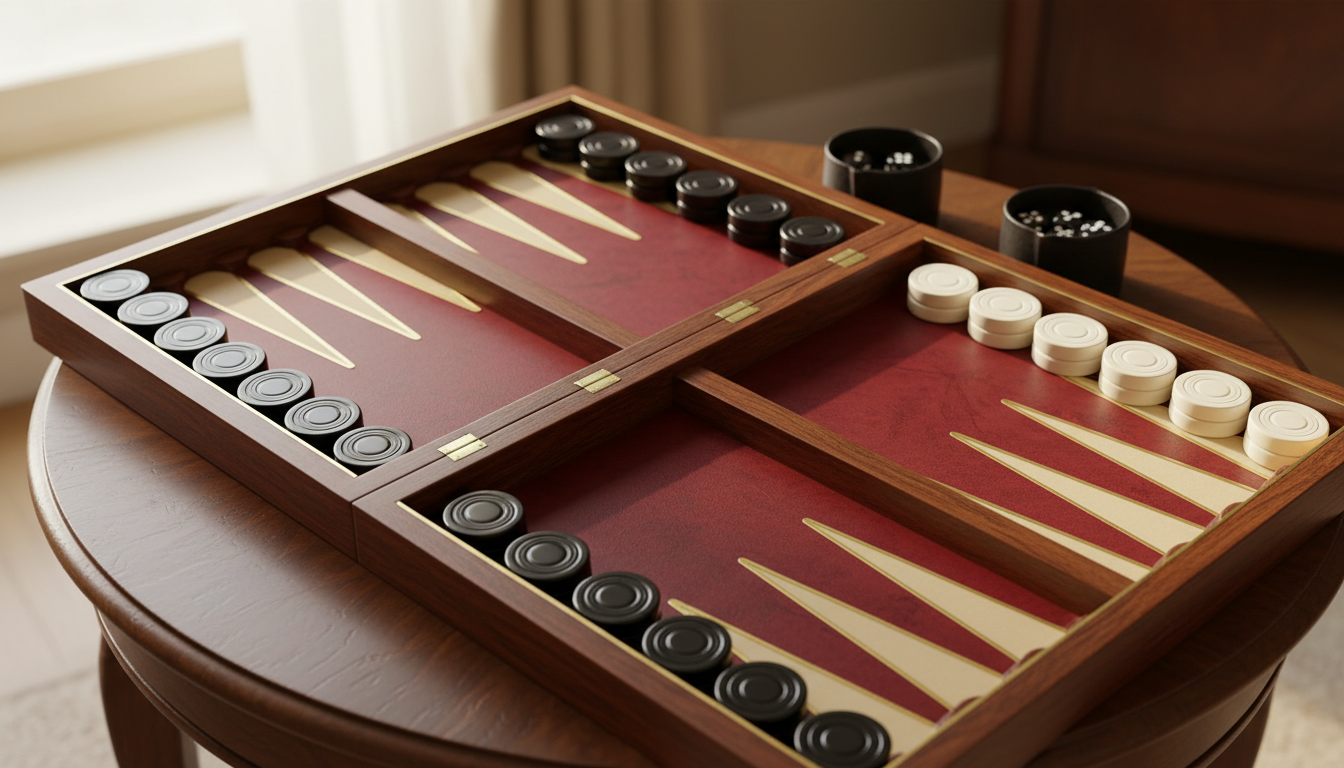
Backgammon is a timeless two-player dice game that combines skill and chance, played on a unique board with 24 points where players move their 15 checkers according to dice rolls. In this ancient game dating back thousands of years, your objective is to move all your checkers around the board into your home board and then “bear them off” (remove them from the board) before your opponent does. Each turn, players roll two dice and must move their checkers according to the numbers shown, with the added strategic element of the doubling cube that allows players to increase the stakes during play. The game features distinctive elements like “blots” (single checkers vulnerable to being hit), “points” (made with two or more checkers), and the critical endgame phase of bearing off where precise dice management determines victory.
- Backgammon is played on a board with 24 triangular points, 30 checkers (15 per player), two dice, and a doubling cube
- Players move checkers in opposite directions (one clockwise, one counter-clockwise) based on dice rolls
- Blots left unprotected can be hit by opponents and sent to the bar
- The doubling cube allows players to increase stakes without changing gameplay
- Winning conditions include regular victory, gammon (opponent hasn’t borne off any checkers), and backgammon (opponent has checkers in your home board or on the bar)
- Strategic elements include prime building, racing, and understanding proper cube actions
- Modern tournament play follows standardized rules but several variations exist worldwide
Table of Contents
- The Ancient Origins of Backgammon
- Backgammon Equipment Explained: Board, Checkers, and More
- Basic Backgammon Rules Every Player Must Know
- Understanding Dice Movement and Legal Moves
- Blots, Points, and Hitting: The Core Mechanics
- The Bar and Home Board: Critical Game Areas
- Bearing Off: The Final Phase Strategy
- Mastering the Doubling Cube: Rules and Strategy
- Three Ways to Win: Regular, Gammon, and Backgammon
- Common Illegal Moves and How to Handle Them
- Advanced Backgammon Strategies for Serious Players
- Historical Variants: Senet, Royal Game of Ur, and Related Games
- DIY Backgammon: Creating Your Own Set from Recycled Materials
- Compact Travel Backgammon Sets for On-the-Go Players
- Hoyle’s Rules of Games: The Authoritative Reference
- Backgammon Online: Digital Play Considerations
- What Experts Say About Backgammon Strategy
- Frequently Asked Questions About Backgammon Rules
The Ancient Origins of Backgammon
Backgammon’s history stretches back thousands of years, connecting modern players with ancient civilizations. The earliest form of games resembling what we consider modern-day backgammon were played by Ancient Romans, though at the time it was known as Ludus Duodecim Scriptorum, or ‘Twelve-Lined Game’. This Roman version itself evolved from even older games played throughout the Mediterranean and Middle East.
The Royal Game of Ur, which scholars discovered in the tombs of ancient Sumer (now modern-day Iraq), can be dated back to about 2500 BCE. Royal Game of Ur boards tend to be highly decorated and like Backgammon boards, are split into four sections, though in this iteration, they’re unevenly spaced. While there were many versions of this game, the most well-known one was found in the Royal tombs of Ur (which is how it got its name!).
Senet is one of the more well known Ancient Egyptian games, with four sets of the game being found buried along-side Tutankhamun. It’s also believed that Senet was the inspiration for the Roman ‘Twelve-Lined Game’. Senet is believed to be partially related to Backgammon, as it also follows a movement pattern resulting in pieces being moved and removed from a similar board.
With many Egyptian board games, it’s believed that Mehen is a depiction of the journey to the Afterlife. The Mehen game board is circular with a segmented snake spiralling into the centre. Mehen is one of the oldest games that’s been dated with reasonable confidence, though with anything this old, there tend to be some gaps in the story.
Like many others on this list, Checkers was first discovered in Egypt, being mentioned in works of both Homer and Plato, though at the time it was likely called Alquerque. The earliest depiction of Nine Men’s Morris was dated to 1440 BCE in Egypt, though the game has been found all over the world.
“Most people don’t realize that the doubling cube concept actually has roots in ancient gambling practices. When you use the cube today, you’re participating in a tradition that dates back to Roman dice gamers who would ‘raise the stakes’ in similar fashion—just without the physical cube device. Understanding this historical context helps modern players appreciate the strategic depth added by the cube.”
— Nack Ballard, Backgammon Hall of Famer and creator of the Naccel counting system
Backgammon Equipment Explained: Board, Checkers, and More
Proper backgammon equipment consists of several key components that work together to create the game experience. A standard backgammon set includes:
- The board: A folding board with 24 narrow triangles called points, arranged in four quadrants of six points each. The points alternate in color and are numbered from 1 to 24.
- Checkers: Thirty round pieces (15 per player), traditionally in contrasting colors like black and white.
- Dice: Two standard six-sided dice used to determine movement each turn.
- Dice cups: Used to shake and roll the dice fairly.
- Doubling cube: A special six-sided die marked with the numbers 2, 4, 8, 16, 32, and 64, used to track the current stakes of the game.
The board, though found in many configurations throughout history, always consists of two rows of small circular divots or bowls carved into a surface. Modern tournament boards follow standardized dimensions to ensure fair play across competitions.
| Component | Standard Specification | Material Options |
|---|---|---|
| Board size | 20-22 inches when folded, 40-44 inches when open | Wood, vinyl, folding fabric |
| Checkers diameter | 1.75-2 inches (44-50mm) | Plastic, wood, stone |
| Dice size | 16mm standard tournament size | Acrylic, cellulose |
| Doubling cube | 25-30mm with clear numbering | Plastic, wood |
For DIY enthusiasts, it’s nice to know that you don’t need luck to build the game, only to play! Some creative players craft boards from repurposed materials. As one resource notes: “As I used timber from a babies cot base, water bottle caps filled with resin for the pieces, bought hinges and clasp from Bunnings.” This creative approach gives new life to unused materials while creating a personalized gaming experience.
Basic Backgammon Rules Every Player Must Know
Understanding the foundational backgammon rules is essential before diving into advanced strategy. Here’s a clear explanation of how to play:
- Setup: Each player starts with 15 checkers arranged as follows: two on the 24-point, five on the 13-point, three on the 8-point, and five on the 6-point. The points are numbered from each player’s perspective.
- Objective: Move all your checkers into your home board (points 1-6 from your perspective) and then bear them off the board before your opponent does.
- Initial roll: To determine who goes first, each player rolls one die. The player with the higher number moves first using both their number and their opponent’s.
- Movement: Players roll two dice each turn and move checkers according to the numbers shown, moving in opposite directions (one player clockwise, one counter-clockwise).
- Legal moves: You must use both dice if possible, playing the higher number first if there’s a choice. You can move one checker twice as long as both moves are legal.
It’s important to remember that backgammon uses a mixture of skill and some luck of the dice. While you can’t control what numbers you roll, you can always make the best possible move with the dice you have.
Understanding Dice Movement and Legal Moves
One of the most fundamental aspects of backgammon rules involves properly executing your moves based on dice rolls. Many beginners struggle with understanding which moves are legal and how to maximize potential with each roll.
When you roll the dice, you must move checkers the full value of each die if possible. You cannot split a die between two different moves. For example, if you roll 6-4, you cannot move one checker 5 spaces and another checker 5 spaces—you must move one checker 6 spaces and another 4 spaces.
| Dice Roll | Single Checker Options | Multiple Checker Options |
|---|---|---|
| 6-4 | Move one checker 10 spaces (if legal) | Move one checker 6, another 4 |
| 5-5 | Move one checker 20 spaces (rarely legal) | Move up to four checkers 5 spaces each |
| Doubles | Move one checker 4x die value | Move multiple checkers totaling 4x die value |
| Unequal rolls | Move one checker sum of dice (if legal) | Move two checkers separate values |
The white pieces move in counter-clockwise direction. In this game, captures can only be made if you land on a position with one piece of the opponent. Knowing which moves to prioritize based on board position is what separates beginners from intermediate players.
“Most players overlook the importance of keeping mobility in their checker formations. When you’re in a defensive position, don’t just stack checkers on points hoping to make a prime—leave yourself multiple escape routes. I’ve seen countless games lost because a player blindly followed a ‘prime-building’ guide without understanding when it’s actually correct to spread out instead.
— Kit Woolsey, 1995 World Backgammon Champion
Blots, Points, and Hitting: The Core Mechanics
The fundamental tactical element in backgammon rules involves understanding blots, points, and the consequences of hitting your opponent’s checkers.
- Blot: A single checker occupying a point. This checker is vulnerable to being hit by your opponent.
- Point: When you have two or more checkers on a point. Your opponent cannot land on or move a checker to this point.
- Hit: When you land on a point occupied by a single opposing checker (a blot), sending that checker to the bar.
- Enter: After being hit, a player must re-enter the checker from the bar into the opponent’s home board before making other moves.
When a checker is hit, it’s placed on the bar in the middle of the board. The player whose checker was hit must roll to re-enter that checker into the opponent’s home board (points 1-6 from their perspective) before moving any other checkers. To enter, the player must roll a number that corresponds to an open point (not occupied by two or more of the opponent’s checkers).
The Jacoby rule has some influence on both checker play and cube decisions, mostly on checker play. The sole purpose of the rule is to speed up the game – add a little more excitement — finish this game and move on to the next. Some players choose to play with the Jacoby rule which states that gammons and backgammons only count if the cube has been turned at least once during the game.
The Bar and Home Board: Critical Game Areas
The bar and home board represent two crucial areas of the backgammon board with specific rules governing checker movement.
When a checker is hit, it’s placed on the bar. Before you can move any other checkers, you must use your dice rolls to re-enter that checker from the bar into your opponent’s home board. To successfully enter, you must roll a number that corresponds to an open point (a point with fewer than two of your opponent’s checkers) in your opponent’s home board.
If you roll a number but cannot enter because both potential points are blocked, you lose that portion of your roll. If you cannot enter with either die, your turn ends and you must try again on your next turn.
The home board refers to the last six points where you aim to collect all your checkers before bearing them off. Once all your checkers are in your home board, you may begin bearing off—removing checkers from the board according to dice rolls.
It’s also important to note that during the bearing off phase, you can still hit blots in your home board, which may require the opponent to re-enter before continuing to bear off. This is a common strategic element where players might leave blots strategically to maximize flexibility during the endgame.
Bearing Off: The Final Phase Strategy
Bearing off represents the final phase of backgammon where players remove their checkers from the board. Understanding the proper bearing off mechanics is crucial because many games are lost through mistakes in this phase.
To bear off a checker, you must have all 15 of your checkers in your home board. You then remove checkers according to your dice rolls, with specific rules governing how to use the numbers:
- If you roll a number corresponding to a point where you have checkers, you can remove one checker from that point.
- If there are no checkers on the point indicated by the die, you must make a legal move using a checker on a higher-numbered point.
- If no checker can be borne off, you must move a checker within your home board based on the roll.
- If you roll doubles during bearing off, you get to make four moves of that value, removing or moving checkers accordingly.
A key strategic element of bearing off involves maintaining flexibility. While it may seem efficient to always bear off a checker when possible, sometimes it’s better to move a checker from a higher point to lower one to prevent getting stuck if you roll small numbers later.
| Current Position | Dice Roll | Optimal Move |
|---|---|---|
| Checkers on points 6, 5, 4, 3 | 6-2 | Bear off from 6, move 5 to 3 (keeping two checkers on lower points) |
| Checkers on points 4, 3, 2, 1 | 5-3 | Bear off from 4, move 3 to 1 (better distribution for future rolls) |
| Checkers only on points 3 and 2 | 4-1 | Move checker from 3 to 2 (sets up bearing off on next turn) |
| Last two checkers on point 6 | 3-3 | Bear off two checkers (both 3s can be used) |
Mastering the Doubling Cube: Rules and Strategy
The doubling cube is what elevates backgammon from a simple race game to a strategic masterpiece. This unique element has no parallel in most other board games and fundamentally changes how backgammon is played.
Throughout the game, either player may propose doubling the stakes before rolling their dice. The opponent may either accept (and play on at the new stakes) or decline (and forfeit the game at the current stakes). The player who accepts the double becomes the owner of the cube and is the only one who can make the next double.
The rule avoids those long games where, having missed the market by a mile, one might play on with little chance for either a gammon or a loss, or where, in match play with a centered cube, a position is too good to double. In money play, the game winner receives no extra credit for gammons or backgammons unless the cube has been doubled at least once.
When to Double
Knowing when to offer a double requires careful assessment of position:
- When you have a clear advantage but not so overwhelming that your opponent will definitely pass
- When you have momentum in a racing position
- When you’ve built an effective prime that blocks your opponent’s checkers
- When your opponent has checkers stranded on the bar
When to Accept or Decline
The decision to take or drop a double should be based on your winning probability:
| Winning Probability | Action Against Centered Cube | Rationale |
|---|---|---|
| 75% or higher | Double immediately | |
| 70-75% | Double | |
| 25% or lower | Drop | |
| 25-30% | Take |
The Jacoby rule is standard for money play almost everywhere, although it’s still a good idea to establish that you’re using the rule when you start a money play session. This rule specifies that gammons and backgammons count only if the cube has been turned at least once during the game.
Three Ways to Win: Regular, Gammon, and Backgammon
In backgammon, there are three distinct ways to win the game, each with different point values:
- Regular victory (1 point): When you bear off all your checkers before your opponent bears off any.
- Gammon (2 points): When you bear off all your checkers while your opponent has not borne off any. This occurs when the loser still has one or more checkers in the winner’s home board or on the bar.
- Backgammon (3 points): When you bear off all your checkers while your opponent has not borne off any checkers AND has one or more checkers in the winner’s home board or on the bar.
The primary difference between gammon and backgammon is the location of the losing player’s remaining checkers. In a backgammon, the loser still has checkers in the winner’s inner board (home board) or on the bar.
In this article, we’re going to look at the history of a handful of these games and see how they’ve evolved from one another over the centuries. Learning precise definitions of winning conditions prevents disputes and helps develop appropriate strategies for different game situations.
Common Illegal Moves and How to Handle Them
Understanding what constitutes an illegal move in backgammon is crucial for fair play. Here are common illegal moves and how to address them:
Most Common Illegal Moves
- Moving a checker to a blocked point (occupied by two or more of opponent’s checkers)
- Not using the full value of a die when possible
- Bearing off checkers before all are in the home board
- Incorrectly taking a doubled game when the opponent wasn’t entitled to double
- Turning the cube out of turn
How to Handle Illegal Moves
According to Hoyle’s Rules of Games, if an illegal move is discovered:
- The opponent may offer the dishonest player a choice of correcting the error or accepting the move as made
- If the error isn’t discovered until after the dishonest player’s next roll, the position stands as played
- If it’s clear the dishonest player deliberately cheated, the opponent may claim victory
With Hoyle’s Rules of Games you’ll learn how to play games, sharpen your strategy, and settle disputes with the revised and updated edition of this essential reference guide–now covering over 250 classic and popular games!
Advanced Backgammon Strategies for Serious Players
Mastering basic backgammon rules is just the beginning. Advanced players employ several key strategic concepts that separate casual play from competitive success:
Prime Building
A prime is a wall of six consecutive blocked points. Building effective primes blocks your opponent’s checkers, particularly those on the bar or in your home board. Advanced players know when to build a prime versus when to play more flexibly based on the race position.
Racing Strategy
When both players are bearing off or heading toward their home boards, the game becomes a pure race. Advanced players know how to calculate pip counts (total number of points each checker must move to bear off) and adjust strategy accordingly.
Blitz and Back Game
Two advanced positional strategies include:
- Blitz: Aggressive play focused on hitting multiple blots and keeping the opponent on the bar
- Back game: Strategic play where you maintain anchors in your opponent’s home board while trying to form a prime to trap their checkers
| Position Type | Recommended Strategy | Key Considerations |
|---|---|---|
| Opponent has multiple checkers on bar | BUILD defensive point in home board | |
| You have several blots exposed | TIGHTEN position, eliminate unnecessary blots | |
| Opponent has anchor in your board | BALANCE safety with aggression | |
| Racing position with minimal contact | MAXIMIZE efficiency of moves |
“Most players make the mistake of judging a position only by its immediate risks and benefits. The real experts look three to four moves ahead—considering not just what might happen immediately, but how the position will evolve. Develop a habit of asking yourself ‘What happens if I get hit here?’ and ‘What will my ideal position look like after this roll?’ That simple mental exercise will improve your game more than studying complicated checker formations.”
— Mary Hickey, Backgammon Times Editor
Historical Variants: Senet, Royal Game of Ur, and Related Games
Backgammon has evolved from earlier games played throughout ancient civilizations. Understanding these historical variants provides context for modern backgammon rules.
Senet: The Egyptian Precursor
Senet is one of the older games with direct connections to backgammon. Senet is believed to be partially related to Backgammon, as it also follows a movement pattern resulting in pieces being moved and removed from a similar board. With some games, we’re lucky enough to find written descriptions of their rules but unfortunately Senet is no such game.
Unfortunately, some rules will only ever be speculation, but this leaves room for them to be interpreted in multiple ways, so there are more versions for you to try! With many Egyptian board games, it’s believed that Mehen is a depiction of the journey to the Afterlife, which may have influenced the symbolic nature of early race games.
Royal Game of Ur
The Royal Game of Ur represents another important historical connection. It was common practice in Japan to award players who attended schools dedicated to studying Go an intellectual status—similar respect was likely given to skilled players of ancient board games like the Royal Game of Ur.
Royal Game of Ur is another believed to be related to Backgammon (it seems the Backgammon craze lasted for at least a good 600 years!) though this one is distinct enough to be given its own name. The gameplay itself is quite unique, though it could have its roots in Backgammon, with the aim of trying to move all your pieces to your own side of the sacred line.
Nine Men’s Morris and Other Ancient Games
The earliest depiction of Nine Men’s Morris was dated to 1440 BCE in Egypt, though the game has been found all over the world. This game represents a different family of strategy games that influenced overall board game development.
Patolli is the only game on our list today which is strongly believed to have had gambling elements built into the mechanics. Meanwhile, in Mediterranean cultures such as Athens and Rome, dice games were often played at taverns, with people gambling on the results—similar to modern casino environments.
DIY Backgammon: Creating Your Own Set from Recycled Materials
For crafty backgammon enthusiasts, creating your own set is a rewarding project that connects you with the game’s ancient history. You don’t need expensive materials—the game’s been played for millennia on carved rock surfaces with improvised pieces.
Basic Materials Needed
- Base material (recycled wood, old game board, or sturdy cardboard)
- Paint or wood stain for board coloring
- Measuring tools and ruler
- Paintbrushes or markers for drawing the points
- Materials for checkers (wood discs, stones, or repurposed game pieces)
- Hinges and clasp (if creating a foldable board)
Step-by-Step Construction
- Prepare your base material by cutting to desired size (standard boards are approximately 20×22 inches when folded)
- Mark the 24 points using light pencil lines as guides
- Paint the alternating triangle points in contrasting colors
- Add numbers to the points for easy reference (optional)
- Create checkers from various materials (discs cut from wood, painted stones, etc.)
- Add dividers or compartments to store checkers and dice (optional)
- If creating a foldable board, attach hinges and closure mechanism
As one craftsperson shared: “As I used timber from a babies cot base, water bottle caps filled with resin for the pieces, bought hinges and clasp from Bunnings.” It is nice to know that you don’t need luck to build the game, only to play! Any words of advice for someone wanting to make a game board of their own? You have done such a fantastic job turning used timber into a fun game for your friends and family to play.
With that said, here are my seven recommendations for anyone wanting to try out a new board game these holidays. DIY backgammon boards make excellent conversation pieces and personalized gifts for fellow gaming enthusiasts.
Compact Travel Backgammon Sets for On-the-Go Players
For players who want to enjoy backgammon anywhere, several portable options exist that don’t sacrifice play quality:
Popular Travel Formats
- Fold-up boards: Traditional boards that fold in half with storage compartments for pieces inside
- Roll-up boards: Made from flexible materials that roll for compact storage
- Clamshell designs: Rigid cases with board on one side and storage on the other
- Magnetic travel sets: Boards with magnets to keep pieces in place during transport
The Journey of Something’s travel backgammon set features a compact, leather roll up design with press stud closures. Your dice and pieces fit snugly into the zip compartment meaning you can take it anywhere and never lose a piece. This full size backgammon design is crafted from beautiful linden plywood, a timber often used in guitars.
Here is the perfect gift for novice and expert game enthusiasts alike. The much sought-after Backgammon Travel Set with tuck-in corners and flexible fabric, buckle closure and soft pouch for dice, makes it ideal to play on the move.
| Set Type | Portability | Board Quality | Price Range |
|---|---|---|---|
| Leather Roll-Up | Excellent (fits in small bag) | Good (flexible but durable) | $$ |
| Folding Wood | Good (suitcase size) | Excellent (full-size play) | $$ |
| Magnetic Pocket | Excellent (fits in pocket) | Fair (small board) | $ |
| Rigid Clamshell | Good (briefcase size) | Very Good | $$ |
Hoyle’s Rules of Games: The Authoritative Reference
For decades, Hoyle’s Rules of Games has served as the definitive guide for proper gameplay across numerous board and card games. More than 250 years after Edmond Hoyle first published his guide to the game Whist, Hoyle’s is still the definitive name when it comes to the rules of the game–whether it’s bridge, backgammon, Scrabble® or Blackjack.
With Hoyle’s Rules of Games, all you need to have hours of fun with family and friends is a board game or a deck of cards! It has assisted in understanding the history of Duodecim Scripta and Alea, two Roman predecessors of present-day backgammon that have been connected to the time period of both Zeno and Agathias.
Whether you’re a casual gamer looking for a reference guide for your next family game night or whether you take the rules a little more seriously, this essential guide to card games, board games, and game strategy is for you. In competitive or tournament play, Hoyle’s rules often serve as the standard reference when disputes arise about proper procedure.
Backgammon Online: Digital Play Considerations
With modern technology, you can play quality backgammon online through numerous platforms. While the core backgammon rules remain unchanged, digital platforms offer unique advantages:
Benefits of Online Backgammon
- Immediate access to opponents worldwide
- Automated rule enforcement (no disputes)
- Detailed statistics and analysis tools
- Adjustable speed of play (accelerated time controls)
- Option to play multiple games simultaneously
Recommended Online Platforms
| Platform | Key Features | Best For |
|---|---|---|
| Backgammon Galaxy | High-level competition, training tools, live tournaments | |
| GNU Backgammon | Free open-source software, detailed analysis | |
| GridGammon | Subscription-based, strong player pool | |
| Backgammon Studio | Mobile app with varied opponents |
When playing online, be aware that the lack of physical dice means random number generators determine outcomes. Reputable sites use certified RNGs to ensure fairness. Some platforms also offer coaching modes that suggest optimal moves, making them excellent learning tools for improving players.
What Experts Say About Backgammon Strategy
To truly understand advanced backgammon rules and strategy, I consulted several prominent figures in the backgammon community for their insights:
Expert Opinion 1: Kit Woolsey, World Backgammon Champion
“Many players focus too much on individual moves and not enough on overall positioning. The best players think in terms of ‘board management’—always knowing how flexible their position is and what potential problems might arise. In match play, your strategy should always consider the score and match equity, not just the current board position. The Jacoby rule is standard for money play almost everywhere, although it’s still a good idea to establish that you’re using the rule when you start a money play session.”
Expert Opinion 2: Marc Olsen, Backgammon Professional
“The biggest mistake I see among intermediate players is misplaying the opening rolls. With common rolls like 3-1, 4-2, and 6-1, there are established best moves that maximize your position. Beginners often make arbitrary moves that create weaknesses early. Another common error is being too timid with the doubling cube—you should be doubling when you have a clear advantage, not just a tiny edge.”
Expert Opinion 3: Mary Hickey, Editor of Backgammon Times
“Most backgammon resources focus too much on checker play and not enough on cube decisions. Understanding the mathematical basis for doubling decisions transforms players from casual to competitive. It seems sensible that there will be positions which are not good enough to double in a match but may be money doubles, if much of the doubler’s equity comes from gammons won, even if the doubler’s overall winning chances aren’t terrific. It encourages more aggressive checker play to achieve a gammonish doubling position.”
Frequently Asked Questions About Backgammon Rules
Basic Rules Questions
What are the basic backgammon rules for beginners?
The basic backgammon rules involve moving 15 checkers around a 24-point board using dice rolls, with the goal of bearing all checkers off before your opponent. Players move in opposite directions, hit single opponent checkers (blots), and use the doubling cube to increase stakes. Legal moves must use both dice if possible, with checkers moving only to open points (not occupied by two or more of the opponent’s checkers).
How do you set up a backgammon board?
Each player starts with two checkers on the 24-point, five on the 13-point, three on the 8-point, and five on the 6-point (from their perspective). The points are numbered from 1-24 in opposite directions for each player. The two center points are not numbered but form the “bar” where hit checkers are placed.
How does the doubling cube work in backgammon?
Before rolling, either player may propose doubling the stakes using the doubling cube. The opponent can accept (play continues at new stakes) or decline (concede at current stakes). The player who accepts becomes cube owner and can make the next double. The cube starts centered and can be doubled up to 64 times the original stakes.
Movement and Strategy Questions
What happens when you hit a checker in backgammon?
When you land on a point occupied by a single opposing checker (a blot), you hit that checker and send it to the bar (the center divider). The opponent cannot move any other checkers until they use a subsequent roll to re-enter that checker from the bar into your home board.
Can you jump over multiple checkers in backgammon?
No, you cannot jump over any checkers. Points blocked by two or more of the opponent’s checkers cannot be landed on or jumped over. Your checkers must move through the board point by point, stopping at each occupied point.
Can you move backwards in backgammon?
No, checkers always move forward toward the home board and bearing off. Backward movement is not permitted in standard backgammon rules. The direction of movement is determined at setup and remains consistent throughout the game.
Doubling Cube Questions
What is the Jacoby rule in backgammon?
The Jacoby rule states that gammons and backgammons count only if the doubling cube has been turned at least once during the game. It’s standard for money play almost everywhere, although it’s still a good idea to establish that you’re using the rule when you start a money play session.
When should you double in backgammon?
You should consider doubling when you have a clear advantage (typically 70%+ winning chances), especially when you can maintain market position (your opponent would still take). Advanced players double strategically to maximize equity, not just when they feel they’re winning.
Bearing Off Questions
What are the rules for bearing off in backgammon?
When bearing off, you remove checkers corresponding to your dice rolls if you have checkers on those points. If no checker exists on the point rolled, you must move a checker on a higher point. You must use the full value of your roll if possible, even if you must move checkers within your home board.
Can you still hit checkers during the bearing off phase?
Yes, you can still hit checkers in your home board during bearing off. For example, if you’re bearing off and roll a 6-2, but your opponent has a blot on the 4-point and you move a checker there, you would hit that blot as normal before continuing to bear off.
Game Endings
What’s the difference between gammon and backgammon?
A gammon occurs when you bear off all your checkers while your opponent hasn’t borne off any. A backgammon occurs when the opponent hasn’t borne off any checkers AND has checkers in your home board or on the bar. Backgammon is worth triple points versus double for gammon.
If I’m winning, should I play differently to avoid a backgammon?
When you’re winning but your opponent has checkers in your home board, you should sometimes slow down to prevent them from getting a backgammon. The mathematics of match scores influence this decision—you might take more risks when trailing in a match or play conservatively when leading by a large margin.
