
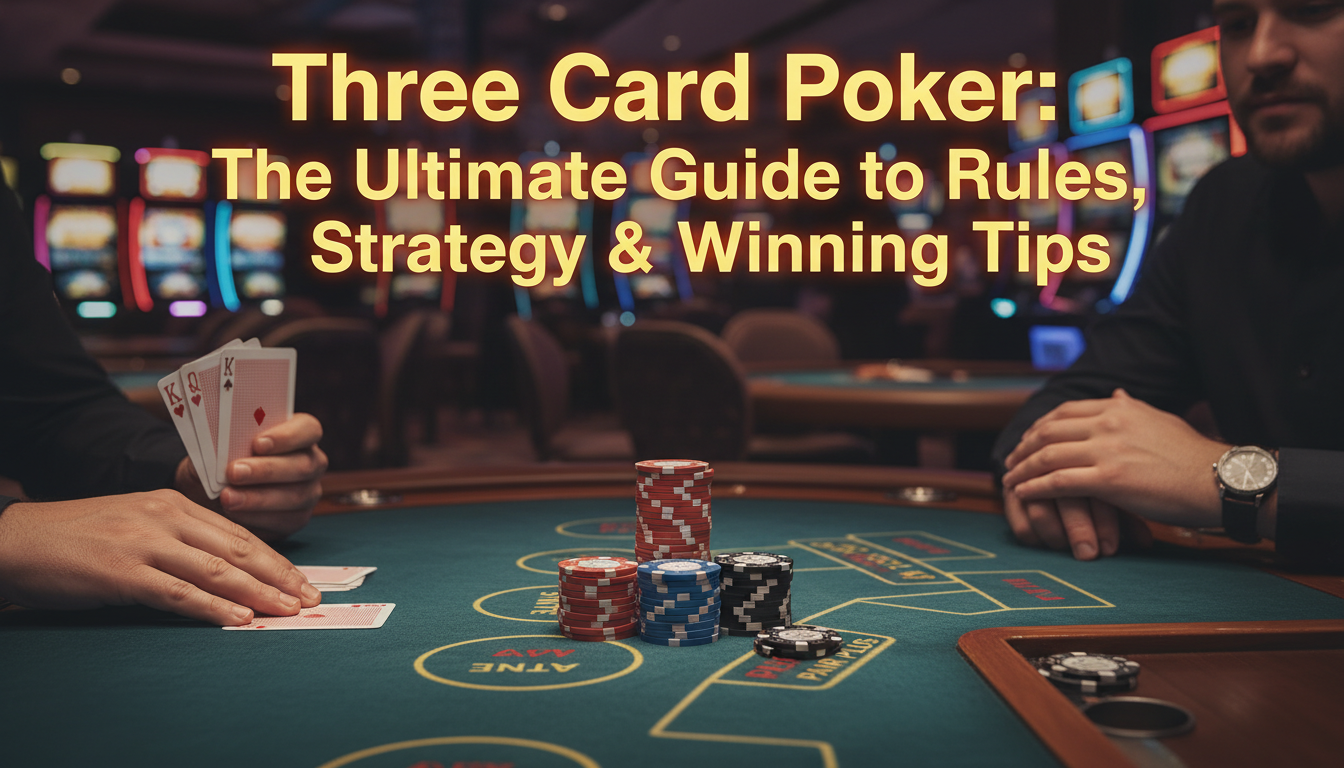
Three Card Poker is a fast-paced casino table game that combines traditional poker hand rankings with simplified gameplay against the dealer. Unlike standard poker variants where players compete against each other, this game pits you directly against the house using just three cards instead of the traditional five. Players start by placing an Ante bet, receive three cards, and must decide whether to fold or play by matching their original bet. The dealer must qualify with at least Queen-high to continue, and the best three-card hand wins. Key to success is understanding the unique hand rankings where a straight beats a flush, and following the optimal Q-6-4 strategy that minimizes the house edge. With straightforward rules, quick rounds, and multiple betting options including the popular Pair Plus side bet, Three Card Poker has become one of the most accessible and entertaining casino table games worldwide.
Key Takeaways
- Three Card Poker is played against the dealer, not other players, using just three cards per hand
- Follow the Q-6-4 rule: Play with Queen-6-4 or better, fold weaker hands to minimize house edge
- Hand rankings differ from traditional poker: straight beats flush due to probability with three cards
- Two main betting options: Ante/Play bet (main game) and Pair Plus (side bet based solely on your hand)
- The house edge is approximately 3.37% on Ante/Play bets when using optimal strategy
- Dealer must qualify with Queen-high or better for main bets to play out
- Never be tempted by high-edge side bets like the 6-Card Bonus with ~8.5% house edge
- Manage your bankroll carefully as hands are quick and losing track of spending is easy
Table of Contents
- What is Three Card Poker? Origins and History
- Three Card Poker Rules Explained
- Hand Rankings in Three Card Poker: Key Differences
- Betting Options in Three Card Poker
- How to Play Three Card Poker: Step-by-Step Guide
- Three Card Poker Strategy & Tips
- The Q-6-4 Rule: Optimal Basic Strategy
- Managing Your Bankroll for Long-Term Play
- Three Card Poker Side Bets Explained
- House Edge and Payouts
- Online Three Card Poker vs Land-Based Casinos
- What Experts Say About Three Card Poker
- Three Card Poker FAQ
What is Three Card Poker? Origins and History
Three Card Poker was invented by Derek Webb, a British professional poker player, in 1994. His goal was to create a game that offered the excitement of poker, was simple to learn, and could be played quickly like blackjack. Unlike traditional poker games like Texas Hold’em which require strategic thinking, betting rounds, and can be intimidating for beginners, Three Card Poker eliminates much of this complexity while retaining familiar poker hand rankings.
Webb spent several years testing and “fine-tuning” his concept before introducing it to casinos in Las Vegas. Initially, it wasn’t well accepted in traditional poker circles, with purists claiming it’s not “proper” poker because there’s no bluffing or playing against other players. However, casual players loved it for its simplicity and fast pace.
Its growth was largely due to its fast pace, relatively simple strategy, and the availability of side bets like Pair Plus, which appealed to recreational gamblers. It quickly spread through land-based casinos worldwide, including Australia, and became particularly popular in the United States after securing a patent and widespread casino acceptance in 1997.
Today, Three Card Poker is a staple in casinos worldwide. So, even though it’s an ‘old’ game by online casino standards, it’s relatively new as a poker game. It’s played with a standard 52-card deck (no jokers), and the objective is simple: beat the dealer’s three-card hand or have a strong enough hand to win a payout. Unlike regular poker, Three Card Poker has each player trying to beat the dealer or simply get dealt a good hand, rather than compete against each other.
Three Card Poker Rules Explained
Three Card Poker is played against the dealer using a standard 52-card deck. Dealers usually use a standard 52-card deck, and it’s shuffled after each round. In most casinos, however, in order to bet the Pair Plus portion, players must also make an Ante bet. The game follows this basic sequence:
- Players place an Ante bet (and optionally, a Pair Plus side bet)
- Each player and the dealer receive three cards face down
- Players view their cards and decide to fold or place a Play bet (equal to their Ante)
- If players fold, they forfeit their Ante bet
- The dealer must qualify with at least Queen-high (a Queen or better)
- If the dealer doesn’t qualify, all remaining players win even money on their Ante bets, and Play bets are returned
- If the dealer qualifies, hands are compared directly
- Players with better hands win even money on both Ante and Play bets
- Ties result in a push (bets returned)
Dealer Qualification Rule
One of the most important rules in Three Card Poker is the dealer qualification rule. The dealer must have at least a Queen-high hand to qualify. This means that if the dealer’s highest card is a Jack or lower, they don’t qualify to play against your hand.
If the dealer doesn’t qualify (has Jack-high or worse), the Ante bets pay even money and Play bets are automatically returned to players. This rule actually favors the player by preventing the house from having an even bigger advantage.
Winning Outcomes
When both the player and dealer have qualifying hands, the following winning conditions apply:
- If player’s hand beats dealer’s hand: Player wins even money on both Ante and Play bets
- If dealer’s hand beats player’s hand: Player loses both Ante and Play bets
- If hands tie: Both bets push (returned to player)
Hand Rankings in Three Card Poker: Key Differences
Hand rankings in Three Card Poker differ slightly from traditional five-card poker because they’re based on the probability of making hands with only three cards. This is the key difference:
- In Three Card Poker: Straight beats Flush
- In Traditional Poker: Flush beats Straight
Why the difference? With only three cards, it’s statistically harder to make a straight than a flush. A flush is easier to get with three cards because you only need three cards of the same suit, while a straight requires three sequential cards.
| Three Card Poker Hand | Description | Probability | Traditional Poker Ranking |
|---|---|---|---|
| Straight Flush | Three sequential cards of same suit (e.g., 8-9-10 of hearts) | 0.22% | 2nd strongest hand |
| Three of a Kind | Three cards of same rank (e.g., three Queens) | 0.24% | 4th strongest hand |
| Straight | Three sequential cards not same suit (e.g., 4-5-6 of mixed suits) | 3.26% | 5th strongest hand |
| Flush | Three cards same suit not sequential (e.g., 3-7-Jack of diamonds) | 4.96% | 3rd strongest hand |
| Pair | Two cards same rank (e.g., two Aces) | 16.94% | 2nd weakest hand |
| High Card | No matching cards (e.g., Ace-7-2 of mixed suits) | 74.39% | Weakest hand |
Note that several hands from traditional poker are impossible with only three cards:
- Full House (requires five cards)
- Four of a Kind (requires four cards)
- Two Pair (requires four cards)
- Royal Flush (special type of straight flush)
Also important: When comparing hands of the same rank, the highest card determines the winner. For example, King-Jack-8 beats Queen-Jack-10 because King > Queen. If the highest cards match, then the second highest card breaks the tie.
Betting Options in Three Card Poker
Three Card Poker offers multiple betting options that create different ways to win. Here’s a breakdown of each betting option:
1. Ante/Play Bet (Main Game)
This is the primary bet in Three Card Poker, consisting of two parts:
- Ante Bet: The initial bet required to participate in the main game
- Play Bet: An optional bet placed after seeing your cards, equal to your Ante bet
The Ante bet is the main bet to start playing a hand, and it’s a bet against the dealer. The player left of the dealer is called the left blind, also known as the small blind; they make the initial bet in the game. However, unlike traditional poker, this isn’t really a “blind” in the Texas Hold’em sense, but rather the mandatory starting bet.
After viewing your cards, you either fold (surrendering your Ante) or place a Play bet equal to the Ante to continue. If you decide to play, you compare your hand to the dealer’s.
2. Pair Plus Bet (Side Bet)
This is an optional side bet that pays based solely on your hand’s strength, regardless of whether you beat the dealer or even if you fold. You can win the Pair Plus bet even if you lose to the dealer.
Players can expect the following payouts for Pair Plus bets:
| Hand | Standard Payout | Alternative Payouts |
|---|---|---|
| Straight Flush | 40:1 | 35:1 or 40:1 |
| Three of a Kind | 30:1 | 25:1 or 30:1 |
| Straight | 6:1 | 5:1, 6:1 or 7:1 |
| Flush | 3:1 | 3:1 or 4:1 |
| Pair | 1:1 | 1:1 |
3. 6-Card Bonus Bet
This bet combines your three cards with the dealer’s three cards to form the best possible five-card poker hand. It’s resolved at the conclusion of the round.
Standard payouts for the 6-Card Bonus bet:
| Poker Hand | Payout |
|---|---|
| Royal Flush | 1000:1 |
| Straight Flush | 200:1 |
| Four of a Kind | 100:1 |
| Full House | 20:1 |
| Flush | 15:1 |
| Straight | 10:1 |
| Three of a Kind | 7:1 |
How to Play Three Card Poker: Step-by-Step Guide
If you’re new to Three Card Poker, don’t worry—it’s one of the simplest casino table games to learn. Here’s exactly what happens during each round:
- Place Your Bets: Before any cards are dealt, place your Ante bet (and optionally, a Pair Plus bet) in the designated circles on the table.
- Receive Cards: The dealer distributes three cards face down to each player, including themselves.
- Evaluate Your Hand: Look at your cards and assess their strength based on Three Card Poker hand rankings.
- Decision Time: You have two choices:
- Fold: Surrender your Ante bet and end your participation in this round
- Play: Place an additional bet equal to your Ante in the Play circle to continue
- Dealer Qualification Check: The dealer reveals their cards and checks if they have Queen-high or better.
- Resolution:
- If dealer doesn’t qualify (Jack-high or lower): You win even money on your Ante bet; Play bet is returned
- If dealer qualifies: Your hand is compared to the dealer’s
- If your hand wins: You win even money on both Ante and Play bets
- If dealer’s hand wins: You lose both bets
- If tie: Both bets push (returned)
- Side Bets Paid: If you made a Pair Plus bet, it’s paid based solely on your hand strength, regardless of the main game outcome. The same applies to the 6-Card Bonus bet.
Note that the dealer’s message display will give prompts for action and messages about the status of the game, especially in online versions. Keep an eye on this display for guidance as you play.
Three Card Poker Strategy & Tips
While Three Card Poker is largely a game of chance due to the limited number of cards, there are strategic elements that can significantly improve your results. The key to minimizing the house edge lies in knowing when to play and when to fold.
Viable Strategies when Playing with Basic Rules
Three Card Poker strategy is remarkably simple compared to other casino games. The main decision point each round is whether to fold or place the Play bet after seeing your cards. This decision should be based entirely on your hand strength.
Before we dive into specific strategy, it’s important to understand that in Three Card Poker:
- You’re playing against the dealer, not other players
- There’s no bluffing or psychological elements
- The outcome depends primarily on mathematical probability
- You can’t draw or exchange cards after the initial deal
This makes Three Card Poker more similar to blackjack than traditional poker. It’s a game where mathematical strategy can reduce the house edge significantly.
The Golden Rule of Three Card Poker Strategy
The most important strategic principle in Three Card Poker is this: You must decide to Play to collect this bonus, which you should be doing anyway since the bonus is only awarded for Straight or higher. Yet, the optimal strategy says to fold.
This seemingly contradictory advice highlights why a mathematically proven strategy is essential. The truth is, some hands that seem decent might not be worth playing when you consider the dealer’s qualifying requirement and the probability of winning.
The Q-6-4 Rule: Optimal Basic Strategy
The Q-6-4 rule is the foundation of optimal Three Card Poker strategy. This mathematically derived strategy tells you exactly which hands to play and which to fold:
“Always play with Queen-6-4 or better, and fold anything weaker. With a Q-6-4 hand, the odds are roughly around 0.001%, meaning that it’s basically neutral.”
More precisely, you should play if your hand contains at least:
- A Queen as your highest card
- AND a Six as your second highest card
- AND a Four as your lowest card
This means:
- Queen-6-4: Play (the borderline hand)
- Queen-6-3: Fold
- Queen-7-2: Play (since the second card is higher than 6)
- King-2-2: Play (since highest card is better than Queen)
Expert Advice: The Psychology of Folding
“Folding is crucial; fold if your hand has a Queen-6-4 or worse. Many players fall into the trap of playing hands like Queen-5-4 because they ‘feel’ like they should play, but mathematically, this increases the house edge significantly. Remember: the dealer needs at least Queen-high to qualify, so weak hands have low probability of winning even money on the Ante bet, let alone both bets.
– Alan Longo, high-performance psychologist specializing in poker
Why Q-6-4 is the Optimal Strategy Threshold
You might wonder why this specific combination is the cutoff. The answer lies in probability calculations that factor in:
- The dealer’s 70% chance of qualifying (having Queen-high or better)
- The probability of your hand beating a random three-card hand
- The impact of the dealer not qualifying (returning your Play bet)
With the Q-6-4 hand, the expected value is essentially neutral. Playing hands stronger than this yields positive expected value, while playing weaker hands loses money in the long run.
Simple Strategy Cheat Sheet
Here’s an easy way to remember the basic strategy:
| If your highest card is… | Play if second card is at least… | Play if third card is at least… |
|---|---|---|
| Ace or King | Any | Any (ALWAYS PLAY) |
| Queen | 6 | 4 (when second card is exactly 6) |
| Jack or lower | – | NEVER PLAY |
Remember: This strategy applies only to the Ante/Play bets, not to side bets like Pair Plus.
Managing Your Bankroll for Long-Term Play
Bankroll management is critical in Three Card Poker, especially because the game moves quickly. Hands are dealt rapidly, and it’s easy to lose track of how much you’ve wagered. Like most table game side bets, these are completely optional and have no impact on the game round or the main bets you make.
Why Bankroll Management Matters in Three Card Poker
Three Card Poker has a house edge of approximately 3.37% when using optimal strategy. While this is better than many casino games, it means you’ll lose about $3.37 for every $100 wagered over the long term. Proper bankroll management ensures you can play longer and weather normal variance.
As Cliff Spiller, a casino and sports enthusiast with nineteen-plus years of experience notes:
Expert Advice: Knowing When to Walk Away
“Like any casino game, it’s important to know when to walk away from the 3-Card Poker table. Setting win and loss limits before you play is crucial. I recommend establishing a session budget that’s only 5-10% of your total gambling bankroll, and never chasing losses when the cards aren’t falling your way.”
– Cliff Spiller, casino and sports industry veteran
Effective Bankroll Management Strategies
Here are proven bankroll management techniques specifically for Three Card Poker:
- Set a Fixed Session Budget: Decide exactly how much you’re willing to lose before you sit down, and stick to it. This should be an amount you can afford to lose without impacting your financial obligations.
- Use Consistent Bet Sizes: Choose your Ante bet amount based on your total session budget. A common recommendation is to make your Ante bet no larger than 1-2% of your session bankroll.
- Avoid Side Bets for Bankroll Preservation: Since Pair Plus and 6-Card Bonus bets have significantly higher house edges, they’ll deplete your bankroll faster. Stick primarily to Ante/Play bets.
- Track Your Results: Keep a simple tally of wins and losses. Three Card Poker is one of the very few common casino games in which players can actually influence the outcome.
- Take Breaks: Because hands are so quick, take regular breaks to assess your bankroll and emotional state. It’s very easy to get caught up in the fast pace.
The Danger of Side Bets on Your Bankroll
Side bets might seem attractive with their big payouts, but they’re designed to drain your bankroll faster:
- Ante/Play bets: ~3.37% house edge (with optimal strategy)
- Pair Plus bets: ~7.28% house edge (depending on paytable)
- 6-Card Bonus: ~8.56% house edge
This means side bets will deplete your bankroll 2-3 times faster than the main game. If you’re tempted by side bets, allocate only 10-20% of your session budget to them.
Three Card Poker Side Bets Explained
Side bets add excitement to Three Card Poker but come with significant trade-offs. Let’s examine the most common side bets and whether they’re worth playing.
Pair Plus Bet: When to Consider It
The Pair Plus bet pays based solely on your hand strength, regardless of whether you beat the dealer or even if you fold your hand. The key facts:
- Must be placed at the same time as your Ante bet
- Pays for any hand of Pair or better (Pair, Flush, Straight, Three of a Kind, Straight Flush)
- Payoffs vary by casino but are generally as shown in the betting options table
- RTP is approximately 95.51%, compared to 96.63% for the main game with optimal strategy
Despite the temptation of big payouts for strong hands, the higher house edge makes this a generally poor bet from a mathematical perspective. However, if you do decide to play it:
- Look for casinos with the most favorable paytables (40:1 for Straight Flush, 30:1 for Three of a Kind)
- Only allocate a small portion of your bankroll to this bet
- Never make the Pair Plus bet without also making the Ante bet
6-Card Bonus Bet: The High-Risk Option
This bet combines your three cards with the dealer’s three cards to form the best possible five-card poker hand. Key features:
- Pays based on the traditional five-card poker ranking of the best hand from all six cards
- Top payout is typically 1000:1 for a Royal Flush
- House edge is approximately 8.56%, making it one of the worst bets on the table
- You win this bonus even if the dealer’s hand wins and even if the dealer’s hand doesn’t qualify to play
Unlike the Pair Plus bet, the 6-Card Bonus bet is influenced by the dealer’s cards, so it is resolved at the conclusion of the round. This creates the potential for bigger payouts but with much lower probability.
Expert Advice: Side Bet Reality Check
“The Pair Plus bet has a house edge of about 7.3%, compared to 3.4% for the main game using optimal strategy. That’s more than double the casino’s advantage. While it’s tempting to play for those big flush and straight payouts, remember that the casino designed these side bets specifically because they’re more profitable for them. If you want the best value, stick to the Ante/Play bets and avoid side bets entirely.”
– Matt, co-founder of The Casino Wizard
Should You Play Side Bets?
Here’s a practical approach to side bets:
- For serious bankroll management: Avoid side bets completely
- For moderate enjoyment: Allocate 10-15% of your session bankroll to Pair Plus only
- For maximum entertainment (high risk): Small fixed amount on both side bets, understanding you’ll lose faster
Remember that all side bets are completely optional. The main Ante/Play game offers better odds and is where skilled players focus their attention.
House Edge and Payouts
Understanding the house edge and payout structure is essential for making informed decisions at the Three Card Poker table. Let’s break down the numbers.
The House Edge Explained
The house edge represents the casino’s mathematical advantage on each bet you make. Think of the house edge as a small fee the casino takes on every bet you place. In Three Card Poker, the house edge varies significantly based on your betting choices:
| Bet Type | House Edge | Return to Player (RTP) |
|---|---|---|
| Ante/Play (with Q-6-4 strategy) | 3.37% | 96.63% |
| Ante/Play (playing every hand) | 7.28% | 92.72% |
| Pair Plus (standard paytable) | 7.28% | 92.72% |
| 6-Card Bonus | 8.56% | 91.44% |
These numbers explain why following the Q-6-4 strategy is so important—it cuts the house edge in half compared to playing every hand.
Ante Bonus Payouts
One feature that makes Three Card Poker unique is the Ante Bonus, which pays automatically for strong hands regardless of whether you beat the dealer:
| Hand | Payout | Probability |
|---|---|---|
| Straight Flush | 5:1 | 0.22% |
| Three of a Kind | 4:1 | 0.24% |
| Straight | 1:1 | 3.26% |
The Ante Bonus is taken into account while calculating the RTP of the Ante bet. This means you can win the Ante bonus even if you lose to the dealer or if the dealer doesn’t qualify.
How the Main Game Payouts Work
When comparing hands after the dealer qualifies, the payouts are straightforward:
- You beat dealer: Win even money (1:1) on both Ante and Play bets
- Dealer beats you: Lose both bets
- Tie: Both bets push (returned)
Additionally:
- If dealer doesn’t qualify: Ante bets pay even money; Play bets returned
- Ante bonus paid separately based on your hand strength
Pay Table Variations
Not all Three Card Poker tables use identical paytables. Small tweaks can significantly impact the house edge:
- Pair Plus: Some casinos pay 35:1 instead of 40:1 for Straight Flush (increases house edge)
- Ante Bonus: Some reduce Straight payout from 1:1 to nothing (significantly increases house edge)
Always check the table layout before sitting down. As noted in the content: “Small tweaks in pay tables (like lowering the flush payout) can push Pair Plus beyond a 7% edge, so check the felt before sitting down.”
Online Three Card Poker vs Land-Based Casinos
Whether you prefer the convenience of home play or the atmosphere of a physical casino, Three Card Poker is widely available in both formats. Here’s how they compare:
Online Three Card Poker Advantages
- Convenience: Play from anywhere at any time
- Lower stakes: Minimum bets often as low as $0.50-$1
- Free practice: Many sites offer demo modes to practice strategy
- Speed: No waiting for other players; hands proceed quickly
- Bonuses: Welcome offers and promotions that reduce effective house edge
Land-Based Three Card Poker Advantages
- Social interaction: Play with other people and chat with the dealer
- Atmosphere: Casino energy and excitement
- Comps and rewards: Earn points for food, rooms, and other perks
- Physical cards: Tangible experience that some players prefer
- Higher limits: For high rollers, tables may have much higher maximum bets
Live Dealer Online Three Card Poker
For the best of both worlds, many online casinos now offer live dealer Three Card Poker. This combines the convenience of online play with the authenticity of a physical dealer:
- Real dealers streaming from studio casinos
- Interactive chat features to communicate with dealers
- Multiple camera angles to view cards and action
- Real-time betting with other online players
- Higher minimum bets than RNG versions but lower than land-based
Strategy Consistency Across Platforms
Importantly, the optimal strategy remains the same regardless of where you play. As the content notes: “The rules are the same in both cases, and the only difference is whether you’re playing with a computerised dealer or a real one streamed live.”
The Q-6-4 rule applies equally whether you’re at a Las Vegas table or playing online from home. The key is maintaining discipline and sticking to the mathematically optimal strategy in both environments.
What Experts Say About Three Card Poker
When it comes to casino games like Three Card Poker, expert opinions help separate fact from casino marketing hype. Let’s hear what leading poker professionals and analysts have to say about this popular game.
Alec Torelli: Professional High-Stakes Poker Player
“Three Card Poker is a beautifully streamlined version of traditional poker, designed for speed and simplicity. While it lacks the strategic depth of games like Texas Hold’em, its accessibility makes it perfect for recreational players. The key to enjoying it responsibly is understanding that it’s closer to blackjack than poker—you’re playing against the house with fixed odds, not out-thinking opponents. For casual play with solid odds, stick to the Q-6-4 strategy and avoid the flashy side bets.”
Justin Saliba: Two-Time WSOP Bracelet Winner
Many traditional poker players dismiss Three Card Poker as ‘not real poker’ because there’s no bluffing or player interaction. And they’re right—it’s a different animal entirely. But that doesn’t make it bad. It’s incredibly well-designed as a casino table game: simple enough for beginners, fast-paced, with clear decision points. As a tournament player, I appreciate how it gives my non-poker friends a way to enjoy ‘poker’ without needing years of experience. Just remember: treat it as entertainment first, money-making second.”
Cliff Spiller: Casino Industry Veteran
“From a casino perspective, Three Card Poker was revolutionary. Derek Webb solved a problem that had plagued table games for years: how to create a poker-based game that casual players could understand immediately. The dealer qualification rule and simple Q-6-4 strategy make it approachable. What’s impressive is how the odds work out—they created something that feels fair to players but still gives the house a solid edge. For players, the lesson is to respect those odds: the house edge can be minimized to 3.37%, but not beaten long-term.”
Alan Longo: High-Performance Psychologist for Poker Players
Three Card Poker reveals fascinating psychological patterns. Players consistently overvalue hands like Queen-Jack-10 because they ‘look strong’ compared to their previous hand, ignoring the mathematical reality that it’s actually a fold. The speed of the game also creates decision fatigue—after 50 hands, players start deviating from optimal strategy. The most successful players treat it like chess against probability: make the right move every time, don’t chase losses, and know when your session is over.”
Three Card Poker FAQ
What are the basic rules of Three Card Poker?
Players place an Ante bet and optionally a Pair Plus bet. Each player and the dealer receive three cards. Players decide to fold or match their Ante with a Play bet. The dealer must qualify with Queen-high or better. If the dealer doesn’t qualify, Ante bets pay even money and Play bets are returned. If the dealer qualifies, hands are compared—the higher hand wins even money on both bets.
What is the Q-6-4 rule in Three Card Poker?
The Q-6-4 rule is the optimal basic strategy: you should play (place the Play bet) if your hand is Queen-6-4 or better, and fold weaker hands. This specific threshold minimizes the house edge to approximately 3.37%. With Queen-6-4 exactly, the odds are neutral, making it the precise mathematical cutoff.
How do the hand rankings differ from traditional poker?
With only three cards, the probabilities change significantly. A straight (three sequential cards) is harder to make than a flush (three same-suit cards), so in Three Card Poker, straight beats flush. Three of a kind beats both, and straight flush remains the strongest hand. Full houses, four of a kind, and two pair are impossible with only three cards.
What’s the best strategy for Three Card Poker?
The optimal strategy is remarkably simple:
1. Play if your hand is Queen-6-4 or better
2. Fold if your hand is worse than Queen-6-4
3. Avoid side bets like Pair Plus and 6-Card Bonus due to their higher house edge
4. Manage your bankroll with consistent bet sizes
5. Never deviate from the strategy based on emotion or recent results
What are the house edges for different bets?
The house edges vary significantly:
– Ante/Play bets with optimal strategy: 3.37%
– Ante/Play bets playing every hand: ~7.28%
– Pair Plus bet: ~7.28% (varies by paytable)
– 6-Card Bonus bet: ~8.56%
This is why following the Q-6-4 strategy and avoiding side bets is crucial for minimizing the house advantage.
When should I play the Pair Plus bet?
Mathematically, you should almost never play the Pair Plus bet because it has a significantly higher house edge (about 7.28%) compared to the main game with optimal strategy (3.37%). If you do decide to play it, only allocate 10-15% of your session bankroll to it, and look for tables with the best paytable (40:1 for Straight Flush, 30:1 for Three of a Kind).
Can I count cards in Three Card Poker?
No, card counting doesn’t work in Three Card Poker because the deck is shuffled before every single hand, whether you’re playing live or online. Each hand is an independent event with no memory of previous cards. The single deck used in the game is shuffled and split after every round, which makes card counting impossible.
What is the Ante Bonus in Three Card Poker?
The Ante Bonus is an automatic payout for strong hands (Straight or better) regardless of whether you beat the dealer or if the dealer qualifies. Straight pays 1:1, Three of a Kind pays 4:1, and Straight Flush pays 5:1 on your Ante bet. This bonus is paid in addition to any regular winnings.
Can I play Three Card Poker online for free?
Yes, many online casinos offer free demo versions of Three Card Poker where you can practice strategy without risking real money. These are excellent tools for learning the game flow and testing the Q-6-4 strategy before playing with real funds.
What’s the difference between Three Card Poker and traditional poker?
Key differences:
– Three Card Poker is played against the dealer, not other players
– Uses only three cards per hand (vs. five or seven in traditional poker)
– No betting rounds—only one decision point per hand
– No bluffing or psychological elements
– Straight beats flush in hand rankings
– Dealer must qualify with Queen-high or better
– Much faster pace with immediate decisions
Is there any skill involved in Three Card Poker?
While Three Card Poker is largely a game of chance due to the limited number of cards, there is one crucial skill element: knowing when to play and when to fold. Making the mathematically optimal decision (Q-6-4 rule) reduces the house edge from about 7.28% to 3.37%. Bankroll management and avoiding emotional decisions are also important skills for long-term success.
How does the dealer qualification rule benefit players?
The dealer qualification rule (dealer must have Queen-high or better) actually benefits players by reducing the house edge. When the dealer doesn’t qualify (which happens about 30% of the time), your Play bet is returned and your Ante bet pays even money. This rule exists to balance the odds between you and the house, because it saves you money in weak-dealer situations.
What is the best hand in Three Card Poker?
The best possible hand in Three Card Poker is a straight flush, which consists of three sequential cards of the same suit (for example, 8-9-10 of hearts). The highest possible straight flush is Ace-King-Queen (sometimes called a “mini royal flush”), followed by King-Queen-Jack, and so on down to 3-2-Ace.
How many decks are used in Three Card Poker?
Three Card Poker is played with a single standard 52-card deck. Unlike blackjack which often uses multiple decks, Three Card Poker uses just one deck per hand, which is shuffled after each round. This ensures each hand is completely independent of previous ones.
What are the odds of getting a straight flush in Three Card Poker?
The probability of being dealt a straight flush in Three Card Poker is approximately 0.22%, which means you can expect to see one about once every 460 hands. This is why the payout for this hand is typically 40:1 in the Pair Plus bet and 5:1 in the Ante Bonus.
How much should I bet when playing Three Card Poker?
Your bet size should be based on your overall bankroll and session limits. A common recommendation is to make your Ante bet no larger than 1-2% of your session bankroll. For example, if your session budget is $200, your Ante bet should be $2-$4. Consistent bet sizing helps manage variance and prevents quick bankroll depletion.
What’s the biggest mistake beginners make in Three Card Poker?
The most common mistake is not following the Q-6-4 strategy. Beginners often play hands like Queen-5-4 because they “feel” like they should play, or they chase losses by increasing bets after a losing streak. Another frequent error is getting tempted by the high payouts of side bets despite their significantly higher house edge.
Can I use the same strategy in online and land-based casinos?
Yes, the optimal strategy (Q-6-4 rule) is identical regardless of where you play. The rules don’t change between online and land-based casinos, and the mathematical probabilities remain the same. Whether you’re playing at a Las Vegas casino or from home online, sticking to this straightforward strategy minimizes the house edge.
When should I walk away from a Three Card Poker table?
Set predetermined win and loss limits before you play. Typical recommendations:
– Stop if you’ve lost 50-75% of your session bankroll
– Consider stopping if you’ve doubled your session bankroll
– Always stop if you’re feeling frustrated, emotional, or tired
– Take regular breaks (every 20-30 hands) to assess your situation
How do I find Three Card Poker tables with the best rules?
Look for these favorable rule variations:
– Ante Bonus paying 5:1 for straight flush (not 4:1)
– Pair Plus paying 40:1 for straight flush (not 35:1)
– No reduction in straight payout for Ante Bonus
– Lower minimum bets if you’re a beginner
– Always check the payout table printed on the felt before sitting down
